
24/7 Customer Support

Free returns

Same-day & Next-day Delivery

Quality Guaranteed

Unlock Your Welcome Offers: FREE Delivery | Up to 80% OFF | Free 30-day JoyPlus trial
Download the APP
A dash cam can provide useful video evidence after a collision, support a dispute about what happened and help monitor a vehicle when it is parked. However, choosing one is not simply a matter of selecting the highest resolution on the product page. Camera coverage, storage, power requirements and installation quality all affect whether the footage is genuinely useful.
A 4K dash cam can capture more detail than a 1080P model, but resolution alone does not guarantee readable number plates. A dirty windscreen, glare, poor compression, narrow viewing angle or weak night performance can reduce usable detail.
Look for a suitable combination of resolution, lens aperture, HDR or WDR processing and night vision. A 2K camera with a wide aperture may be more practical for some drivers than a poorly positioned 4K unit.
Many products advertise parking monitoring, but recording while the ignition is off usually requires a separately purchased hardwire kit or compatible OBD power cable. Without a continuous power source, the camera normally switches off when the vehicle is parked.
Check whether the kit is included, optional or unavailable. A suitable hardwire installation should also include low-voltage protection, reducing the risk of excessive battery drain.
Continuous recording places more demand on a microSD card than occasional photography. A dash cam with SD card support may require a high-endurance card, and manufacturers commonly recommend formatting the card through the camera at regular intervals.
Loop recording helps by overwriting older unlocked clips when storage is full, while the G-Sensor can lock footage after a sudden impact. Locked files may still fill the card if they are not checked and managed periodically.
A single front camera is compact and generally easier to install. A front and rear dash cam adds evidence of traffic behind your car, which can be useful in rear-end collisions. A dual dash camera may require routing a cable through the roof lining and rear hatch, so check your vehicle layout before buying.
Some systems add an interior camera or side-facing cameras. These can suit taxi drivers, delivery drivers and fleet operators who need wider coverage, but they usually involve more installation work and consume more storage.
Common specifications include:
A 140° to 170° field of view can provide broad coverage. Position the camera carefully so that the road remains the main subject rather than too much dashboard or sky.
A GPS dash cam can record speed, route and location data with compatible footage. GPS reception may be weaker behind certain windscreens with metallic coatings, so the front unit should have a reasonably clear view of the sky.
A Wi-Fi dash cam connects to a smartphone app for previewing and downloading clips without removing the card. This is convenient after an incident, but it does not necessarily provide remote viewing from another location. For 24/7 car parking monitor use, confirm the power arrangement, motion or impact activation method and low-voltage safeguards.
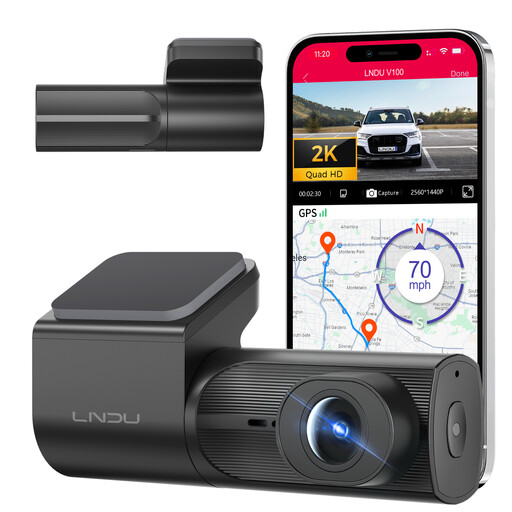
Why This Fits Their Persona: A practical front-facing option for commuters and motorists buying their first car camera, with app access for straightforward file handling.
The listing states that 24-hour parking monitoring requires a separately purchased hardwire kit, making the installation requirement clear rather than implying it works from the standard charger alone.
2K recording, Wi-Fi app control, G-Sensor, loop recording and night vision support.
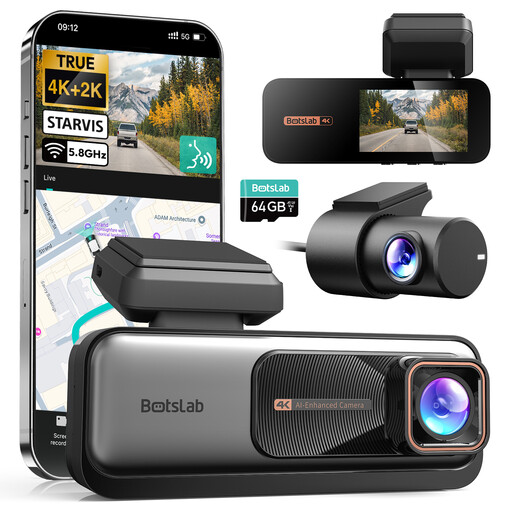
Why This Fits Their Persona: Suits drivers who want detailed front footage alongside rear coverage, GPS data and smartphone connectivity in one system.
The product information identifies the separate hardwire requirement for parking mode and specifies 4K front plus 2K rear recording rather than presenting a single resolution for all channels.
4K front and 2K rear video, 170° and 150° lenses, built-in GPS, 5.8GHz Wi-Fi and a 64GB microSD card.
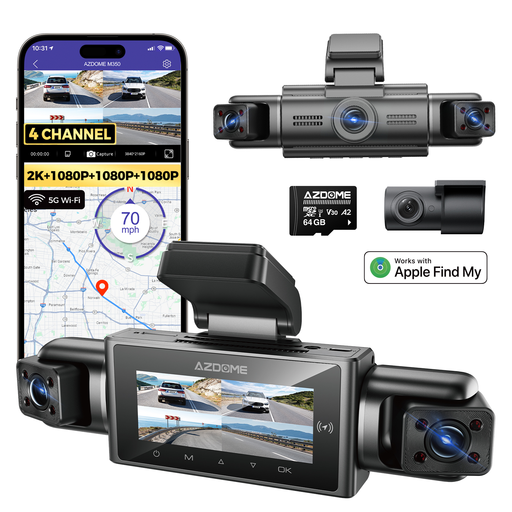
Why This Fits Their Persona: Appropriate for taxi, delivery and fleet use where front, rear and side visibility may be more valuable than a compact single-camera setup.
Its four-channel layout states the coverage clearly: 2K front plus 1080P rear, left and right cameras. Buyers can assess whether they need that installation complexity before ordering.
Four-channel coverage, built-in GPS, 5G Wi-Fi, voice control, infrared night vision and 24-hour parking mode support.
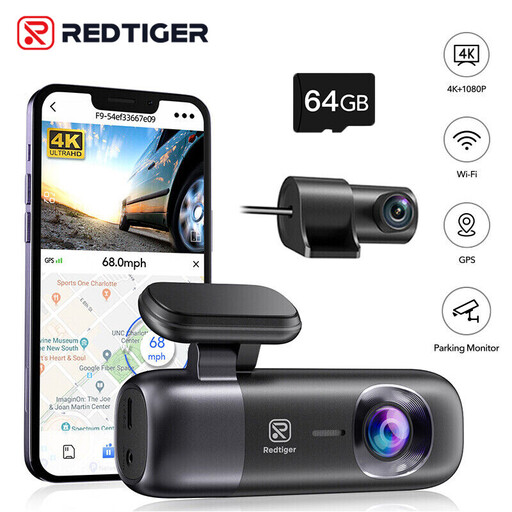
Why This Fits Their Persona: A dual-camera arrangement for motorists who want high-resolution forward footage and a separate rear view for everyday driving.
The supplied 64GB card and stated support for cards up to 256GB make storage planning easier. The product information also notes that parking mode typically needs a professional hardwire installation.
4K front and 1080P rear recording, Wi-Fi app control, GPS, loop recording, night vision and parking mode.
We have compiled a complete, real-time list of products that fully satisfy these strict selection criteria and UK safety regulations.
Before fixing a dash cam to the windscreen, confirm that it does not obstruct the driver’s view. Place it behind or close to the rear-view mirror where practical, and route cables away from airbag deployment areas.
For a rear camera, check that the cable length suits your car and that the rear windscreen is not heavily tinted. Test the image after installation rather than assuming the camera is centred correctly.
If recording audio or sharing footage, consider privacy. Avoid recording private conversations unnecessarily, and take care when publishing footage that identifies other people or vehicles. A dash cam is an evidence-collection device, not a substitute for safe driving.
For many motorists, it can be useful for documenting road incidents, insurance discussions or attempted theft. Its value depends on reliable recording, correct installation and regularly maintained storage rather than headline resolution alone.
Lifespan varies with heat exposure, daily recording hours, battery or supercapacitor design and memory-card condition. Keeping the camera out of direct sunlight where possible, using a compatible high-endurance microSD card and formatting it as instructed can support dependable operation.
A standard camera powered only while driving has a modest electrical demand. Parking mode uses power while the engine is off, so installation with low-voltage cut-off is important. Check the hardwire kit specifications and your vehicle’s battery condition before enabling continuous monitoring.