What should you check before buying?
Start with the equipment you use at home, then compare caffeine disclosure, flavour and a pack size you are likely to finish.
| Priority | What to check | Your needs |
|---|
| Caffeine information |
Look for a product-specific caffeine declaration rather than treating the decaffeination method as a caffeine limit. illy UK states no higher than 0.1% caffeine for its Whole Bean Decaffeinated Coffee; that is not a per-cup figure or a specification for other beans. |
I want to know what caffeine information applies to the beans I buy. If I am breastfeeding, I also need to consider caffeine from other foods and drinks; the NHS advises trying not to exceed 300mg a day. |
| Brewer fit |
Check that you have a grinder and that the beans suit your usual brewer. Lavazza lists espresso, filter, French press and moka for Decaf Intenso; Union recommends Decaf Blend for espresso or bean-to-cup use. |
My usual coffee should work with the equipment already in the kitchen, without adding an unwanted grinding step. |
| Roast and flavour |
Compare descriptions for the specific bean, not the brand as a whole. Lavazza describes Decaf Intenso with tobacco and woody notes; Union describes Decaf Blend with chocolate and caramel notes. |
I would choose a flavour profile I expect to enjoy regularly, rather than choosing by decaf process alone. |
| Pack size |
Match the pack to how often you make decaf. Taylors of Harrogate lists Decaffé in 200g and 1kg sizes, while Lavazza lists a 500g Decaf Intenso pack. |
If I am trying an unfamiliar bean or making decaf only occasionally, I would start with a smaller pack before committing to more. |
Brand and range references
These examples describe particular decaf bean ranges; they do not establish that every product from each brand has the same specifications.
Lavazza
Decaf Intenso is a whole-bean option for households using more than one brewing method.
- Lavazza lists a 500g pack, carbon dioxide decaffeination and use with espresso, filter, French press and moka.
- Check the specific pack if you need a declared residual-caffeine limit.
illy
Whole Bean Decaffeinated Coffee is worth comparing when a stated caffeine ceiling matters to the choice.
- illy UK states no higher than 0.1% caffeine for this coffee and lists a 250g whole-bean pack.
- The stated percentage is for this product; it should not be applied to another decaf bean or read as a per-cup amount.
Taylors of Harrogate
Decaffé offers a choice of pack sizes for people considering a water-process whole bean.
- Taylors of Harrogate describes its Pure Water Process and lists 200g and 1kg formats.
- Check the current pack for the caffeine and brewing information you need; the process name alone does not provide a caffeine limit.
Union
Decaf Blend is directed towards espresso and bean-to-cup brewing.
- Union recommends those brewing methods and says its decaffeination process uses water and carbon dioxide.
- That process description does not state the residual-caffeine level in the finished coffee.
Waitrose
No.1 Organic Fairtrade Peru Decaf Coffee Beans offers a smaller supermarket whole-bean pack.
- Waitrose & Partners lists a 227g, medium-roast, 100% Arabica decaf with organic and Fairtrade labelling.
- Check the current pack for details important to you, including its caffeine information and brewing instructions.
M&S
The decaf range includes beans as well as formats that need less preparation.
- Marks & Spencer lists Roast and Ritual Decaf Coffee Beans in a 227g pack alongside ground, instant and coffee-bag options.
- A processing description for M&S ground coffee should not be assumed to describe its whole-bean product.
Whole-bean decaf options on Joybuy
These whole-bean decaf options suit households considering a 500g bag or a smaller 200g pack. Check the particular product and your brewing setup before choosing.
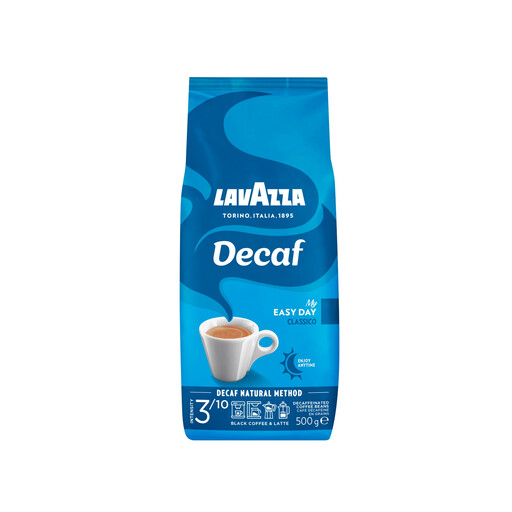 Image unavailable
Lavazza Decaffeinated Coffee Beans 500g
A 500g whole-bean decaf option for a household that regularly grinds coffee. Check the product’s brewing guidance against your equipment and look for a product-specific caffeine declaration if you need one.
View on Joybuy
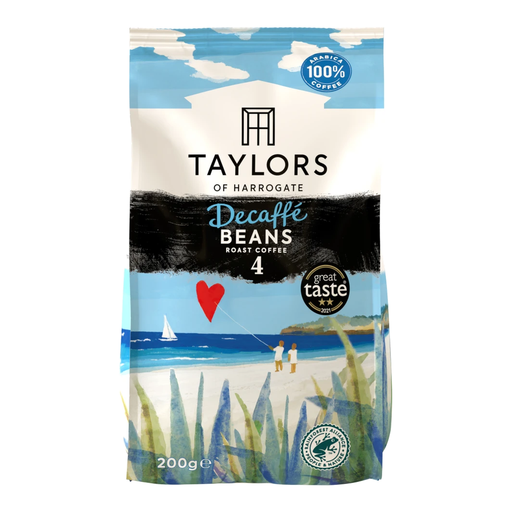 Image unavailable
Taylors Decaf Coffee Beans 200 g
A smaller whole-bean decaf pack to consider when trying a new coffee or making it occasionally. You will need a grinder; check the product’s brewer guidance and caffeine information if either affects your choice.
View on Joybuy
Questions about decaf coffee beans
Can I have decaf coffee while breastfeeding?
Decaf can reduce caffeine from coffee, but it should not be treated as caffeine-free. The NHS advises breastfeeding parents to try not to have more than 300mg of caffeine a day, including caffeine from tea, chocolate, energy drinks and soft drinks.
Does decaf mean there is no caffeine in the beans?
No. Decaffeination does not necessarily remove all caffeine. illy UK states that its Whole Bean Decaffeinated Coffee contains no higher than 0.1% caffeine; check other products individually rather than assuming they have the same limit.
Which decaf beans can I use for espresso or bean-to-cup coffee?
Union recommends its Decaf Blend for espresso or bean-to-cup machines. Lavazza lists espresso among the methods for Decaf Intenso, along with moka, filter and French press. Check the guidance for the exact beans you plan to buy.
Are whole beans the quickest decaf option?
Not if you need to grind them before brewing. If that extra step does not suit your routine, compare other decaf formats; Marks & Spencer, for example, lists instant coffee and coffee bags alongside its beans.
What if I have been told to avoid caffeine completely?
Do not rely on the word ‘decaf’ as a zero-caffeine guarantee. Ask the clinician or pharmacist managing your care whether a particular product and the amount you intend to drink are appropriate.


