Buyers offering decaf on request
For retirement shops that want to describe a whole-bean decaf option accurately, without promising that it contains no caffeine.


Choose decaf whole beans if the shop can grind them, then match the bag size to how often customers order decaf. A smaller bag is a sensible starting point for occasional orders; consider a larger one when turnover justifies it, and check the exact pack for brewing guidance, storage instructions and any caffeine declaration.
For retirement shops that want to describe a whole-bean decaf option accurately, without promising that it contains no caffeine.
For buyers choosing a bag size that fits less frequent orders and the storage instructions on the opened pack.
For shops that can grind whole beans and need to check a product’s brewing guidance against their equipment and drinks menu.
Start with bean format and equipment, then consider caffeine wording, expected turnover and the roast descriptions that fit the drinks served.
| Priority | What to check | Your needs |
|---|---|---|
| Decaf designation | Confirm that the exact pack contains decaffeinated whole beans. Read its own caffeine declaration before describing it to customers; illy states no higher than 0.1% caffeine for its 250 g decaf beans. | I want to offer decaf without telling customers that every decaf coffee is caffeine-free. |
| Equipment fit | Check that the shop has a grinder and that the product’s preparation guidance fits its brewing method. Lavazza UK lists espresso, filter and moka for Decaf Intenso; Union recommends espresso for its Decaf Blend. | Our counter needs beans that work with the way we prepare coffee, not simply a product labelled decaf. |
| Pack size | Compare pack size with expected decaf orders and follow the specific opened-pack instructions. Waitrose & Partners advises sealing Taylors Decaffé Beans, storing them somewhere cool and dry, and using them within two weeks of opening. | If decaf orders are occasional, I would rather start with a smaller bag than leave an opened one in use for too long. |
| Roast and flavour | Read the roast and tasting description for the exact product rather than treating all decaf beans as alike. Taylors is described with caramel and malt notes, while Union describes its Decaf Blend as a darker, espresso-led option. | The decaf choice should fit the drinks we serve, whether that is mainly espresso or another preparation. |
Decaf does not necessarily mean zero caffeine: illy declares no higher than 0.1% caffeine for its 250 g decaf beans.
Describe the drink as decaffeinated and use the caffeine wording on the exact pack. Do not make an individual health judgement for a customer who needs to avoid caffeine.
An opened bag may remain in use longer than its product-specific storage guidance allows. Waitrose & Partners advises using Taylors Decaffé Beans within two weeks of opening.
Start with a bag size that fits expected orders, then review actual turnover before moving to a larger format.
A bag that stays open too long may need replacing before it is finished.
A process description does not tell you whether a particular roast or recommended brewing method fits the shop’s service.
Check the exact beans’ roast description, preparation guidance, pack size and caffeine declaration alongside any process information.
A decaf range can include ground coffee, pods, instant coffee and bags as well as whole beans. M&S lists several such formats in its decaf range.
Confirm that the exact product says coffee beans or whole bean before ordering for a grinder or bean-to-cup machine.
Lavazza Decaf Intenso and Decaf Classico are distinct whole-bean products; do not transfer one product’s roast description to the other.
illy offers 250 g decaffeinated whole beans with a classic roast description.
Taylors Decaffé Beans come in a 200 g pack described by Waitrose & Partners as smooth and balanced, with caramel and malt notes.
Union’s whole-bean Decaf Blend is offered in 200 g and 1 kg formats and described by the brand as a dark roast.
M&S lists Roast and Ritual Decaf Coffee Beans 227 g within a wider decaf coffee range.
This whole-bean option is a 200 g bag to consider when the shop expects occasional decaf orders and can grind beans on site.
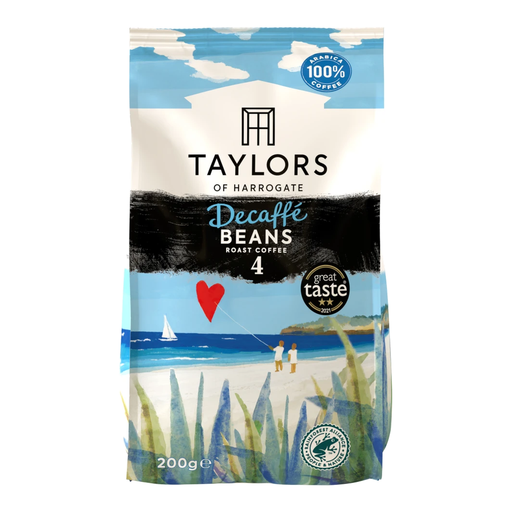 Image unavailable
The 200 g bag offers a smaller batch for a shop with occasional decaf orders. Its product description states 100% Arabica beans, water-method decaffeination and caramel-and-malt notes. Waitrose & Partners advises sealing Taylors Decaffé Beans, keeping them cool and dry, and using them within two weeks of opening. Check the exact pack’s caffeine declaration and that the beans suit the shop’s grinding and brewing setup.
Not necessarily. illy declares no higher than 0.1% caffeine for its 250 g decaf beans; read the declaration on the exact product rather than assuming that every decaf bean has the same residual caffeine.
They give customers who prefer decaffeinated coffee a whole-bean option, provided the shop can grind and brew it. Describe the drink as decaf without promising that it contains no caffeine.
Whole beans need grinding before brewing. Check the shop’s equipment and the product’s preparation guidance; if there is no grinder, choose a suitable ground-coffee format instead of whole beans.
Follow the instructions on the individual pack. For Taylors Decaffé Beans, Waitrose & Partners advises sealing the opened bag, storing it somewhere cool and dry, and using the beans within two weeks.