Buyers specifying a caffeine-free chai
Choose by the exact product description, not the word “chai” alone. Pukka describes its Spiced Vanilla Chai as a caffeine-free blend; its ingredients still need checking for the people who will drink it.


If the canteen needs a chai-style drink explicitly labelled caffeine-free, choose a herbal chai with that product-specific description and check its ingredients before serving. If a familiar black-tea brew matters more than chai spices, decaffeinated black tea is a different option: Twinings says UK decaf teas typically contain no more than 0.2% caffeine. Do not treat an ordinary black-tea chai as decaf unless its own label says so.
The useful distinction at lunchtime is whether the request is for chai flavour, a black-tea base, or a product explicitly labelled caffeine-free.
Choose by the exact product description, not the word “chai” alone. Pukka describes its Spiced Vanilla Chai as a caffeine-free blend; its ingredients still need checking for the people who will drink it.
Decaffeinated black tea suits a brief where a conventional tea base matters more than chai spices and minor caffeine traces are acceptable. Check the particular product rather than assuming a decaf tea is also chai.
Keep ingredient and allergen information current at the serving point, particularly when milk is added or the tea supplier changes. UK Government and Food Standards Agency guidance requires allergen information for both prepacked and non-prepacked food and drink.
Set the caffeine requirement first; then check whether the tea base, ingredients and serving format fit the lunch service.
Choose when: The lunch offer needs chai-style spices and an explicit caffeine-free product description.
Bear in mind: A herbal infusion does not have a black-tea base; check its individual herbs, including liquorice where present.
Choose when: Staff want a familiar black-tea brew and reduced caffeine matters more than chai flavour.
Bear in mind: Decaf tea can retain caffeine traces, and a plain decaf black tea is not a chai blend.
Choose when: The canteen wants spiced black tea and has not specified a decaf option.
Bear in mind: Twinings Classic Chai is described as black tea, while Teapigs says its chai naturally contains caffeine; neither should be labelled decaf without a product-specific declaration.
| Priority | What to check | Your needs |
|---|---|---|
| Caffeine wording | Look for “caffeine-free” or “decaffeinated” on the exact product. Decide whether minor traces are acceptable; Twinings says UK decaf teas typically contain no more than 0.2% caffeine. | I need the canteen label to reflect the tea actually served, rather than assuming “chai” means decaf. |
| Tea base and spices | Read the tea-base and ingredient descriptions. Black-tea chai needs its own decaf declaration; spices alone do not establish caffeine status. | For a spiced lunchtime drink, I want to know whether I am choosing a herbal infusion or black tea. |
| Ingredients and allergens | Check the current pack and keep serving information up to date. Account for milk if added. The NHS advises pregnant people to avoid teas containing liquorice root. | If I serve drinks to colleagues with different ingredient needs, I need the full ingredient information and a clearly identified alternative. |
| Pack format | Check the number of bags or envelopes and where they will be stored and replenished. Clipper lists 250 envelopes for its Organic Everyday Decaf Tea catering pack; it is decaf black tea, not chai. | Our lunch service needs a pack size that fits the number of drinks made and the available storage space. |
| Preparation | Use the chosen pack’s brewing directions rather than one timing for every tea. Clipper gives 2–4 minutes for its Organic Everyday Decaf Tea catering pack. | I want staff and self-service users to have clear directions for the product at the tea point. |
Chai can contain black tea: Twinings calls its Classic Chai a spice-flavour black tea, and Teapigs says its chai naturally contains caffeine.
Approve a decaf or caffeine-free offer only after checking the declaration on that exact product.
Decaffeinated black tea can retain caffeine traces and does not automatically supply chai flavour.
Specify whether the canteen needs an explicitly caffeine-free herbal chai or a reduced-caffeine black tea before choosing the pack.
A change of product or formulation can make previously displayed ingredient information inaccurate. UK Government and Food Standards Agency guidance requires allergen information for prepacked and non-prepacked food and drink.
Keep the current pack or an up-to-date ingredient record at the serving point, and account for milk when it is added.
Pukka identifies liquorice in its Spiced Vanilla Chai. The NHS advises pregnant people to avoid teas containing liquorice root.
Make the ingredient list available and keep a clearly labelled alternative; do not describe the herbal option as suitable for every member of staff.
These product-line examples help distinguish chai from decaf tea; a brand name alone does not establish the caffeine status of every product it sells.
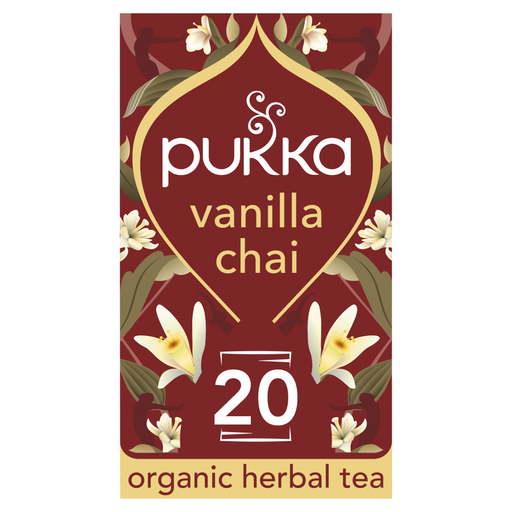
Pukka describes its Spiced Vanilla Chai as a caffeine-free chai blend sold in a 20-teabag pack.
Twinings has a decaffeinated-tea range and separately sells Classic Chai, which it describes as spice-flavour black tea.
Clipper lists an Organic Everyday Decaf Tea catering pack containing 250 envelopes.
Teapigs sells chai tea and lists decaf English Breakfast separately.
Tesco’s everyday-tea listing includes decaf black tea, including Yorkshire Tea Decaf.
This product is a portioned, caffeine-free herbal chai option for a lunchtime tea point. Check the current pack’s ingredients and preparation directions before putting it into service.
 No image available
This listing describes a caffeine-free herbal chai for a portioned lunch service. It names cinnamon, ginger, liquorice, fennel, cardamom and vanilla; check the current pack’s ingredient information and brewing directions before service. The NHS advises pregnant people to avoid teas containing liquorice root.
No. Decaffeinated tea can retain traces of caffeine: Twinings says UK decaf teas typically contain no more than 0.2% caffeine. For a chai-style option specifically described as caffeine-free, check that wording on the exact herbal chai product.
Only if that exact tea is labelled decaffeinated or caffeine-free. Twinings describes Classic Chai as black tea, while Teapigs says its chai naturally contains caffeine; the word “chai” does not settle the question.
UK Government and Food Standards Agency guidance requires food businesses to provide allergen information for prepacked and non-prepacked food and drink. Use the current pack or an up-to-date ingredient record, and include milk in the information when it is added to a drink.
Pukka identifies liquorice in its Spiced Vanilla Chai, and the NHS advises pregnant people to avoid teas containing liquorice root. Show the full ingredients and provide a clearly labelled alternative rather than assuming one herbal blend suits everyone.
Use the directions for each product instead of one timing for both. For example, Clipper specifies 2–4 minutes for its Organic Everyday Decaf Tea catering pack; check the herbal chai pack for its own instructions.