Hosts serving different coffee preferences
An instant jar lets you prepare individual cups and leave guests to add milk or sugar as they wish.


For an afternoon tea party, an instant decaf jar lets you make coffee one cup at a time without brewing equipment. Choose the size according to how many guests are likely to want coffee and whether you will use the rest later; use maker flavour descriptions as a starting point rather than a promise about taste. Decaf should not be treated as caffeine-free.
An instant jar lets you prepare individual cups and leave guests to add milk or sugar as they wish.
If this is a small gathering, consider how much coffee you expect to serve and whether the remaining jar will be used afterwards.
Decaffeinated coffee is not necessarily caffeine-free. Check the product label, and leave decisions involving an individual caffeine restriction to the guest and their appropriate clinical adviser.
Start with the preparation format and likely number of coffee orders, then consider the jar size, flavour description and caffeine wording.
| Priority | What to check | Your needs |
|---|---|---|
| Quick service | Check that the product is instant or soluble coffee rather than beans, ground coffee or pods. Follow the jar’s preparation directions when making each cup. | I want to make coffee as guests ask for it, without setting up brewing equipment. |
| Jar size | Compare pack weights and any stated serving count. Sainsbury’s lists 55 servings for its 200g Gold Roast Decaffeinated jar, using one teaspoon per cup; serving directions for other jars may differ. | A smaller gathering may leave coffee in the jar, so I need to consider both party orders and later use. |
| Caffeine wording | Check that the exact jar is labelled decaffeinated. Do not read “decaf” as “caffeine-free”: regulation 5 of the Coffee Extracts and Chicory Extracts (England) Regulations 2000 permits a defined residual caffeine level for decaffeinated soluble coffee. | Someone at the party may need to limit caffeine carefully and should be able to check the label before choosing a drink. |
| Flavour style | Read the maker’s roast, bean or intensity description, keeping in mind that it is not an independent taste result. Check the current label if the ingredients matter to a guest. | Some guests will drink coffee black and others will add milk; I can offer those additions separately rather than assume one flavour description suits everyone. |
For soluble coffee, the Coffee Extracts and Chicory Extracts (England) Regulations 2000, regulation 5, permit the term “decaffeinated” when residual anhydrous caffeine does not exceed 0.30% of the coffee-based dry matter. A guest with a strict caffeine limit may need more information than the word “decaf” alone provides.
Keep the jar available for guests to read and let anyone with an individual restriction seek appropriate clinical advice.
Taylors of Harrogate lists Decaffé as coffee beans, not instant granules. Beans cannot be prepared by simply adding hot water to a mug.
Choose an instant jar for individual cups unless you already have the equipment and time to brew the beans.
Bean preparation also requires a grinder and suitable brewing equipment.
A large jar may leave substantial coffee after a one-off gathering, while a smaller pack may not cover repeated orders.
Estimate how many guests may choose coffee, compare pack weights and stated servings where available, and consider whether the remainder will be used later.
Words such as “smooth” or “balanced” and maker intensity ratings describe a product; they do not establish what every guest will prefer.
Use those descriptions to narrow your choice, and put milk and sugar out separately so guests can adjust their own cups.
Nescafé UK & IE lists Original Decaf instant coffee in 100g, 190g and 300g jars. Its Gold Blend Decaf is another soluble-coffee option.
Kenco GB lists Decaf in 95g and 190g jars and gives it a maker intensity rating of 7.
Sainsbury’s lists Gold Roast Decaffeinated Instant Coffee Granules in a 200g jar, with 55 stated servings and a one-teaspoon-per-cup instruction.
Tesco Groceries lists Tesco Decaff Gold Instant Coffee and Tesco Decaffeinated Classic Coffee in 200g packs.
Marks & Spencer describes its 200g Gold Decaf Instant Coffee as freeze-dried coffee made from medium-roasted Arabica beans.
Taylors of Harrogate lists Decaffé coffee beans in 200g and 1kg packs, rather than an instant jar.
These coffee packs offer different sizes to consider for an afternoon tea party. Check the current label for the instant format and decaffeination wording where those details affect what you plan to serve.
 Image unavailable
The 300g jar is worth considering if several guests may request coffee or you expect to use the remainder later. Nescafé UK & IE lists Original Decaf as instant coffee; use the current jar directions to plan individual cups.
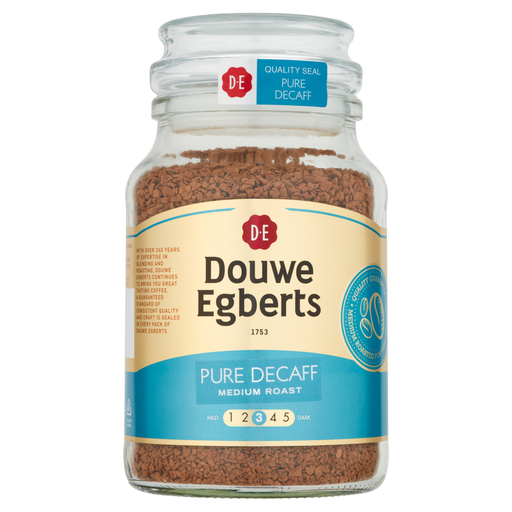 Image unavailable
This 190g instant-coffee pack is an option for making decaf cups individually. Check the jar’s preparation directions when estimating how many cups to make.
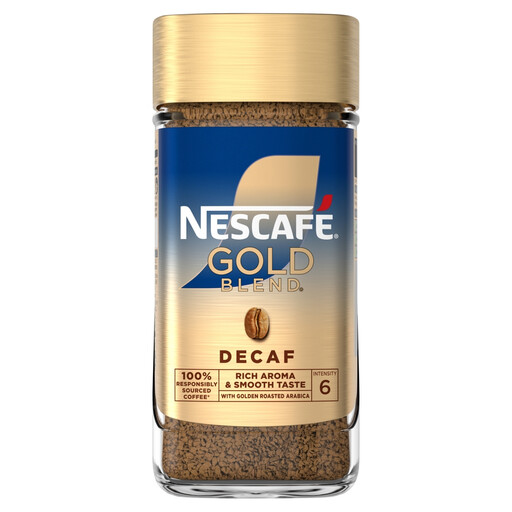 Image unavailable
The 190g Gold Blend Decaf pack offers a soluble-coffee choice for individual cups, as described by Nescafé UK & IE. Compare its size with likely party use and follow the current jar directions.
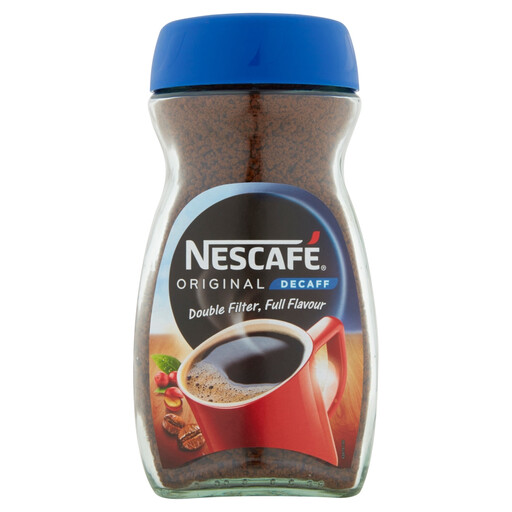 Image unavailable
This 200g New Shape variant offers another pack size for a gathering. Check its current label for preparation directions before planning how many cups it will cover.
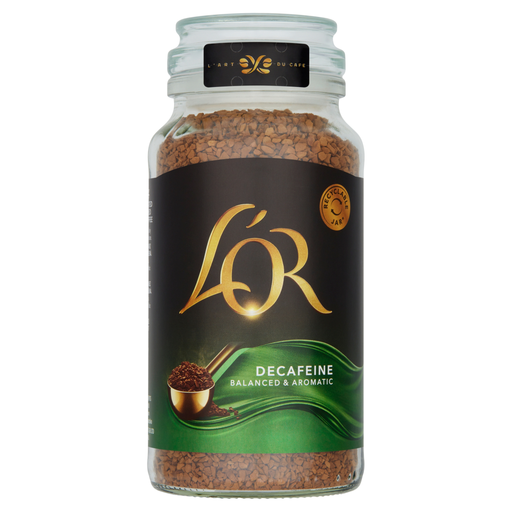 Image unavailable
The 150g pack is a smaller option to consider if fewer guests are likely to ask for coffee. Before serving it as instant decaf, confirm the preparation format and decaffeination wording on the current label.
No: decaf should not be described as caffeine-free. For soluble coffee, regulation 5 of the Coffee Extracts and Chicory Extracts (England) Regulations 2000 permits “decaffeinated” when residual anhydrous caffeine does not exceed 0.30% of the coffee-based dry matter. Guests who must restrict caffeine particularly carefully should check the label and seek individual clinical advice.
Estimate how many guests may choose coffee, then use the directions for the jar you intend to buy. Sainsbury’s states 55 servings for its 200g Gold Roast Decaffeinated jar at one teaspoon per cup, while Nescafé UK & IE lists Original Decaf jars in 100g, 190g and 300g sizes. Consider whether you will use any coffee left after the party.
Yes, if you have the equipment and time to prepare them. Taylors of Harrogate lists Decaffé as beans, which need grinding and brewing; an instant jar better fits a plan to make individual cups with hot water.
Yes, especially if a guest has an ingredient or allergen concern or you are choosing a flavoured or mixed coffee product. Sainsbury’s lists decaffeinated soluble coffee as the ingredient in its Gold Roast Decaffeinated jar; read the current label of the exact product you serve.