Occasional second-home visitors
Individually wrapped bags make it straightforward to count what is left between visits. Amazon.co.uk lists Taylors of Harrogate Decaffé as a box of 80 individually enveloped coffee bags.


Choose an explicitly labelled 80-bag box when you need a known number of individually wrapped portions for occasional second-home visits: Amazon.co.uk lists Taylors of Harrogate Decaffé in that format. An instant-decaf jar is an alternative for more regular use, but the number of mugs depends on how much coffee you use, and a jar does not provide 80 separate portions.
The useful distinction is how often the coffee will be made and whether each portion needs to be counted separately.
Individually wrapped bags make it straightforward to count what is left between visits. Amazon.co.uk lists Taylors of Harrogate Decaffé as a box of 80 individually enveloped coffee bags.
A single-serve coffee bag lets a guest make a mug without measuring granules or using a coffee machine. Check the bag count if you need to plan stock for a particular number of visits.
A jar suits people who prefer to measure their own coffee and add hot water. Nescafé and Kenco list instant-decaf jars in several sizes, but the amount used in each mug affects how long a jar lasts.
Decide whether a fixed portion count matters first, then check preparation and storage against how the second home is used.
| Priority | What to check | Your needs |
|---|---|---|
| Portion count | Look for an explicit coffee-bag count. Amazon.co.uk lists Taylors of Harrogate Decaffé as 80 individually enveloped bags; a jar weight is not a fixed mug count. | I want to know how many single-bag portions are left when planning the next visit. |
| Preparation | Check whether the pack contains coffee bags or soluble coffee. Kingdom Coffee directs users to brew the Taylors bag in boiling water for about two minutes; Nescafé gives one 1.8g teaspoon with 200ml water as its instant-coffee mug basis. | Guests may prefer to make one mug without measuring coffee, or I may prefer the adjustable amount used from a jar. |
| Storage | Read the exact pack’s storage directions and best-before date. Kenco says to keep its instant coffee cool and dry and to find the best-before date on the base of the pack. | The property may be empty between visits, so I need a storage place that meets the pack’s directions. |
| Product type | Confirm that the title and pack identify decaf coffee, then check whether it is bags, instant coffee, ground coffee or beans. Tesco Groceries also lists 80-count decaf tea products. | An 80-count search result is only useful to me if it contains the coffee format I meant to buy. |
Tesco Groceries lists 80-count decaf tea products, which would not meet a coffee stock plan.
Check that the product name and ingredients identify coffee before relying on the bag count.
The number of mugs depends on the serving measure and how much granulated coffee each person uses. Nescafé gives a 1.8g teaspoon with 200ml water as its mug basis.
Choose a pack labelled with 80 coffee bags when an exact bag count matters; otherwise use the jar’s stated serving guidance to plan stock.
A coffee-bag pack’s weight alone does not tell you whether it contains 80 individually wrapped bags.
Check the stated number of bags on the exact pack before buying for a fixed-count stock plan.
Marks & Spencer advises that online ingredient, dietary and allergen information can change.
Check the current label, best-before date and availability of the exact product before stocking the property.
These brand examples show the difference between a stated 80-bag pack, other single-serve bags and instant jars; check the exact product rather than assuming every pack from a brand has the same format.
Amazon.co.uk lists Taylors of Harrogate Decaffé Roast 4 as 80 individually enveloped decaffeinated Arabica coffee bags.
Nescafé lists Original Decaf instant coffee in 100g, 190g and 300g jars.
Kenco describes its Decaf as a medium-roast instant coffee with intensity 7 and lists 95g and 190g jars.
Sainsbury's lists own-label decaf instant coffee in a 200g size alongside other decaf coffee formats.
Marks & Spencer describes its decaffeinated coffee bags as individually wrapped and single-serve.
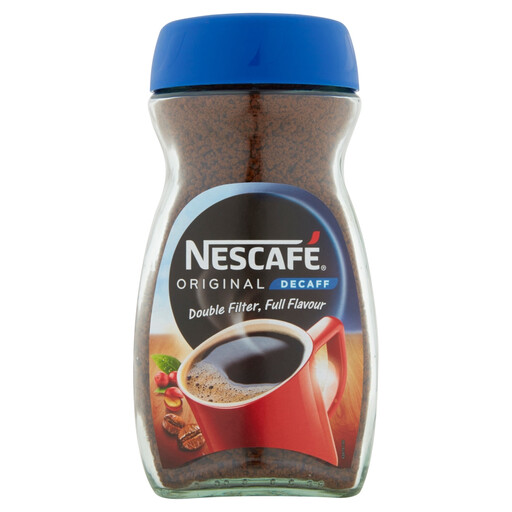
This instant-decaf jar is an option for a second home where coffee is used regularly; it is not an 80-bag coffee box.
 No image available
This 200g soluble-decaf coffee suits a stock plan based on measured servings rather than individual bags. Store it in a cool, dry place, and check the serving guidance if you need to plan a particular number of mugs.
Choose a labelled 80-bag pack if you need a known number of separate portions for occasional visits. Choose an instant jar if coffee is used regularly and measuring each mug is convenient; jar weight alone does not guarantee 80 mugs.
Kingdom Coffee directs users to put a bag in a mug, add boiling water and brew for about two minutes before squeezing the bag. Follow the instructions on the pack you buy if they differ.
Do not treat the word ‘decaf’ as a guarantee of zero caffeine. Nescafé says most caffeine is removed from its Original Decaf coffee using water; if complete caffeine avoidance matters, check the exact pack information and seek appropriate professional advice.
Follow the directions on the exact pack. Marks & Spencer specifies cool, dry storage for its decaf coffee bags, while Kenco gives the same storage direction for its instant coffee and puts the best-before date on the base of the pack.
Read the current label on the exact product before serving it. Marks & Spencer advises that online ingredient, dietary and allergen details can change and should not replace checking the pack.