What should you check before buying?
Confirm the exact beans are decaffeinated first. Then compare any stated caffeine limit, your brewing method, the flavour description and a pack size you expect to use.
| Priority |
What to check |
Your needs |
| Decaf status |
Look for “decaffeinated” on the exact whole-bean product. Treat roast and intensity as flavour descriptions, not caffeine measurements. |
I want to keep the coffee-making ritual without choosing an ordinary caffeinated blend close to bed. NHS Borders advises avoiding caffeine-containing drinks at that time. |
| Caffeine statement |
Check whether the exact product states a numerical maximum. illy states caffeine content no higher than 0.1% for its 250g whole-bean decaf; that is not a zero-caffeine claim. |
A stated limit matters more to me than a general decaf label, particularly if I am sensitive to caffeine. |
| Brewing method |
Match the product’s brewing guidance to your equipment. Lavazza lists Decaf Intenso for espresso, moka, filter and French press; Union recommends its Decaf Blend for espresso or bean-to-cup. |
I use a particular machine or brewer and want beans intended for that way of making coffee. |
| Flavour profile |
Compare the maker’s roast and tasting descriptions. Union describes its Decaf Blend as dark-roasted with chocolate and caramel notes; its lighter-roast Decaf Maraba has a tangerine-accented profile. |
I still want to choose between a darker and a fruitier cup after switching to decaf. |
| Pack and storage |
Consider how often you will use the beans and follow the pack’s storage directions. Waitrose advises using its 227g Peru Decaf beans within two weeks of opening for best taste. |
Evening coffee is occasional for me, so I would rather choose a pack I can use while it is at its best. |
Which brands offer relevant decaf beans?
These are references for comparing particular decaf bean products and flavour directions, not a judgement about every coffee sold by each brand.
illy
illy describes its 250g whole-bean decaf as 100% Arabica, with caffeine content no higher than 0.1%.
- illy lists moka, filter, espresso and lungo preparation for this product.
- Its classic-roast caramel and floral notes are a different flavour direction from a dark-roast blend.
Lavazza
Lavazza describes Decaf Intenso as a 500g medium-dark decaf blend of Arabica and Robusta beans.
- Lavazza lists espresso, moka, filter and French press preparation, with an intensity of 6/10.
- If you need a numerical caffeine maximum, check the exact pack rather than treating its intensity rating as one.
Union
Union describes its whole-bean Decaf Blend as dark-roasted with chocolate and caramel notes and recommends it for espresso or bean-to-cup.
- Union also describes Decaf Maraba as a lighter-roast, tangerine-accented single-origin alternative.
- Choose between those two products by the flavour direction and brewing guidance for the exact beans.
Waitrose
Waitrose describes its No.1 Organic Fairtrade Peru Decaf Coffee Beans as a 227g, 100% Arabica, medium-roast whole-bean product.
- The product description notes caramel and lemon acidity.
- Waitrose advises storing the beans in an airtight container and using them within two weeks of opening for best taste.
Taylors of Harrogate
Joybuy lists Taylors Decaf Coffee Beans in a 200g pack.
- The listing identifies a decaf bean option in a smaller pack.
- Check the exact pack for brewing guidance and any numerical caffeine statement that matters to you.
Decaf coffee beans on Joybuy
These Joybuy options are decaffeinated coffee beans in 500g and 200g packs for a bean-based evening coffee ritual. Check the exact pack if you need a stated caffeine limit or guidance for your brewer.
 No image available
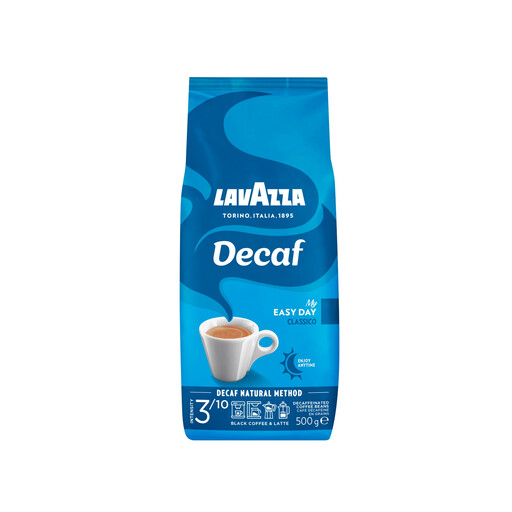
Lavazza Decaffeinated Coffee Beans 500g
Decaffeinated coffee beans in a 500g pack for an evening coffee ritual.
If you need a numerical caffeine limit or use a particular brewing method, check the details for this exact pack.
View on Joybuy
 No image available
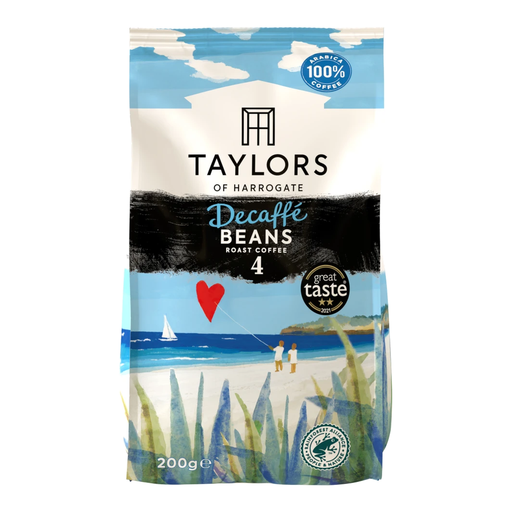
Taylors Decaf Coffee Beans 200g
Decaf coffee beans in a 200g pack if you prefer a smaller quantity for occasional evening brewing.
Check the exact pack for a numerical caffeine statement and guidance for your brewing method.
View on Joybuy
Questions about bedtime coffee beans
Should I choose decaf beans for coffee close to bedtime?
Choose beans explicitly labelled decaffeinated if you want to avoid an ordinary caffeinated coffee near bed. NHS Borders advises avoiding caffeine-containing drinks close to bedtime because they can make you more awake and disrupt sleep; decaf is not necessarily caffeine-free.
Does decaf mean the beans contain no caffeine?
No: illy states that its whole-bean decaf has caffeine content no higher than 0.1%, not zero. If a defined limit matters, check the statement for the exact product you intend to buy.
Can roast darkness or intensity tell me which beans have less caffeine?
Use those descriptions to choose flavour, not to establish decaf status. For example, Lavazza calls its Decaf Intenso medium-dark and rates its intensity 6/10; the explicit decaffeinated designation is the relevant label to check.
Which decaf beans are described for espresso or bean-to-cup?
Union recommends its Decaf Blend for both espresso and bean-to-cup. Lavazza lists Decaf Intenso for espresso, moka, filter and French press, while illy lists its whole-bean decaf for espresso, moka, filter and lungo; check the guidance for the exact product and your equipment.
What changes when choosing decaf beans during pregnancy?
The NHS advises no more than 200mg of caffeine a day during pregnancy, so consider total intake rather than coffee alone. Tea, cola, chocolate, energy drinks and some tablets or supplements can also contain caffeine; decaf coffee does not remove the need to count other sources.


