Hosts serving different coffee preferences
If friends favour different styles of coffee, start with beans whose stated preparation guidance matches your brewer. Then compare the flavour notes rather than assuming every decaf will taste alike.


For brunch with friends, choose decaf whole beans that suit the brewer you will use, then pick flavour notes your guests are likely to enjoy. A 200–250 g pack is a smaller commitment for an occasional gathering; consider 500 g or 1 kg if you expect to use the beans regularly and can follow the pack’s storage instructions. Decaf does not necessarily mean caffeine-free, so check the individual product statement when a guest needs to limit caffeine.
If friends favour different styles of coffee, start with beans whose stated preparation guidance matches your brewer. Then compare the flavour notes rather than assuming every decaf will taste alike.
A 200–250 g pack lets you try a decaf without opening a larger bag for one gathering. Follow that product’s instructions for storing any beans left after brunch.
Decaffeinated is not necessarily caffeine-free. For example, illy UK states that its whole-bean decaf contains no more than 0.1% caffeine; check the statement on the particular product you plan to serve.
Start with the brewer on your kitchen counter, then choose a flavour and pack size that fit the gathering.
| Priority | What to check | Your needs |
|---|---|---|
| Brewing method | Look for preparation guidance covering your machine or cafetière. Lavazza UK lists espresso, filter, French press and moka for Decaf Intenso; illy UK lists moka, filter, espresso and lungo for its whole-bean decaf. Union Coffee names espresso or bean-to-cup as the preferred method for its Decaf Blend, although it says any method can be used. | I want to serve the beans using the equipment I already have, without assuming that every product gives the same brewing guidance. |
| Flavour | Read the stated tasting notes: Taylors of Harrogate describes caramel and malt, while illy UK describes caramel, orange blossom and jasmine. Roast or intensity alone does not describe those differences. | For friends whose preferences I know, I can choose notes they enjoy; for an unfamiliar group, I would check whether they tend to prefer chocolate, caramel or malt notes over floral ones. |
| Residual caffeine | Check the caffeine statement for the exact beans being served. illy UK states no more than 0.1% for its whole-bean decaf; Waitrose & Partners lists no more than 0.10% for Lavazza Decaf Classico, a different Lavazza product. | If a guest needs to limit caffeine, I need an accurate description of the coffee rather than a promise that decaf contains none. |
| Pack and storage | Compare the quantity with how often you will make coffee after brunch. Options described by the producers and retailers range from 200–250 g to 500 g and 1 kg; check the chosen pack’s instructions once opened. | Will we use a larger bag regularly, or would a smaller pack be easier to finish after this gathering? |
A decaf label alone does not establish zero caffeine. illy UK, for example, states a maximum of 0.1% caffeine for its whole-bean decaf.
Check the exact product’s caffeine statement before describing it to a guest who limits caffeine.
Union Coffee recommends espresso or bean-to-cup for its Decaf Blend, whereas Lavazza UK lists several methods for Decaf Intenso. Their preparation guidance is not identical.
Match the product guidance to the brewer you will use and choose an appropriate grind for it.
A 1 kg pack leaves more beans to store if you only make coffee occasionally.
Consider a 200–250 g pack for a first trial, and follow the chosen product’s storage instructions for any remainder.
A roast label cannot tell you whether guests would prefer woody notes, chocolate or a more floral cup.
Compare the product’s stated flavour notes with what your friends usually enjoy.
These examples describe particular products or retailer listings, not every coffee sold under each name.
Taylors describes its Decaffé whole beans with caramel and malt notes.
Lavazza UK lists Decaf Intenso as a 500 g option for espresso, filter, French press and moka.
illy UK describes its 250 g whole-bean decaf with caramel, orange-blossom and jasmine notes.
Union describes Decaf Blend as a dark-roast coffee with chocolate and caramel notes.
M&S lists Roast & Ritual Decaf Coffee Beans and gives instructions for storing them after opening.
Waitrose & Partners lists Raw Bean Definitely Decaf Beans in a 200 g pack, described with cocoa and walnut notes.
These two whole-bean decaf packs offer different quantities for a brunch gathering. Check their pack directions against your brewer and your guests’ caffeine requirements before serving.
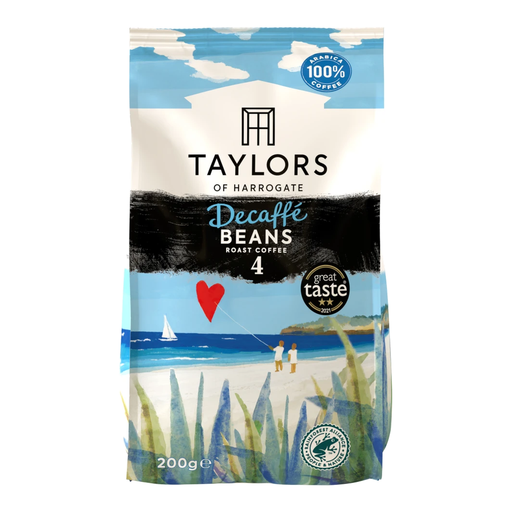 No image available
The 200 g pack is a smaller quantity to try for an occasional brunch. Check the brewing directions for your equipment and the pack’s caffeine statement if a guest needs to limit caffeine.
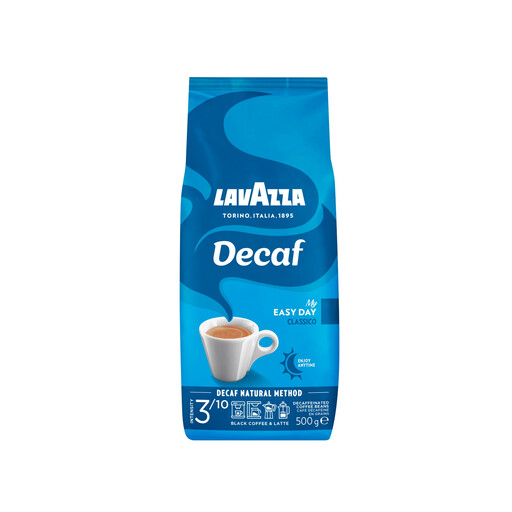 No image available
Consider the 500 g pack if you expect to make more coffee after brunch. Check this product’s brewing directions and caffeine statement rather than applying details from a different Lavazza decaf.
Not necessarily. illy UK states that its whole-bean decaf contains no more than 0.1% caffeine, while Waitrose & Partners gives a maximum of 0.10% for Lavazza Decaf Classico. Check the statement on the exact pack you intend to serve.
Choose beans that name the method you use: Lavazza UK lists espresso, filter, French press and moka for Decaf Intenso, while illy UK lists moka, filter, espresso and lungo for its whole-bean decaf. Union Coffee says its Decaf Blend works with any method but recommends espresso or bean-to-cup.
A 200–250 g pack is a smaller commitment when trying a decaf for an occasional gathering. Consider 500 g or 1 kg if you expect to keep using the beans, and check the chosen product’s instructions for storage after opening.
Follow the instructions for the beans you bought. The Waitrose & Partners listing for Raw Bean advises an airtight container away from direct sunlight; M&S specifies an airtight container for its Roast & Ritual beans, with separate refrigerator and freezer storage periods.