Who is this for?
The choice affects both the coffee served to residents and the routine staff use to prepare it.
Teams planning a decaf-first offer
For catering leads considering decaf as the usual coffee option while retaining caffeinated drinks for residents who prefer them. Care Quality Commission guidance says food and drink provision should take individual preferences into account.
Homes using whole-bean equipment
For teams matching beans to their grinder or bean-to-cup workflow, the number of cups served and a practical routine for storing opened packs.
Teams managing individual drink requests
For staff who need to check a resident’s preferences and assessed food-and-drink needs, as well as the current product information used when serving coffee with milk, plant drinks or accompaniments.
What to check before buying
Start with the residents’ drink choices, then match the beans to service volume, equipment and the information needed for each serving.
| Priority |
What to check |
Your needs |
| Caffeine information |
Check that the pack identifies whole-bean decaf. If an individual plan specifies a caffeine limit, check the current label for the exact product; decaf does not necessarily mean zero caffeine. |
I need to know what is being served when a resident has a specific caffeine requirement. |
| Resident choice |
Check which flavours and preparations residents prefer, and how staff will distinguish decaf from caffeinated coffee when both are offered. |
A decaf-first offer should still leave room for my residents’ individual drink preferences. Care Quality Commission guidance says those preferences should be taken into account. |
| Pack and preparation |
Match pack size to cups served and the opened-pack storage instructions. Check the beans against the equipment used: Union recommends its Decaf Blend for espresso or bean-to-cup service, while illy lists moka, filter, espresso and lungo for its whole-bean decaf. |
If we serve only a few decaf coffees, I want a pack we can use within its stated freshness window. A busier service may have a reason to consider a larger bag. |
| Service information |
Keep current pack details accessible and check the ingredients and allergen information for drinks and accompaniments. GOV.UK guidance says food businesses must provide allergen information for prepacked and non-prepacked food and drink and train staff on allergens. |
Staff need to answer questions about what goes into the coffee as served, including any milk, plant drink, syrup or accompaniment. |
Brands and retailer references
These references describe particular decaf products and listings, not every coffee sold under each name or its availability on Joybuy.
Lavazza
Waitrose lists Lavazza Decaf Intenso as a 500 g whole-bean coffee with intensity 6 and stated caffeine content no higher than 0.10%.
- The listed pack size gives a higher-throughput service a larger format to assess.
- Use the Decaf Intenso figure only for that identified product; check the current label before applying a caffeine limit.
Taylors of Harrogate
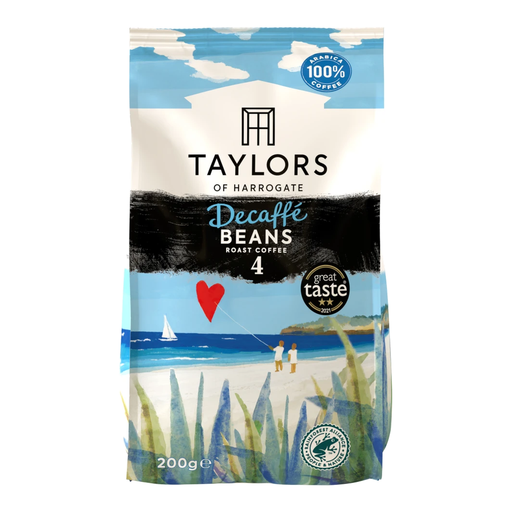
Taylors Decaffé Beans offer a 200 g whole-bean route. Waitrose describes a water decaffeination method and advises using the beans within two weeks of opening.
- The smaller pack gives a lower-volume service a way to plan around the stated opened-pack window.
- Check the exact pack if a quantified residual-caffeine limit matters.
illy
illy lists a 250 g whole-bean decaf for moka, filter, espresso and lungo, with stated caffeine content no higher than 0.1%.
- The listed preparation methods offer several ways to use this particular coffee.
- Check the current product label and whether its format fits the home’s equipment and turnover.
Union
Union lists Decaf Blend in 200 g and 1 kg whole-bean formats and recommends it for espresso or bean-to-cup preparation.
- The two pack sizes allow a choice based on service volume; Union says it uses water and carbon dioxide in decaffeination.
- Assess its dark, full-bodied profile against residents’ tastes, and check the pack if a numerical caffeine limit is needed.
M&S
M&S describes Roast & Ritual Decaf Coffee Beans as decaffeinated Arabica and gives specific storage directions after opening.
- Its directions cover two weeks in an airtight container in the refrigerator or four weeks in the freezer after opening.
- Check the current pack for product details and whether its storage routine fits the home’s service.
Waitrose
Waitrose is a retailer reference here, with listings for the distinct Lavazza Decaf Intenso and Taylors Decaffé Beans products.
- The listings provide product-specific pack and use information for comparison.
- Check the delivered pack rather than transferring details between products or relying on an earlier listing.
Whole-bean decaf options on Joybuy
These two Joybuy listings offer a 200 g Taylors pack for a smaller decaf service and a 500 g Lavazza pack to consider where more beans are used. Check each exact pack for any individual caffeine requirement; the Lavazza listing here is not identified as the Decaf Intenso variant discussed above.
 No image available
Taylors Decaf Coffee Beans 200 g
The 200 g pack suits a service planning smaller batches. Joybuy’s information for this SKU advises consuming the beans within two weeks of opening; check the current pack if a resident needs a quantified caffeine limit.
View on Joybuy
 No image available
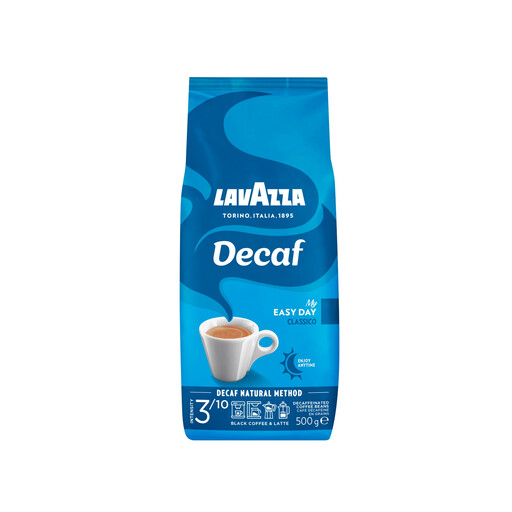
Lavazza Decaffeinated Coffee Beans 500g
The 500g pack is an option for a service that can use a larger bag. Plan storage and stock rotation around actual consumption, and check this exact pack for caffeine information rather than applying figures from a different Lavazza variant.
View on Joybuy
Care-home decaf questions
Should decaf be the only coffee a care home serves?
A decaf-first offer need not remove caffeinated coffee. Care Quality Commission guidance says food and drink provision should take residents’ preferences into account, so consider each person’s assessed needs and choices when planning what is available.
Does decaf coffee contain no caffeine?
Not necessarily: Nottingham and Nottinghamshire Integrated Care Board information says decaf can retain very low levels. Waitrose lists a maximum of 0.10% for Lavazza Decaf Intenso, and illy states no higher than 0.1% for its whole-bean decaf. Those figures should not be applied to other products; check the current exact pack where an individual limit matters.
Which pack size makes sense for a smaller service?
Start with actual decaf usage and the product’s opened-pack instructions rather than pack size alone. A 200 g Taylors pack has a stated two-week use window after opening; consider a larger pack only if the home can store and use it appropriately.
What allergen information matters when serving decaf?
Check the drink as served, including milk, plant drinks, syrups and accompaniments, as well as the coffee pack. GOV.UK guidance says food businesses must provide allergen information for prepacked and non-prepacked food and drink and train staff on allergens.
Can a bean-to-cup machine be part of a decaf-first service?
It can be considered if the beans suit the equipment and staff can reliably identify which coffee is being dispensed. Union recommends its Decaf Blend for bean-to-cup preparation; check the particular machine’s instructions for using and changing beans, especially when caffeinated coffee is also offered.


