What should you check?
Start with the equipment available in the new accommodation, then choose a decaf label, pack size and flavour profile that fit how the coffee will be used.
| Priority | What to check | Your needs |
|---|
| Grinding and brewing |
Confirm access to a separate grinder or a machine with one built in. Check the product’s suggested brewing methods and select a suitable grind for your equipment. |
I need to make coffee with the equipment I will actually have in the flat. A kettle or cafetière alone cannot grind whole beans. |
| Decaf labelling |
Look for an explicit decaffeinated designation and read any stated caffeine limit. Roast strength is a flavour description, not a substitute for a caffeine statement. |
I want to reduce caffeine without assuming that decaf means none: University Hospitals of Leicester NHS Trust notes that decaffeinated coffee can still contain very low levels. |
| Pack size and storage |
Compare 200–250 g trial packs with 500 g packs against likely household use. Read the particular pack’s directions for storage after opening and its date marking. |
If I am the only occasional drinker, I would rather start with less. For a flat using decaf regularly, a larger pack may be practical if we can store and use it as directed. |
| Roast and flavour |
Read the stated roast, bean blend, flavour notes and suggested brewing method. Treat flavour descriptions as the brand’s guidance, not a guarantee of how the coffee will taste to you. |
I can choose a profile that sounds suited to my usual drink: illy describes caramel and floral notes for its decaf whole beans, while Union describes its Decaf Blend as a dark roast for espresso or bean-to-cup brewing. |
Brand and product-line references
These examples help distinguish pack sizes and brewing styles; they do not imply that every named product is in the Joybuy selection below.
Lavazza
Lavazza UK lists Decaf Intenso as a 500 g whole-bean option for a household expecting regular use.
- Lavazza specifies an Arabica–Robusta blend and lists espresso, moka, filter and French press among its brewing methods.
- The 500 g quantity is a larger flavour and storage commitment for one occasional drinker.
illy
illy lists its decaffeinated whole beans in a 250 g tin, a smaller quantity for a first purchase.
- illy describes the coffee as 100% Arabica, suggests moka, filter, espresso and lungo preparation, and states a caffeine content no higher than 0.1%.
- Its caramel and floral tasting notes are the brand’s description; try a smaller quantity if you are unsure whether that profile suits you.
Union
Union Hand-Roasted Coffee offers a 200 g wholebean Decaf Blend for shoppers considering espresso or bean-to-cup brewing.
- Union describes it as a dark roast and recommends espresso or bean-to-cup preparation.
- Confirm that the new accommodation has suitable grinding and brewing equipment before choosing the wholebean format.
Taylors of Harrogate
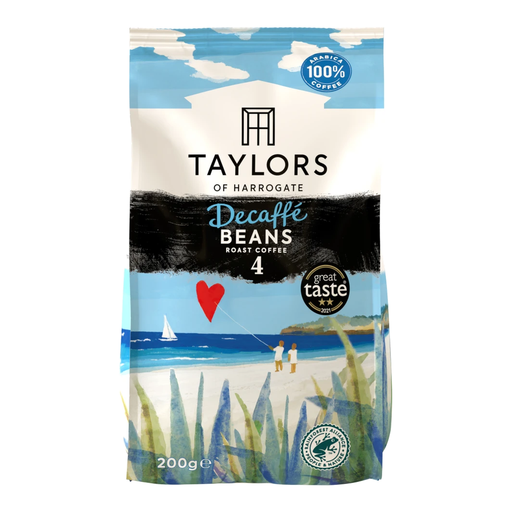
Waitrose & Partners lists Taylors Decaffé Beans as a 200 g decaf option for a smaller first bag.
- The listing describes 100% Arabica beans and a water decaffeination method.
- For this product, the listing advises sealing the opened bag with a clip and keeping it in a cool, dry place for up to two weeks.
M&S
M&S describes Roast & Ritual Decaf Coffee Beans as a 227 g whole-bean option.
- M&S states that the product is made with 100% decaffeinated Arabica beans.
- Its directions specify an airtight container and different storage periods for refrigeration and freezing after opening; read the pack before storing it.
Decaf beans on Joybuy
These two whole-bean pack sizes address different move-in plans: a 200 g first purchase and a 500 g bag for a flat expecting regular decaf use. Both require access to grinding equipment.
 No image available
Taylors Decaf Coffee Beans 200 g
The smaller bag is a way to try decaf beans before buying more. Confirm that you can grind whole beans, and check the pack for brewing and storage directions.
View on Joybuy
 No image available
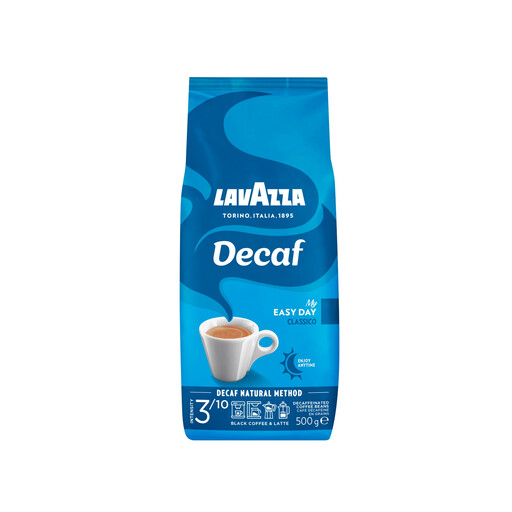
Lavazza Decaffeinated Coffee Beans 500 g
The larger bag is worth considering if several flatmates expect to use decaf regularly. Confirm access to a grinder and follow the storage directions on this pack; do not assume it is the same Lavazza blend described in the brand section.
View on Joybuy
Common questions
Do decaf coffee beans still contain caffeine?
They can. University Hospitals of Leicester NHS Trust explains that decaffeinated coffee may still contain very low levels of caffeine. illy states a limit of no higher than 0.1% for its decaffeinated whole beans; check the statement for the particular product you are considering rather than applying that figure to every bag.
Can I brew whole decaf beans without a grinder?
No: whole beans must be ground before brewing, unless your machine has an integrated grinder. Check what will be available in your accommodation before buying beans; if you cannot grind them, look for a suitable decaf ground coffee instead.
Which pack size suits a first term in student accommodation?
A 200–250 g pack is a smaller commitment if you are trying a new flavour or buying for one occasional drinker. Consider 500 g when the flat expects regular use and can store the opened beans according to that product’s directions.
How should I store opened decaf beans?
Follow the directions for the particular coffee. Waitrose & Partners advises sealing its Taylors Decaffé Beans with a clip and keeping them in a cool, dry place for up to two weeks after opening; do not assume the same directions apply to another brand.
What should I check on the coffee pack when it arrives?
Check that it is the decaf whole-bean product you intended to buy, then read its net weight, date marking and storage directions. Check ingredient and allergen information where relevant to you, and follow the directions on the physical pack when opening and storing it.


