Late-evening coffee drinkers
If you want coffee during a film without choosing a standard caffeinated version, look for an explicitly decaffeinated product. Decaf is not a promise of zero caffeine or a stated amount in your glass.


Choose a decaf concentrate if you want to mix iced drinks with milk or water during the film; choose a cold-compatible decaf instant coffee if you would rather prepare each drink from a cupboard-stored format. Tesco Groceries lists 10 servings for its 500ml concentrate and 16 glasses for Nescafé’s 500ml concentrate under different recipes, so guest numbers, mixer choice and post-opening storage matter more than bottle size alone. Neither listing establishes that its concentrate is traditionally cold brewed, and decaf does not mean caffeine-free.
If you want coffee during a film without choosing a standard caffeinated version, look for an explicitly decaffeinated product. Decaf is not a promise of zero caffeine or a stated amount in your glass.
A decaf liquid concentrate lets you combine a measured amount with ice and a chosen milk or water. Check the bottle’s recipe and stated yield against the number of drinks you plan to make.
If one movie night will not use a whole bottle, compare post-opening instructions before buying a concentrate. A cold-compatible instant coffee offers a different preparation format when you do not want an opened bottle in the fridge.
Start with the drink you want to serve, then check the recipe, storage instructions and label for the exact product.
| Priority | What to check | Your needs |
|---|---|---|
| Decaf label | Check that the exact product is labelled decaffeinated. If you need a particular caffeine amount, ask the manufacturer for product-specific information rather than treating decaf as caffeine-free. | I want a decaf coffee for a late film, but I do not want to assume that a prepared glass contains no caffeine. |
| Preparation | Compare the stated amounts of coffee and mixer. Tesco Groceries directs 50ml of its concentrate into 150ml of cold water, milk or a milk alternative; its Nescafé listing uses 30ml concentrate with 150ml milk. | For guests, I want to know how many drinks I can mix and whether each person can choose their own mixer. |
| Yield and storage | Tesco Groceries lists 10 servings and refrigeration for up to 4 weeks after opening for its 500ml concentrate. Its Nescafé listing gives 16 glasses under a different recipe and says to refrigerate and consume within 14 days. | If I will make only a few drinks tonight, the time allowed after opening matters as well as the stated number of servings. |
| Cold-brew method | Check the current label or manufacturer information for an explicit cold-brew production claim. Directions for serving a coffee cold do not, by themselves, establish how it was brewed. | I specifically want traditionally cold-brewed decaf, rather than any coffee that can be served over ice. |
| Ingredients and mixer | Read the current coffee label and the label of any milk or other mixer. Check the finished drink against each guest’s ingredient and allergen requirements. | When serving others, I need to account for what goes into their whole drink, not just the coffee component. |
The Nescafé and Tesco options are described as decaf coffee concentrates for cold drinks. Those descriptions do not establish a traditional cold-brewing process.
If the brewing method is essential to your choice, look for an explicit statement on the exact product’s current label or manufacturer information.
A decaffeinated designation does not mean zero caffeine or tell you the amount in a prepared glass.
Choose a clearly labelled decaf product for a general evening preference. If you need to observe a specific caffeine limit, seek product-specific information rather than relying on the designation alone.
Tesco Groceries lists 10 servings using 50ml of its concentrate per drink; its Nescafé listing states 16 glasses using 30ml per drink. Both recipes also call for a mixer.
Work out how many drinks you intend to serve using each bottle’s stated recipe, and include your chosen mixer when planning what to buy.
Tesco Groceries states up to 4 weeks refrigerated after opening for its concentrate, compared with 14 days for the Nescafé concentrate. Those periods affect how useful a partly finished bottle will be after movie night.
Follow the storage directions on the pack you buy, and check its current ingredient and allergen label before serving guests.
Tesco Groceries and Sainsbury’s list a 500ml Nescafé decaf iced-coffee concentrate for mixing with a cold drink and ice.
Tesco Groceries lists its own-label 500ml Decaff Coffee Concentrate as unsweetened and suitable for vegans.
Waitrose & Partners lists Grind Craft Instant Decaf Barista Blend as an instant coffee that mixes hot or cold.
M&S lists decaf beans, ground coffee, pods, instant coffee and coffee bags for home preparation.
Waitrose & Partners lists several decaf coffee formats, including instant, ground coffee, beans and capsules.
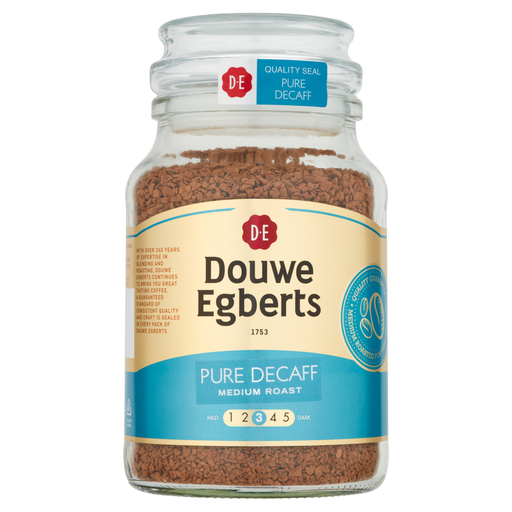
This instant decaf coffee is an option to consider if you would rather prepare a chilled movie-night drink than buy a liquid concentrate. Check its pack directions for the mixing method before planning drinks for guests.
 No image available
The product description presents this decaf instant coffee as intended to be enjoyed chilled. Check the pack directions for how to prepare it with cold liquid before choosing it for several iced drinks; if traditional cold-brew production matters to you, confirm that separately on the label.
No. Decaf does not mean caffeine-free, and the designation does not tell you how much caffeine is in a particular prepared glass. If an exact amount matters, seek information for the specific product.
A liquid decaf concentrate lets you measure and mix drinks without brewing coffee during the film. Tesco Groceries states that its Nescafé concentrate makes 16 glasses using 30ml per drink, while its own-label concentrate makes 10 servings using 50ml per drink; compare those recipes with your guest numbers and preferred mixers.
Not necessarily. The Tesco Groceries listings describe the Nescafé and Tesco products as decaf coffee concentrates, without establishing a traditional cold-brewing process. If that method is important to you, check for an explicit claim on the current label or in the manufacturer’s information.
Tesco Groceries says to refrigerate the Nescafé concentrate after opening and consume it within 14 days; its own-label Decaff Coffee Concentrate has a stated period of 4 weeks refrigerated. Follow the directions on the pack you buy.
Check the current coffee packaging and the label of every milk or other mixer you add. This lets you assess the ingredients and allergen information for the finished drink rather than relying on the coffee listing alone.