Managers running a self-service lunch station
An instant jar lets people make coffee with hot water without a brewer or capsule system. Check the jar size, serving instructions and where it will be kept between uses.


Choose an everyday soluble decaf jar if the lunch station needs a larger shared jar and straightforward hot-water preparation. A freeze-dried jar keeps the instant-coffee workflow but offers a different, manufacturer-described flavour profile; neither format is a guarantee of zero caffeine, and any milk or other additions need their own allergen information.
An instant jar lets people make coffee with hot water without a brewer or capsule system. Check the jar size, serving instructions and where it will be kept between uses.
Make the decaf option easy to identify, but do not label it caffeine-free. Keep the pack information available for anyone who needs to check the particular coffee.
Freeze-dried and micro-ground decaf offer alternatives within instant coffee. Compare each product’s description and preparation instructions rather than assuming the formats taste alike.
Start with the equipment at the lunch station, then choose a jar size and cup style that work for the people using it.
| Priority | What to check | Your needs |
|---|---|---|
| Quick preparation | Choose an instant coffee intended for hot-water preparation. Follow the specific jar’s serving instructions; NESCAFÉ gives a one-teaspoon and 200ml-water basis for Original Decaf and Gold Blend Decaf. | I want different people to make a cup during lunch without using brewing equipment. |
| Jar size | Match the pack to how the station is stocked and used. NESCAFÉ lists Original Decaf in 100g, 190g and 300g jars, while its Gold Blend Decaf comes in 95g and 190g jars. | A larger shared jar may be useful if staff regularly prepare coffee from the same station. |
| Cup character | Compare product descriptions without treating them as a taste test. NESCAFÉ describes Gold Blend Decaf as freeze-dried; Ocado lists M&S Fairtrade Gold Decaf as a medium-roast, 100% Arabica freeze-dried coffee and M&S Decaf Americano as an instant coffee blended with finely ground roast coffee. | I would like a different coffee style, but still need an instant option for the canteen. |
| Caffeine information | Keep the coffee’s own pack information available. The description ‘decaffeinated’ does not mean that every trace of caffeine has been removed. | People choosing decaf should be able to distinguish it from a caffeine-free drink. |
| Additions | Check ingredient and allergen information for the coffee and for milk, plant drinks, cream or flavourings offered alongside it. The Food Standards Agency’s catering guidance covers allergen information for food and drink. | I need people using the station to find information about what they add to their coffee, not just the jar itself. |
Someone avoiding caffeine entirely could misunderstand the station label. The rules for describing relevant coffee products as decaffeinated in England allow residual caffeine.
Label the option as decaf, keep its pack information available and avoid making a zero-caffeine promise.
Beans, ground coffee and coffee bags are not direct replacements for an instant jar at a hot-water-only station. Tesco’s decaf catalogue lists Taylors products in those formats separately from instant coffees.
Check the preparation method before ordering. If the canteen relies on jars and hot water, choose a product whose instructions fit that setup.
A brewing format also brings equipment, cleaning or additional preparation into the lunch-service routine.
Milk and other additions have their own ingredients, so the coffee jar alone cannot describe the finished drink. Food Standards Agency guidance addresses allergen information in catering.
Keep information for each addition accessible at the station and make containers clear to people serving themselves.
These product examples show which formats to look for; a brand’s presence here does not mean every product it makes is an instant decaf jar.
Original Decaf and Gold Blend Decaf provide two instant-jar options with different product descriptions.
Tesco’s decaf catalogue identifies own-label instant-coffee options.
A branded decaf option to consider if a refill format also works for the canteen.
Its listed decaf instant coffees include a freeze-dried glass jar and a separate micro-ground blend.
Relevant when the canteen is considering brewed decaf as well as instant coffee.
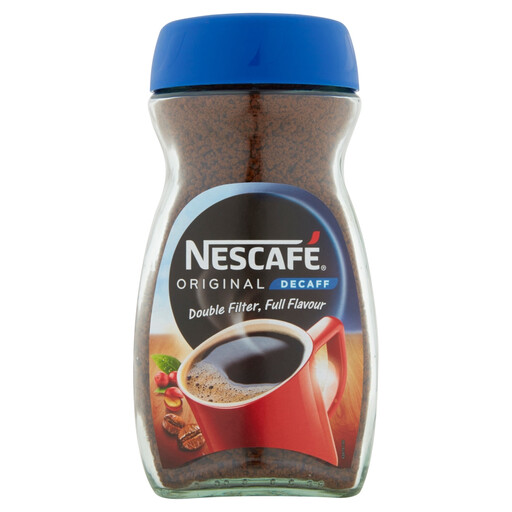
These instant decaf options fit a workplace hot-water station: one freeze-dried Gold Blend jar and two soluble decaf jars in different sizes.
 No image available
This freeze-dried instant option keeps the hot-water workflow for a canteen considering a different cup style. NESCAFÉ’s Gold Blend Decaf instructions give one teaspoon with 200ml hot water as a starting point; decaf does not guarantee zero caffeine.
 No image available
The 300g soluble-coffee jar suits a station seeking a larger shared pack. NESCAFÉ states a serving basis of one 1.8g teaspoon with 200ml water for Original Decaf; do not describe the coffee as caffeine-free.
 No image available
This 200g soluble decaf jar is another option for a hot-water canteen station. Check its own pack instructions before setting a shared serving measure, and label it decaf rather than caffeine-free.
No. ‘Decaffeinated’ does not guarantee zero caffeine. The Coffee Extracts and Chicory Extracts (England) Regulations 2000 set a residual-caffeine limit for relevant coffee products described as decaffeinated in England, so keep the particular product’s information available rather than promising a caffeine-free drink.
Use the instructions on the chosen product as the station’s starting point. NESCAFÉ specifies one 1.8g teaspoon with 200ml water for Original Decaf and one teaspoon with 200ml hot water for Gold Blend Decaf; the M&S Fairtrade Gold Decaf listing calls for one teaspoon with hot, not boiling, water.
Check both the coffee and anything offered with it, including milk, plant drinks and flavourings. Food Standards Agency guidance addresses allergen information for food and drink in catering, so information about additions should be accessible to people using the station.