Gift buyers who know her usual coffee
If she already favours a bold or a smoother-tasting instant coffee, its familiar flavour description is a useful starting point for choosing decaf.


Choose a decaf instant-coffee jar that fits how she normally drinks coffee: a familiar bold profile, a smoother description or particular sourcing credentials may matter more to her than an intensity number. Check that the gift is a jar rather than a refill or brewed-coffee format, and read the exact label if caffeine intake or allergens affect the choice.
If she already favours a bold or a smoother-tasting instant coffee, its familiar flavour description is a useful starting point for choosing decaf.
A decaf jar can fit the same preparation routine as instant coffee, but decaf should not be mistaken for caffeine-free coffee.
Compare the stated pack weights and preparation guidance with how often the recipient makes coffee. Check that the product is a jar, not a refill intended for an existing container.
Start with her usual coffee format and flavour, then check the exact product label for any dietary considerations.
| Priority | What to check | Your needs |
|---|---|---|
| Flavour | Compare the product’s stated flavour and roast with her usual coffee. NESCAFÉ explains that intensity numbers describe flavour characteristics, not caffeine content. | I want a decaf jar whose flavour description sounds like the coffee she already enjoys, rather than choosing by an intensity number alone. |
| Caffeine | Read the exact product’s caffeine information. NESCAFÉ explains that decaf retains some caffeine; Food Standards Scotland advises a 200 mg daily limit from all sources during pregnancy. | If caffeine intake matters to her, I need to consider her other sources of caffeine too, rather than assuming a decaf label settles the question. |
| Format and size | Confirm that it is instant coffee in a jar, and check the net weight. Kenco’s 150 g paper refill is intended to be decanted into a jar; ground coffee and beans need brewing equipment. | The gift should be ready for her usual instant-coffee routine, without relying on a spare jar or different brewing equipment. |
| Ingredients and allergens | Read the label of the exact variant. M&S marks its Decaf Americano Micro-Ground Instant Coffee as unsuitable for people with a milk allergy; do not transfer that warning to a different M&S jar. | Where an allergy or dietary restriction matters, I need to check the particular product I am giving her. |
Decaf still contains some caffeine, according to NESCAFÉ. That distinction matters when the recipient monitors caffeine from coffee and other drinks or foods.
Describe the gift as decaf, not caffeine-free. If she follows an individual caffeine limit, let her own professional guidance inform the choice.
An intensity number is a flavour clue, not a measure of how much caffeine a decaf coffee contains, as NESCAFÉ explains.
Match the stated flavour to her usual preference and check the product’s decaf information separately.
Kenco’s paper refill is intended for an existing jar, while ground coffee and beans require brewing equipment. Neither is the same gift as a ready-to-use instant jar.
Check whether she uses instant coffee and whether the pack is a jar before choosing it.
A refill needs a suitable container; ground coffee or beans need appropriate brewing equipment.
These product-line descriptions can help narrow the flavour and format, but they do not predict which coffee she will prefer.
Original Decaf and Gold Decaf offer different stated flavour profiles within the brand’s instant-decaf range.
Tesco describes the 190 g Decaf Instant Coffee jar as freeze-dried, smooth and balanced, with a stated intensity of 7.
M&S describes its Gold Decaf 200 g jar as freeze-dried coffee made from medium-roasted Arabica beans harvested from Fairtrade farms.
Tesco lists Decaff Gold Instant Coffee and Decaffeinated Classic Coffee as two distinct 200 g own-label jars.
Tesco lists Taylors decaf beans and ground coffee as brewed-coffee formats, not instant-coffee jars.
These options are relevant to an instant-decaf gift for a home coffee routine. Compare the named variant and pack weight, and confirm the container format on the listing if giving a jar is important.
 No image available
Consider this 300 g NESCAFÉ Original Decaff option if she already chooses that coffee line. Confirm the container format and read the current label if she monitors caffeine.
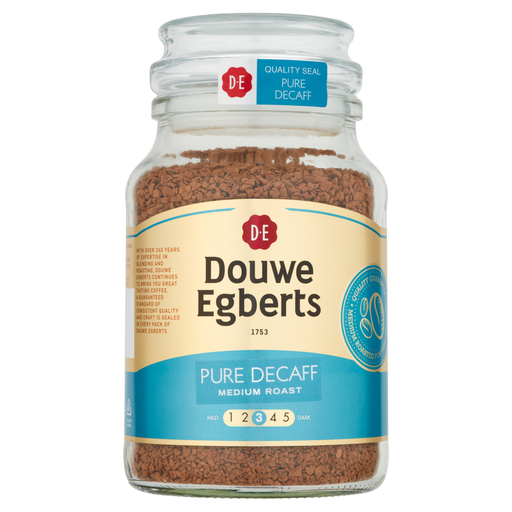 No image available
This 190 g instant-decaf option is worth considering if she uses instant coffee. Confirm the container format and check the current label for caffeine information if that affects the gift.
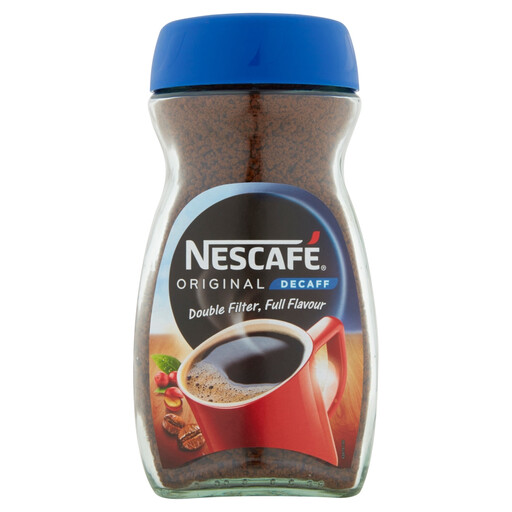 No image available
This 200 g NESCAFÉ Decaf variant may appeal if she usually chooses the brand. Check the listed format and flavour description rather than assuming it is identical to NESCAFÉ Original Decaff.
 No image available
Consider this 190 g Gold Blend Decaf option if she already likes that NESCAFÉ line. Check the container format and current label; the Gold Blend name does not establish her flavour preference.
No. NESCAFÉ explains that decaf has most of its caffeine removed but retains some. Do not treat a decaf label as a promise of zero caffeine.
Do not choose on the word “decaf” alone. Food Standards Scotland advises a 200 mg daily caffeine limit during pregnancy, counting caffeine from all sources. The recipient’s clinician or midwife can advise on individual circumstances.
No. NESCAFÉ explains that intensity numbers generally describe flavour and roast characteristics, not caffeine content. Use the number as a flavour clue and check decaf information separately.
No. Kenco describes its 150 g paper refill as intended for decanting into an existing glass jar. If the recipient needs a ready-to-use jar, check the pack format before buying.
Yes, especially if the recipient has an allergy or dietary restriction. M&S marks its Decaf Americano Micro-Ground Instant Coffee as unsuitable for people with a milk allergy; read the label of the exact product you choose.