What should you check before choosing?
Start with caffeine and ingredient requirements, then narrow the jars by preparation, stated coffee style and likely household use.
| Priority | What to check | Your needs |
|---|
| Caffeine |
Check that the exact product is labelled decaf. Do not treat decaf as zero caffeine; account for caffeine from other foods and drinks. |
I want to reduce caffeine from coffee while keeping track of my total intake. NHS guidance recommends no more than 200mg a day while breastfeeding. |
| Preparation and size |
Check the preparation directions and jar size. Kenco lists 95g and 190g Decaf jars; NESCAFÉ lists 100g, 190g and 300g Original Decaf jars. |
For a quick cup at home, I want a straightforward preparation method and a size that fits how often we will use it. |
| Coffee style |
Compare each maker’s description rather than treating intensity ratings as a cross-brand taste score. Kenco describes its Decaf as medium roast with an intensity rating of 7; M&S describes Gold Decaf as medium-roasted arabica. |
I have a flavour preference, but a description on the jar cannot tell me which coffee I will prefer. |
| Exact variant |
Read the ingredients, allergen statement and storage directions on the product you buy. M&S marks its Decaf Americano Micro-Ground product as not suitable for people with a milk allergy. |
Someone in my household needs me to check the particular variant, not assume every decaf product from one brand has the same ingredients. |
Decaf coffee options on Joybuy
These NESCAFÉ decaf options offer 300g and 200g sizes to consider for a new-parent household. Check the exact variant and pack directions before choosing.
 No image available
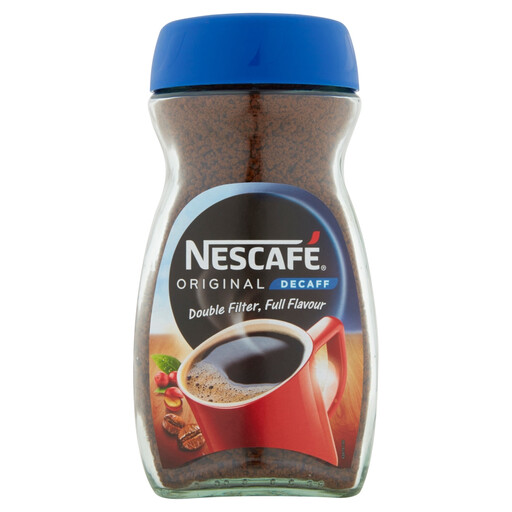
NESCAFÉ Original Decaff Coffee 300g
Consider the 300g size if your household makes decaf regularly. The product is described as decaffeinated soluble coffee, with cool, dry storage directions. If you are counting caffeine, check the pack rather than assuming decaf contains none.
View on Joybuy
 No image available
NESCAFÉ Decaf (New Shape) 200g
The 200g size gives a household another amount to consider. Check this variant’s preparation directions and stated flavour style if either affects your choice; do not assume that decaf means caffeine-free.
View on Joybuy
Questions about decaf jars
Is decaf coffee completely caffeine-free?
No. Decaffeination removes most caffeine rather than necessarily all of it. If you need to avoid caffeine, check the exact product label and ask your clinician or pharmacist for individual advice.
How does decaf fit with caffeine guidance while breastfeeding?
Decaf can reduce caffeine from coffee, but it still needs to be considered alongside other sources. NHS guidance recommends no more than 200mg of caffeine a day while breastfeeding, counting caffeine from foods and drinks.
What if I am still pregnant?
NHS pregnancy guidance says not to have more than 200mg of caffeine a day. Decaf may reduce caffeine from coffee, but account for other sources and check the product you use.
Are all M&S decaf instant coffees suitable for someone with a milk allergy?
Do not assume they have the same allergen suitability. M&S marks its Decaf Americano Micro-Ground Instant Coffee as not suitable for people with a milk allergy; read the label of the exact product you intend to buy.
How should I store an opened decaf jar?
Follow the directions on the jar. Joybuy’s NESCAFÉ Original Decaff 300g product information specifies a cool, dry place; check the pack’s best-before information as well.


