Choose sealed ready-to-drink decaf coffee if guests need individual chilled servings without mixing. A concentrate suits a self-serve station when you can provide cups, ice and a choice of mixers; brewing and chilling your own decaf coffee adds preparation but lets you choose what goes into each drink. Check ingredients and storage instructions for every option, and do not treat ‘decaf’ as a guarantee of zero caffeine.
Who is each format for?
Hosts serving guests with different dietary needs
Choose how to offer dairy and plant-based drinks, then keep the packs available so guests can check ingredients for themselves. A dairy-free latte can still contain an ingredient a particular guest avoids.
Hosts handing out individual drinks
Sealed ready-to-drink decaf packs avoid measuring and mixing during the party. Check each drink’s ingredients and instructions for serving and storing it.
Hosts running a self-serve station
A decaf concentrate allows guests to choose their mixer if you can supply cups, ice and separately labelled dairy and plant-based options.
What should you check before buying?
Decide how much preparation you can manage, then check the exact drink and ingredients you plan to serve.
| Priority | What to check | Your needs |
|---|
| Serving format |
For individual servings, compare sealed ready-to-drink packs. For a station, check the concentrate’s mixing directions, plus the cups, ice and mixers required. |
‘I need to hand out drinks quickly’ points towards individual packs. ‘Guests can mix their own’ makes a concentrate worth considering. |
| Number of serves |
Tesco gives a method of 30ml Nescafé decaf concentrate with 150ml semi-skimmed milk and says its 500ml bottle makes 16 glasses by that method. Plan mixers as well as coffee; another recipe may yield a different number of drinks. |
‘I’m serving a group’ means counting finished drinks, rather than treating a bottle of concentrate as ready-to-serve coffee. |
| Ingredients |
Tesco lists milk in Arctic Coffee Decaf Café Latte. Sainsbury’s describes Nolo’s oat cold-brew latte as dairy-free. Check the current pack and keep ingredient information with each serving choice. |
‘Some guests avoid milk, while others need to check oat’ calls for clearly identified options, not one latte for everyone. |
| Decaf wording |
Check that the exact product is labelled decaffeinated. In England, legislation.gov.uk sets a residual-caffeine limit for coffee extracts described as decaffeinated; that limit is not a caffeine figure per finished drink. |
‘A guest needs to avoid caffeine completely’ means I cannot assume a decaf coffee contains none. |
| Preparation and storage |
If brewing your own coffee, allow time and equipment to make and chill it. For ready-to-drink products, follow the pack’s serving and opened-pack storage instructions. |
‘I have little help on the day’ favours fewer preparation steps; ‘I can prepare drinks beforehand’ leaves a homemade option open. |
Street-party serving mistakes to avoid
-
Calling decaf caffeine-free
Decaffeinated coffee is not a promise of zero caffeine. The limit in England’s rules for decaffeinated coffee extracts concerns residual caffeine in coffee-based dry matter, not the amount in every prepared cold drink.
Keep the product label available for guests to inspect. If someone requires a caffeine-free drink, do not present decaf coffee as that option.
-
Offering only a dairy latte
Tesco lists milk in Arctic Coffee’s decaf latte, while Sainsbury’s describes Nolo’s oat latte as dairy-free. Neither description establishes suitability for every guest.
Check ingredients on the final packs, label serving choices clearly and keep utensils separate where needed to manage allergens.
-
Counting concentrate as finished drinks
Tesco’s 16-glass method for Nescafé decaf concentrate uses 30ml concentrate and 150ml semi-skimmed milk per glass. The coffee bottle alone does not provide the finished servings.
Plan the cups, ice and quantity of each mixer alongside the concentrate, and identify dairy and plant-based mixers separately.
-
Assuming every cold brew is decaf
Cold brewing does not establish caffeine content. Coffee Friend lists a Sandows cold brew with 40.5mg caffeine per 100ml, so that product is not a decaf choice.
Check the wording on the exact product you intend to serve rather than relying on its format or brand.
Relevant brands and products
Nescafé
Tesco lists its Espresso Concentrated Decaf as a mixing option for chilled individual glasses or a self-serve station.
- Tesco’s stated method makes 16 glasses from a 500ml bottle when mixed at 30ml concentrate to 150ml semi-skimmed milk.
- The stated method needs a mixer, ice and cups; its serving count should not be applied unchanged to a different recipe.
Arctic Coffee
Its 330ml decaf café latte is an individual ready-to-drink format listed by Tesco.
- A sealed latte avoids mixing coffee and milk during serving.
- Tesco’s ingredient list includes milk, so guests avoiding milk need another choice.
Nolo
Sainsbury’s lists a 250ml decaf cold-brew oat latte described as plant-based and dairy-free.
- The ready-to-drink oat format does not require a separate plant-milk jug.
- It contains oat, which guests should consider when checking ingredients.
M&S
M&S lists a decaf ground coffee for hosts choosing to brew coffee themselves.
- The listed ground coffee is described by M&S as made from 100% Arabica beans.
- Ground coffee requires brewing and chilling before it can be served cold.
Waitrose
Waitrose lists Taylors of Harrogate Decaffé Ground Coffee as another brew-and-chill option.
- Waitrose describes the coffee as 100% Arabica and water-decaffeinated.
- It is ground coffee, not a sealed ready-to-drink cold brew.
Sandows
The Sandows cold brew listed by Coffee Friend is a regular-caffeine reference, not a decaf serving option.
- Coffee Friend gives its caffeine content as 40.5mg per 100ml; do not use that product as the party’s decaf choice.
Joybuy coffee options
This Joybuy option is decaf instant coffee for preparing a chilled drink yourself. It is not a sealed ready-to-drink cold brew or an iced-coffee concentrate.
 No image available
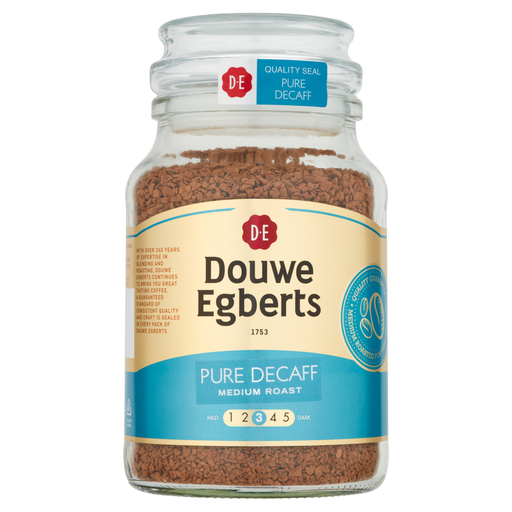
Douwe Egberts Pure Decaffeinated Instant Coffee 190g
An instant-coffee option if you plan to prepare chilled decaf drinks rather than hand out sealed packs. The listing describes it as 100% freeze-dried decaffeinated coffee intended for chilled serving. Check the pack’s preparation directions before planning quantities for a group; it is not a cold-brew product.
View on Joybuy
Questions about serving decaf coffee
Is decaf cold brew caffeine-free?
No: ‘decaf’ does not establish that a finished drink contains zero caffeine. In England, legislation.gov.uk sets a residual-caffeine limit for coffee extracts described as decaffeinated, measured against coffee-based dry matter rather than per prepared serving. Do not rely on the decaf label if a guest needs to avoid caffeine completely.
Is concentrate or ready-to-drink decaf easier to serve?
Sealed ready-to-drink packs involve fewer mixing steps when handing out individual drinks. A concentrate allows guests to choose a mixer, but it needs cups, ice and enough mixer for the planned servings; Tesco’s 16-glass Nescafé method uses 150ml semi-skimmed milk with each 30ml measure of concentrate.
Will a dairy-free oat latte suit every guest avoiding dairy?
Not necessarily. Sainsbury’s describes Nolo’s decaf cold-brew oat latte as dairy-free, but it contains oat. Keep the current pack available so guests can check its ingredients against their own requirements.
Can regular Sandows cold brew be the decaf choice?
No. Coffee Friend lists a Sandows cold brew containing 40.5mg caffeine per 100ml. Choose a product specifically labelled decaffeinated for the decaf offering.


