Choose pods for the canteen’s installed machine before choosing a drink: the Dolce Gusto, Tassimo and Nespresso-labelled decaf products in Tesco’s UK listing are distinct formats. For lunch service, decide whether you need a milk-containing café au lait, an Americano-style drink or an espresso-style base, then check the exact pack’s compatibility and allergen information. Decaf can still contain caffeine, as the British Coffee Association explains.
Who needs to make this choice?
Canteen managers with a pod machine
Start with the installed system and its exact model. Tesco’s UK decaf-pod listing distinguishes Dolce Gusto, Tassimo and Nespresso-labelled products; a familiar coffee brand alone does not establish that its pods fit your machine.
Teams serving both milk and black coffee
A milk-containing café au lait calls for different ingredient checks from an Americano- or espresso-style choice. Nescafé describes its Dolce Gusto Café Au Lait as made with milk, so staff need the current pack information when answering allergen questions.
Workplaces offering a decaf choice
Label the offer accurately for people choosing to reduce caffeine. The British Coffee Association says decaffeination leaves a small amount of caffeine; the word ‘decaf’ should not be presented as a promise of none.
What should the canteen check?
Settle the machine format first, then choose the drink and check the information staff will need at service.
| Priority |
What to check |
Your needs |
| Machine fit |
Record the installed machine’s system and model. Match both to the compatibility statement for the exact pod; Tesco lists Dolce Gusto, Tassimo and Nespresso-labelled decaf products separately. |
I need pods that staff can use in the machine already in the canteen, rather than choosing by coffee brand alone. |
| Drink style and milk |
Decide whether the service calls for a milk-containing drink or a black-coffee option. Nescafé says its Dolce Gusto Café Au Lait contains milk; check the current ingredients and allergen statement for every proposed product. |
We want to distinguish a café au lait from an Americano- or espresso-style choice, and answer ingredient questions before serving. |
| Caffeine description |
Check how the exact product describes its caffeine content. The British Coffee Association states that decaf coffee retains a small amount of caffeine; do not equate ‘decaf’ with ‘caffeine-free’. |
Someone choosing to reduce caffeine should be able to understand what the canteen is offering without being promised a caffeine-free drink. |
| Service format |
Check the stated number of pods or servings and the drink-preparation instructions. If there is no matching pod machine, consider a format suited to the available equipment: Kenco describes a decaf instant option, while Tesco lists Taylors decaf ground coffee and beans. |
Our lunch-service routine needs a coffee format that works with the equipment and the number of drinks we plan to prepare. |
Mistakes to avoid
-
Choosing by brand instead of pod system
Tesco’s UK listing includes decaf products labelled for different systems, and Nescafé specifies a Dolce Gusto machine for its Café Au Lait pods. A brand name cannot establish compatibility with the canteen’s equipment.
Record the machine system and model, then require the exact proposed pack’s compatibility information before ordering.
-
Calling decaf caffeine-free
The British Coffee Association says a small amount of caffeine remains after decaffeination. A caffeine-free description would therefore misrepresent an ordinary decaf offer.
Call the drink decaf, and use a caffeine-free description only if the exact product information supports it.
-
Relying on an old allergen description
Nescafé says its Dolce Gusto Café Au Lait contains milk. Food Standards Scotland states that food businesses must provide consumers with allergen information for prepacked and non-prepacked food and drink.
Keep the current pack or supplier specification accessible at service and make sure staff know how to answer allergen questions. Check any replacement product afresh.
Relevant brands and ranges
These references help distinguish pod systems from other decaf formats; a brand’s inclusion does not mean every product it makes uses the same format.
Nescafé
A reference for canteens considering a milk-containing decaf drink with a Dolce Gusto machine.
- Nescafé says its Dolce Gusto Café Au Lait is made with milk and prepared in a Dolce Gusto machine.
- Check the current allergen information; this product’s instructions do not establish compatibility with other pod systems.
Kenco
A name appearing across different decaf formats, rather than a single pod system.
- Tesco lists Tassimo Kenco Americano Decaff pods. Kenco also describes its Decaf coffee as instant and its Millicano Decaff as instant coffee blended with finely milled beans.
- Check the format of the specific Kenco product; its instant ranges are not pods.
Taylors of Harrogate
A decaf reference for workplaces using equipment for ground coffee or beans.
- Tesco lists Taylors decaf ground coffee and coffee beans.
- Those listed formats are not substitutes for pods in a capsule machine.
Tesco
Its UK listings illustrate the distinction between decaf pod systems and other coffee formats.
- Its decaf-pod listing identifies Starbucks by Nespresso, Nescafé Dolce Gusto and Tassimo Kenco products separately.
- A retail listing does not establish which format fits a particular canteen machine; check the proposed product and installed equipment.
Decaf pod options on Joybuy
These are decaf pod options for a canteen considering portioned coffee service. The Nescafé pack names Dolce Gusto; confirm the pod system for the Morrisons pack before treating it as a fit for an installed machine.
 No image available
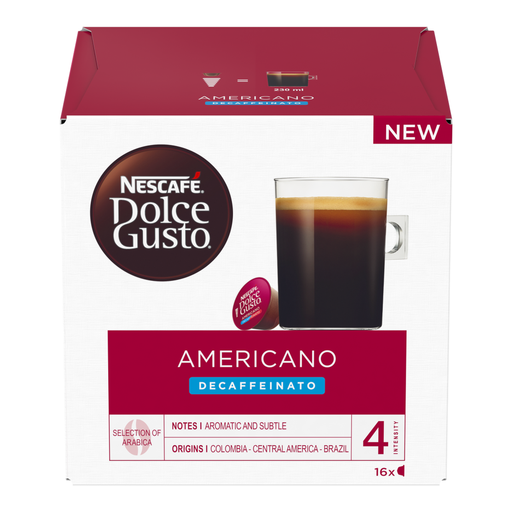
Nescafé Dolce Gusto Americano Decaf, 16 capsules, 128 g
An Americano-style decaf option for a canteen with a compatible Dolce Gusto machine. Confirm the installed model before ordering, and check the current pack’s allergen information before service. Do not describe the drink as caffeine-free.
View on Joybuy
 No image available
Morrisons The Best Fairtrade Decaf Pods, 54 g
A decaf pod option to assess against the canteen’s machine. Confirm its compatible pod system and servings per pack before planning lunch service, and use the current pack for ingredient and allergen information.
View on Joybuy
Frequently asked questions
Will any decaf pod work in the canteen’s machine?
No. Match the exact pod format to the installed system and machine model. Nescafé specifies a Dolce Gusto machine for its Café Au Lait pods, while Tesco separately labels Tassimo Kenco and Starbucks by Nespresso decaf products.
Is decaf coffee caffeine-free?
No. The British Coffee Association says a small amount of caffeine remains after decaffeination. Describe an ordinary decaf pod drink as decaf, not caffeine-free, unless the exact product information supports that further claim.
Does a canteen need allergen information for pod drinks?
Yes. Food Standards Scotland states that food businesses must provide allergen information to consumers for prepacked and non-prepacked food and drink. Keep the current product information available at service, particularly for a milk-containing pod such as Nescafé Dolce Gusto Café Au Lait.
What should staff check before serving a milk-based decaf pod?
Check the current pack or supplier specification for ingredients and allergens, and make that information accessible to staff. Nescafé describes its Dolce Gusto Café Au Lait as made with milk, so do not assume it is suitable for someone avoiding milk.
What if the workplace has no compatible pod machine?
Choose a decaf format suited to the equipment instead of ordering incompatible capsules. Kenco describes decaf instant coffee prepared with hot water, while Tesco lists Taylors decaf ground coffee and beans for consideration with suitable brewing equipment.


