Shops with self-service drinks
Individually wrapped sticks make each instant-coffee portion easy to hand out and count. Check the case quantity and weight per stick before using them to plan replenishment.


Choose individually wrapped decaf sticks when self-service and counting portions matter, but check any advertised 240-count box before ordering: Universal Product Solutions and JD Catering Equipment list Nescafé Gold Blend Decaf cases containing 200 sticks. An instant jar suits staff-made drinks if servings can be measured consistently; coffee bags or ground coffee need a brewing routine and different storage arrangements.
Individually wrapped sticks make each instant-coffee portion easy to hand out and count. Check the case quantity and weight per stick before using them to plan replenishment.
An instant jar suits drinks made by staff who can measure each serving. The number of drinks depends on the measure used, rather than a fixed portion count on the jar.
Coffee bags or ground coffee are options where staff have time and equipment to brew them. Check preparation and post-opening storage directions for the chosen product.
Choose the serving format first, then check whether its pack size and preparation instructions fit the number of drinks you plan to make.
Choose when: Drinks are self-served or each instant-coffee portion needs to be counted.
Trade-off: Each serving has its own wrapper, and a 200-stick case does not meet a requirement for 240 portions.
Choose when: Staff prepare drinks and can use a consistent serving measure.
Trade-off: A jar has no fixed count of individually packed servings; yield depends on the product’s preparation basis and the amount used.
Choose when: The shop can accommodate brewing rather than instant preparation.
Trade-off: Preparation takes additional steps, and ground coffee may have specific post-opening storage directions.
| Priority | What to check | Your needs |
|---|---|---|
| Portion control | Check whether servings are individually wrapped. Compare both the stick count and grams per stick: Universal Product Solutions lists Nescafé Gold Blend Decaf at 200 × 1 g, while JD Catering Equipment lists 200 × 1.8 g. | I need portions that customers or staff can take without measuring coffee, and that I can count when replenishing the drinks point. |
| Required quantity | Confirm the outer-case count and the contents of each portion. A 200-stick case or a 10-bag retail pack should not be counted as 240 drinks. | If my restock plan calls for 240 portions, I need the supplier’s exact case description before placing the order. |
| Preparation | Check who will make the drink and what equipment they can use. Tesco gives Kenco Decaff a 1.6 g serving basis for its cup count; Nescafé gives Gold Decaf a one-teaspoon, 1.8 g recipe with 200 ml water. | Staff can measure coffee from a jar, or I may need a format customers can prepare without a shared measure. |
| Pack information | Check the delivered variant’s ingredients, allergen information, best-before date and storage directions. GOV.UK says prepacked food needs mandatory label information that is accurate and not misleading. | I need the information displayed to customers and used for stock rotation to match the packs actually delivered. |
Universal Product Solutions and JD Catering Equipment list 200-count Nescafé decaf stick cases. Substituting one without checking could leave a 240-portion replenishment plan short.
Check the supplier’s case count, individual portion count and grams per stick, then check the outer carton on receipt.
A jar’s drink count depends on the serving measure; a stick case declares a number of portions, but stick weights can differ.
Use the preparation basis for each exact product when estimating drinks. If comparing displayed business prices, check whether each uses the same VAT basis.
A listing may not describe the exact variant received. GOV.UK says mandatory information on prepacked-food labels must be accurate and not misleading.
Check the delivered pack’s ingredients, allergen information, quantity, best-before date and storage directions before updating customer information or stocking it for use.
A product page does not by itself establish that the exact pack can be ordered when the shop needs it.
Confirm the variant and availability when ordering, and identify another suitable replenishment route if supply timing matters.
A reference for both instant jars and individually portioned decaf sticks.
A jar option for staff-prepared instant decaf.
A coffee-bag or ground-coffee reference where brewing is practical.
A grocery reference for comparing own-label and branded instant decaf formats.
A grocery reference for comparing decaf instant coffee, coffee bags and ground coffee.
A reference for shops considering the product descriptions of instant and ground decaf.
These decaf jars are options for staff-made instant drinks. Measure servings and check the exact pack if the shop’s replenishment plan calls for 240 individually counted portions.
 Image unavailable
A 190 g instant-coffee option for staff-made decaf drinks, rather than individually counted portions. Nescafé’s Gold Decaf preparation guidance uses one teaspoon (1.8 g) with 200 ml water; check the directions on the delivered variant when estimating servings.
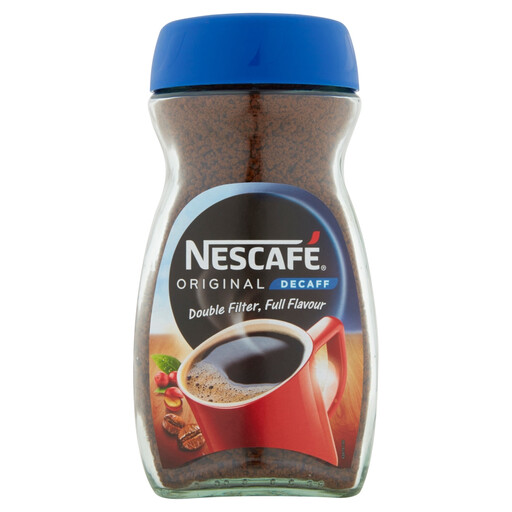 Image unavailable
A 200 g decaf option for drinks prepared by staff, not a box of individually counted portions. Check this variant’s preparation directions to estimate servings rather than applying the measure from a different Nescafé product.
No; check the exact supplier description and delivered carton before counting it as 240 servings. Universal Product Solutions and JD Catering Equipment list decaf stick cases containing 200 portions, with different weights per stick, while Sainsbury’s lists a Taylors coffee-bag pack containing 10 bags.
Choose sticks when individual, countable instant-coffee portions matter for self-service; choose a jar when staff can measure each drink. For yield estimates, use the particular product’s directions: Tesco bases Kenco Decaff’s cup count on 1.6 g, whereas Nescafé gives Gold Decaf a 1.8 g teaspoon recipe.
Check the exact variant, quantity or portion count, current ingredients and allergen information, best-before date and storage directions on the delivered pack. GOV.UK says prepacked food requires mandatory label information that is accurate and not misleading; an older online description should not replace the pack label.
Follow each product’s own storage directions rather than using one rule for every format. M&S instructs buyers to keep its Colombian ground decaf, once opened, in an airtight container for up to two weeks in the refrigerator or four weeks in the freezer; that instruction should not be transferred to an instant jar.