Hosts keeping preparation simple
A ready-to-drink decaf cold-brew oat latte avoids brewing and measuring. Sainsbury’s lists Nolo in a 250 ml can; check that oat is suitable for everyone being served.


For an afternoon tea where decaf and minimal preparation matter, a chilled ready-to-drink decaf cold brew is the closest fit: Sainsbury’s lists the Nolo oat latte in a single-serve can, although it contains oat and its listed flavour needs checking on the can. Nescafé’s decaf iced-coffee concentrate gives guests a choice of milk but needs mixing and refrigerated storage after opening. Decaf ground coffee offers a make-ahead alternative if you can brew and chill it; it is not a ready-to-drink cold brew.
For afternoon tea, the useful distinction is whether you want a drink to serve chilled, a base to mix for each guest or coffee you can prepare ahead.
A ready-to-drink decaf cold-brew oat latte avoids brewing and measuring. Sainsbury’s lists Nolo in a 250 ml can; check that oat is suitable for everyone being served.
A decaf concentrate lets you make drinks individually. Sainsbury’s and Tesco describe Nescafé’s concentrate as a base to mix with a chosen milk or plant-based alternative and ice.
Choose a product explicitly labelled decaffeinated rather than relying on the words “cold brew”. Coffee Friend UK lists 40.5 mg caffeine per 100 ml for its Sandows ready-to-drink cold brew, so that listing does not meet a decaf request.
Start with the decaf label and the drink format, then check the ingredients and whether the opened pack suits the number of servings you expect to make.
| Priority | What to check | Your needs |
|---|---|---|
| Decaf status | Look for “decaffeinated” on the particular product. Cold brew describes how coffee is prepared, not whether it is decaf. | Someone has requested decaf, so I do not want to substitute an ordinary cold brew. Coffee Friend UK lists 40.5 mg caffeine per 100 ml for its Sandows cold brew. |
| Preparation | Check whether the drink is ready to serve chilled, needs mixing with ice and milk, or requires brewing and cooling. For Nescafé concentrate, Sainsbury’s gives a serving guide of 30 ml concentrate with 150 ml semi-skimmed milk. | I would rather open a can than prepare each drink; alternatively, I have time to mix drinks for guests or make coffee ahead. |
| Ingredients | Check the finished drink as well as the coffee base. Sainsbury’s identifies oat in the Nolo latte; with Nescafé concentrate, the host supplies the milk or alternative. | Guests want different milks, or I need to check whether oat is suitable before serving a ready-mixed latte. |
| Opened-pack use | Sainsbury’s says to refrigerate an opened Nolo can and consume it within 24 hours. Its Nescafé concentrate listing says to refrigerate the opened bottle and consume it within 14 days. | If I am making just one drink, a single-serve can may be simpler. For several teas, I can consider whether I will use a bottle within its stated storage period. |
| Home brewing | Allow time to brew and chill decaf ground coffee. Waitrose recommends a cafetière or filter for Taylors Decaffé; neither that product nor M&S decaf ground coffee is a ready-to-drink cold brew. | I can prepare coffee before guests arrive and would prefer to add milk separately, if at all. |
A cold-brew label alone does not establish caffeine status. Coffee Friend UK lists caffeine for its Sandows cold brew, while the Sainsbury’s Nolo and Nescafé listings explicitly describe their products as decaffeinated.
Check the specific product label for “decaffeinated” before serving it to someone who has asked for decaf.
Sainsbury’s describes the Nolo latte as dairy-free, but its listing also identifies oat. Those are separate considerations when checking what a guest can have.
Check the can’s ingredients with the guest. If milk choice needs to vary, consider a decaf concentrate mixed separately for each person.
The Nescafé serving guide published by Sainsbury’s uses 30 ml concentrate and 150 ml semi-skimmed milk. A drink made with another milk or a different portion is not the same prepared serving.
When comparing nutrition labels, check the stated serving size and whether the figures include milk.
Sainsbury’s states that the 500 ml Nescafé bottle makes 16 servings using its suggested measure and must be refrigerated and consumed within 14 days after opening.
For an occasional single drink, compare that opened-pack period with a single-serve option before choosing a bottle.
These named products cover different formats; a brand name alone does not tell you whether a particular coffee is decaf or ready to serve cold.
Sainsbury’s lists a 250 ml ready-to-drink decaf cold-brew oat latte for chilled serving.
Sainsbury’s and Tesco list an iced decaf coffee concentrate for mixing, rather than a ready-to-drink cold brew.
Waitrose lists Decaffé ground coffee as a decaf option for hosts willing to brew coffee and chill it.
M&S describes its 227 g Decaf Ground Coffee as 100% Arabica, offering another coffee to prepare before serving chilled.
The Sandows cold brew listed by Coffee Friend UK is ready to drink but is not presented there as a decaf option.
These Joybuy options are decaf instant and ground coffees for a drink you prepare yourself. Neither is a ready-to-drink decaf cold brew.
 No image available
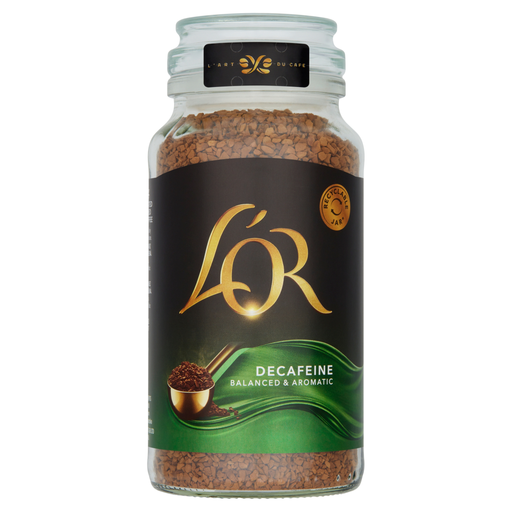
This 150 g freeze-dried instant coffee is a decaf option if you want to prepare a chilled drink without brewing ground coffee. It is not cold brew; check the pack’s preparation directions for the cold drink you plan to make.
 No image available
This 200 g ground coffee suits a host who can brew coffee ahead and chill it for afternoon tea. Its listing identifies 100% Arabica coffee and water decaffeination. It is not ready to drink; check the pack’s preparation directions before making a cold serving.
Do not assume it means zero caffeine. The Nolo and Nescafé products described by Sainsbury’s are labelled decaffeinated, but that label is not a promise that every finished drink contains none. If someone needs to avoid caffeine completely, check the specific product information with them rather than relying on the format or name alone.
A ready-to-drink decaf cold brew avoids brewing or mixing. Sainsbury’s says to chill and shake the Nolo oat latte; check that oat is suitable for the guest and refrigerate and consume the can within 24 hours once opened.
A decaf concentrate lets you mix each glass separately. Sainsbury’s and Tesco describe Nescafé Iced Decaf Concentrated Espresso for use with milk or plant-based alternatives; its stated guide starts with 30 ml concentrate per glass.
Follow the instructions for the particular pack. Sainsbury’s says to refrigerate an opened Nolo can and consume it within 24 hours, and to refrigerate opened Nescafé concentrate and consume it within 14 days. M&S advises keeping its opened decaf ground coffee airtight for up to two weeks in the refrigerator or four weeks in the freezer.
No, not when the guest has requested decaf: Coffee Friend UK lists 40.5 mg caffeine per 100 ml for that Sandows ready-to-drink cold brew. Choose a product explicitly labelled decaffeinated instead.