Hosts serving brewed coffee
If you are making coffee for several guests, start with ground decaf labelled for your filter machine or cafetière. Check your brewer’s instructions before deciding how much to prepare.


For an afternoon tea party, choose ground decaf whose directions match your filter machine or cafetière, then consider the roast and flavour notes alongside the food you plan to serve. Decaffeinated coffee can still contain caffeine, so have a caffeine-free drink available for guests who need one.
If you are making coffee for several guests, start with ground decaf labelled for your filter machine or cafetière. Check your brewer’s instructions before deciding how much to prepare.
Decaf gives guests an alternative to standard coffee later in the day. It is not necessarily caffeine-free, so keep another drink option available when avoiding caffeine matters.
If origin, bean composition or certification matters to you, check the individual pack for those details. They describe the coffee you are buying but do not, by themselves, tell you how it will taste.
Choose the right coffee format for your equipment first; flavour, caffeine information and pack size then help narrow the options for your gathering.
| Priority | What to check | Your needs |
|---|---|---|
| Brewing method | Look for ground coffee and directions naming your filter machine or cafetière. Do not assume instant coffee or capsules will suit the same equipment. | I want to use the brewer I already have and serve coffee prepared the same way for everyone. |
| Flavour and roast | Compare the pack’s roast, strength and flavour descriptions. A stated bean blend identifies its composition, not a quality ranking. | Alongside cakes and sandwiches, I would choose between the coffees’ stated flavour profiles rather than assume all decaf tastes alike. |
| Residual caffeine | Check the caffeine statement on the particular pack if it matters to a guest. Sainsbury’s declares less than 0.1% caffeine by weight for its Colombian Decaff; that is not a claim that all decaf is caffeine-free. | Some guests want decaf, while anyone who needs to avoid caffeine altogether should have another suitable drink choice. |
| Pack size and storage | Choose a pack size with the gathering and likely leftovers in mind. Follow that product’s directions for closing and storing opened coffee. | For a small party, I would check how much my brewer uses before opening more ground coffee than I expect to use. |
Instant coffee is prepared differently from ground coffee in a filter machine or cafetière. Sainsbury’s lists Douwe Egberts Pure Decaf as instant coffee, so the word “decaf” alone does not establish the format.
Check that the pack says ground coffee and gives directions for your brewer.
Decaffeinated does not necessarily mean caffeine-free. Sainsbury’s declares residual caffeine of less than 0.1% by weight for its Colombian Decaff.
Describe what you are serving as decaf, and offer a caffeine-free alternative when a guest needs to avoid caffeine.
Storage instructions matter after the party. M&S advises transferring its opened ground coffee to an airtight container and gives different use periods for refrigerated and frozen storage.
Plan the quantity using your brewer’s directions, then follow the storage advice on the pack you opened.
These examples illustrate differences in brewing directions, stated flavour and coffee format; they do not imply that every product from a brand is suitable for a filter machine.
Lavazza lists its ground Decaf for filter, French press and moka preparation.
Waitrose describes Taylors Decaffé Ground Coffee as suitable for a cafetière or filter.
Tesco lists its Finest Decaffeinated Colombian Ground Coffee for filter machines, cafetières, moka pots and percolators.
Sainsbury’s Taste the Difference Colombian Decaff provides filter-machine directions and is presented as a strength-3, Fairtrade, 100% Arabica coffee.
M&S describes its decaf ground coffee as suitable for a filter or cafetière.
Sainsbury’s lists Douwe Egberts Pure Decaf in an instant-coffee format.
This ground-decaf option is relevant to hosts considering a filter or cafetière brew for afternoon tea. Check its pack directions against your own equipment.
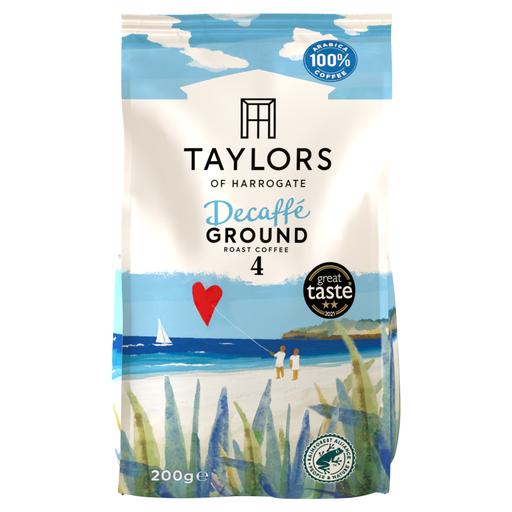 No image available
A ground-decaf option for an afternoon-tea brew. The product description states 100% Arabica coffee and caramel-and-malt notes; check the pack’s brewing directions for your filter machine or cafetière. If a guest needs to monitor caffeine closely, check the pack’s caffeine information rather than assuming decaf means caffeine-free.
Yes, when the particular coffee lists filter preparation. Tesco names filter machines for its Finest Decaffeinated Colombian Ground Coffee, Sainsbury’s provides filter-machine directions for its Colombian Decaff, Lavazza lists filter preparation for its Decaf, and Waitrose describes Taylors Decaffé as suitable for filter or cafetière.
No. Sainsbury’s states that its Colombian Decaff contains less than 0.1% caffeine by weight. Check the declaration on the coffee you serve, and provide another drink for anyone who needs to avoid caffeine.
Base the amount on your cafetière’s capacity and the coffee pack’s preparation directions, then scale it to the number of guests who want coffee. This also helps you decide how much of a pack to open.
Follow the instructions on the pack you opened. M&S advises an airtight container for its ground decaf and specifies use within two weeks when refrigerated or four weeks when frozen.