Filter-machine breakfast hosts
If you are brewing several cups, look for decaf ground coffee with explicit filter-machine guidance rather than assuming any decaf format will work in the brewer.


For a continental breakfast served from a filter machine, choose decaffeinated ground coffee with filter preparation stated on the pack or product page. Let the stated flavour profile guide your choice of cup, and keep instant coffee or coffee bags for individual servings rather than treating them as filter-pot coffee.
If you are brewing several cups, look for decaf ground coffee with explicit filter-machine guidance rather than assuming any decaf format will work in the brewer.
Descriptions such as delicate or smooth can help you choose a breakfast flavour. They describe the cup, not its caffeine content.
A coffee bag or instant decaf can make one cup without preparing a filter pot. Both require a different method from filter brewing.
Start with the brewing method, then choose the flavour and serving format that fit your breakfast table.
| Priority | What to check | Your needs |
|---|---|---|
| Brewing method | Look for filter-machine instructions if brewing a pot. For a cafetière, check the product’s grind suitability and its own recipe. | I’m serving several cups, so I need ground decaf that suits the brewer on the breakfast table. |
| Flavour | Compare stated intensity and tasting notes. Lavazza UK lists its Decaf ground coffee at intensity 3/10 and suitable for filter, French press and moka preparation; intensity is not a caffeine measure. | A delicate cup may suit my preference, or I may want the smoother caramel and malt notes Taylors describes for its Decaffé ground coffee. |
| Decaf label | Read the exact product’s caffeine declaration where the amount matters. Sainsbury’s states that its Italian Decaf R&G contains less than 0.1% caffeine by weight; that figure does not describe other decaf products. | I want to know what the pack says about caffeine, rather than taking “decaf” to mean none is present. |
| Individual cups | Check whether the product is filter-ground coffee, a coffee bag or instant coffee. The Taylors coffee bags listed by Sainsbury’s are individually wrapped and have a four-minute mug-brewing instruction. | For one guest, a separate cup may be easier than making a pot, provided I am happy with a different brewing method. |
Ground coffee, instant coffee and coffee bags are prepared differently. An instant product or mug-brewing bag will not serve as ground coffee for a filter machine.
For a breakfast pot, check for filter preparation on the ground-coffee pack. Consider the other formats for individual cups.
An intensity rating or tasting note describes a stated flavour profile; it does not tell you the product’s residual caffeine content.
Use flavour descriptions to choose the cup you prefer, and consult the exact label for caffeine information.
Sainsbury’s declares less than 0.1% caffeine by weight for its Italian Decaf R&G. That product-specific declaration is not a zero-caffeine claim.
Check the label of the coffee you intend to buy if its caffeine declaration matters to you.
These examples show how preparation guidance and product format differ; a brand name alone does not establish whether a particular pack suits a filter machine.
Lavazza’s Decaf ground coffee is a route to consider if you use more than one brewer.
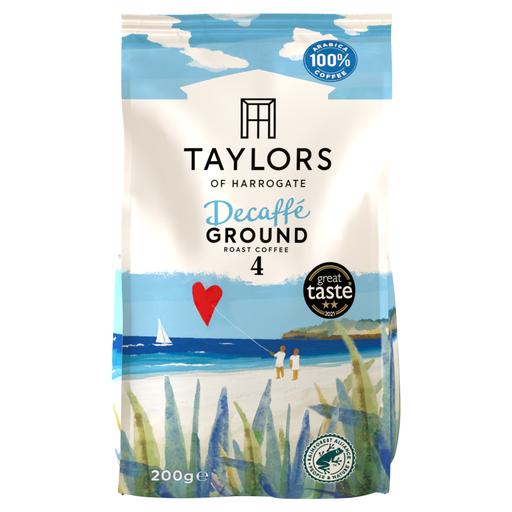
Taylors describes its Decaffé ground coffee with smooth caramel and malt flavours; its coffee bags offer a separate, single-cup format.
Sainsbury’s Italian Decaf R&G provides product-specific directions for a filter machine and cafetière.
M&S describes its decaf ground coffee as suitable for a filter or cafetière.
The Pure Decaffeinated product described by Tesco is freeze-dried instant coffee for an individual cup.
Tesco lists decaf ground coffees from several brands alongside its own Tesco Finest Decaffeinated Colombian Ground Coffee.
This ground-decaf option is relevant if you prefer a smooth breakfast cup. Check the current pack’s brewing directions before planning to use it for a filter pot.
 No image available
For a rounded breakfast cup, Taylors describes its Decaffé ground coffee as smooth, with caramel and malt notes. This 200g product is described as 100% Arabica; check the pack’s filter-machine directions before buying it for a pot.
Instant decaf can make an individual cup, but it is not ground coffee for a filter machine. If you want to brew the main breakfast pot, choose ground decaf with filter preparation stated on its pack or product page.
For its Italian Decaf R&G, Sainsbury’s instructs users to add one tablespoon of coffee to 200 ml of off-the-boil water and wait three to five minutes before plunging. Follow the directions on a different product’s pack rather than applying this recipe to every grind.
No zero-caffeine assumption follows from the word “decaf”. Sainsbury’s declares less than 0.1% caffeine by weight for its Italian Decaf R&G; check the declaration on the exact product you intend to buy.
Follow the instructions for your pack. For its Decaf Ground Coffee, M&S advises an airtight container for up to two weeks in the refrigerator or up to four weeks in the freezer after opening.
Coffee bags suit an individual cup when you do not want to prepare a filter pot. The Taylors bags listed by Sainsbury’s are individually wrapped and brewed in a mug for four minutes; they use a different method from filter-machine ground coffee.