Weekday filter-coffee drinkers
You make breakfast coffee in a filter machine or cafetière and want decaf ground coffee, not an instant drink. The preparation directions matter more than the word “decaf” alone.


For a weekday breakfast made in a filter machine or cafetière, choose decaf ground coffee with preparation directions for that brewer, rather than assuming an instant decaf will do the same job. Then compare the roast and flavour descriptions, check the exact pack if a stated residual-caffeine level matters, and consider how you will store it after opening.
You make breakfast coffee in a filter machine or cafetière and want decaf ground coffee, not an instant drink. The preparation directions matter more than the word “decaf” alone.
You buy coffee for repeated weekday use and want to choose a pack size you can store and use according to its instructions.
You would rather choose from stated roast and flavour descriptions than treat every decaf ground coffee as interchangeable. Those descriptions are useful starting points, not a guarantee of how a cup will taste to you.
Start with the coffee format and your brewer; use the product-specific label details to narrow the choice.
| Priority | What to check | Your needs |
|---|---|---|
| Brewing format | Look for ground coffee and directions naming a filter machine or cafetière. Check the instructions for the brewer you use. | I make coffee with a filter machine or cafetière at breakfast, so an instant decaf jar is a different preparation choice. |
| Caffeine declaration | Read the statement on the exact product. Sainsbury's lists caffeine content below 0.1% by weight for its Italian Decaf R&G and Taste the Difference Colombian Decaff; that figure does not describe every decaf. | If a stated residual-caffeine figure matters to me, I want to check the current pack rather than rely on “decaf” as an exact measurement. |
| Roast and flavour | Compare the named blend and flavour descriptors. Lavazza lists its Decaf at intensity 3/10; Taylors describes Decaffé with caramel-and-malt flavours. | I want a breakfast coffee whose stated roast and flavour direction appeals to me, while recognising that brand descriptions are not independent taste tests. |
| Pack and storage | Check the pack weight and its own after-opening instructions. Marks & Spencer specifies airtight storage for its Decaf Ground Coffee for two weeks in the refrigerator or four weeks in the freezer. | A pack that fits my weekday routine is useful only if I can follow its storage directions after opening. |
Tesco describes Douwe Egberts Pure Decaff as freeze-dried instant coffee. It is not the same format as ground coffee prepared in a filter machine or cafetière.
Before choosing, look for “ground coffee” and preparation directions that name your brewer.
Sainsbury's gives a below-0.1%-by-weight caffeine declaration for its Italian Decaf R&G and Colombian Decaff products. That product-specific statement should not be applied to other packs.
If you need a stated figure, read the declaration on the exact pack you intend to use.
Preparation and storage instructions belong to the particular product. For example, Marks & Spencer gives after-opening storage directions for its own Decaf Ground Coffee, not for all ground decaf.
Check the current pack for its ingredients, brewing directions, caffeine statement and storage instructions.
Lavazza UK lists a 250g Decaf ground coffee for filter, moka and French press preparation, with intensity 3/10.
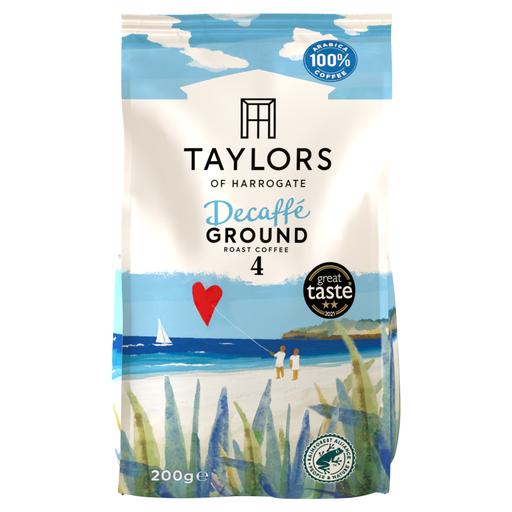
Sainsbury's lists Taylors Decaffé as a 200g, 100% Arabica ground coffee for filter or cafetière use. Taylors describes its flavours as caramel and malt.
Its Italian Decaf R&G and Taste the Difference Colombian Decaff listings give filter-machine directions and state caffeine content below 0.1% by weight.
Marks & Spencer describes its ground decaf as suitable for a filter or cafetière and provides after-opening storage directions for its Decaf Ground Coffee.
Tesco identifies Pure Decaff as freeze-dried decaffeinated instant coffee, a different route from ground filter coffee.
Tesco is a retailer reference here: its listings identify ground Lavazza decaf and instant Douwe Egberts decaf as different formats.
This Taylors ground decaf is an option to consider for a weekday breakfast made with a filter machine or cafetière; check the current pack directions for your brewer.
 No image available
A ground decaf to consider for a filter-machine or cafetière breakfast. Taylors describes its Decaffé coffee with caramel-and-malt flavours; check this pack's preparation directions for your brewer and its label if a stated caffeine figure matters to you.
Choose ground coffee with preparation directions naming a filter machine. Sainsbury's Italian Decaf R&G and Colombian Decaff give filter-machine directions, while Sainsbury's describes Taylors Decaffé as suitable for filter or cafetière use. Check the directions on the pack you buy.
Do not treat “decaf” as a statement of zero caffeine. Sainsbury's states caffeine content below 0.1% by weight for its Italian Decaf R&G and Colombian Decaff; check the exact product label if a stated level is important to you.
Instant decaf is a different preparation choice, not ground coffee for a filter machine. Tesco identifies Douwe Egberts Pure Decaff as freeze-dried instant coffee; choose ground coffee with directions for your brewer if you want a filter or cafetière brew.
Follow the directions for your particular pack. Marks & Spencer says its Decaf Ground Coffee should be kept in an airtight container for two weeks in the refrigerator or four weeks in the freezer after opening; do not assume those timings apply to another product.