Desk workers with a filter machine or cafetière
If you want brewed decaf at lunch, start with preparation guidance that names your equipment. Then compare the bean composition and described flavour of coffees that meet that requirement.


For a desk filter machine, choose ground decaf whose pack or product page specifically mentions filter brewing; a roast name or intensity number cannot establish that it will suit the machine. Instant decaf is quicker to prepare but is a different format, while coffee bags need their own preparation guidance rather than being treated as filter-machine coffee. Among ground options, check the stated brewing method, bean composition and pack size against what matters for your lunch routine.
If you want brewed decaf at lunch, start with preparation guidance that names your equipment. Then compare the bean composition and described flavour of coffees that meet that requirement.
Look for an explicit decaf label and any product-specific residual-caffeine statement. Intensity, dark-roast and Italian-style descriptions do not provide that information.
Check that the coffee suits your brewing method, then consider the pack size and its instructions for storage after opening.
Start with the format and brewing instructions: a decaf product is not necessarily ground coffee for a filter machine. Once those match your setup, the label and pack details can help narrow the choice.
| Priority | What to check | Your needs |
|---|---|---|
| Brewing method | Check whether the pack names filter-machine brewing, a dripper or a cafetière. Follow its preparation directions rather than relying on a roast description. | I have a particular brewer at my desk and want ground decaf intended for that method, not an instant coffee or another format. |
| Decaf labelling | Look for an explicit decaf or decaffeinated label and, if relevant, a product-specific caffeine statement. Sainsbury's states less than 0.1% caffeine by weight for its Italian Decaf R&G. | If residual caffeine matters to me, I want information about the particular coffee rather than treating an intensity number as a caffeine measure. |
| Bean profile | Check whether the product states 100% Arabica or an Arabica-and-Robusta blend. Read flavour notes as descriptions of that product, not as a standard measure across brands. | I may prefer an Arabica-only coffee, or I may want to consider a blend; either way, I still need to confirm it suits my brewer. |
| Pack and storage | Check the pack size and its instructions for resealing and storing the coffee after opening. Follow the directions for the product you choose. | For occasional desk lunches, I want a pack I can use within its stated storage guidance. |
Decaf ranges include instant coffee, beans, pods, bags and ground coffee. The word ‘decaf’ does not tell you how to prepare the product.
For a filter machine, look for ground coffee with filter-brewing guidance; check the separate directions if considering a coffee bag instead.
A flavour description or brand intensity scale does not replace a decaf label. Intensity numbers are not a universal measure of caffeine content.
Choose a product explicitly labelled decaf or decaffeinated, and check for a specific residual-caffeine statement if you need one.
Ground coffee needs storing after opening, and the directions differ between products.
Choose a pack size that fits how often you make desk coffee, then reseal and store it according to its own instructions.
These references cover particular decaf products and retailer listings; a brand name alone does not establish that every product in its range suits filter brewing.
Its Italian Decaf R&G 227g is a ground-coffee option described for filter machines and cafetières.
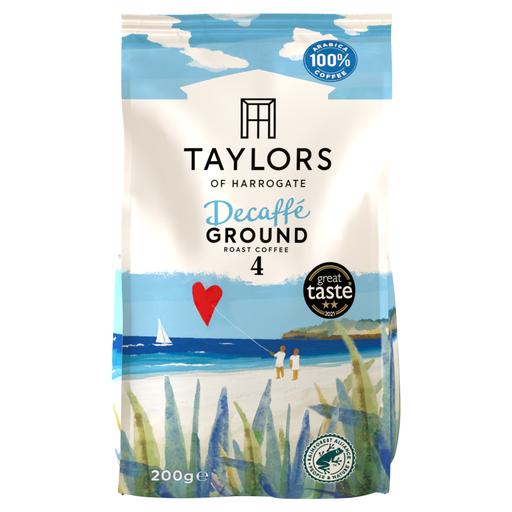
Decaffé Roast is a ground decaf described for filter or cafetière preparation.
Lavazza Decaf Ground Coffee is an Arabica-and-Robusta blend for shoppers considering filter, moka or French-press preparation.
M&S describes its Decaf Ground Coffee as a 100% Arabica, Fairtrade product.
Tesco's ground-coffee category lists decaf products from Lavazza and Taylors of Harrogate.
Pure Decaf appears in Sainsbury's decaf range as instant coffee.
This Taylors ground decaf option is relevant if you have a filter machine or cafetière at your desk and want an Arabica-only coffee.
 No image available
A ground decaf option for a desk filter machine or cafetière; check the pack's brewing directions for your setup. The 200g product is described as 100% Arabica, with a natural-water decaffeination method and caramel and malt notes.
Choose ground decaf with preparation guidance that specifically mentions filter brewing. Sainsbury's Italian Decaf R&G has filter-machine instructions, Taylors describes Decaffé Roast for filter or cafetière use, and Lavazza lists filter preparation for its Decaf Ground Coffee. Instant decaf is a different format.
Do not assume that a decaf label means zero caffeine. Sainsbury's states that its Italian Decaf R&G contains less than 0.1% caffeine by weight; check the information for the particular product if residual caffeine matters to you.
No. An intensity number describes a product within a brand's own range, not its caffeine content on a standard scale. Look for explicit decaf labelling and any product-specific caffeine statement instead.
Follow the directions on the pack you buy. Taylors advises sealing its pack with a clip and keeping it in a cool, dry place, while M&S gives different storage instructions for its Decaf Ground Coffee; neither set of directions applies automatically to every brand.