Coffee commuters cutting down on caffeine
If you usually have coffee on the way to work but want a tea-leaf drink instead, look for green tea explicitly labelled decaffeinated. Check what hot water you can use during your commute or at work.


Choose a product labelled decaffeinated green tea if you want to keep drinking green tea while cutting down on caffeine across your coffee-and-tea routine; decaf does not mean caffeine-free. If avoiding caffeine matters more than green-tea flavour, consider a herbal infusion labelled caffeine-free instead, and check its ingredients because it is a different drink.
If you usually have coffee on the way to work but want a tea-leaf drink instead, look for green tea explicitly labelled decaffeinated. Check what hot water you can use during your commute or at work.
If you want to keep the flavour of green tea later in the day, choose a decaffeinated green-tea product rather than assuming ordinary green tea is decaf.
If a drink labelled naturally caffeine-free matters more to you than green-tea flavour, a herbal infusion is another route. Check the ingredients: it is not decaffeinated green tea.
Decide whether you want green tea or a herbal infusion first, then check the pack against how and where you will make it.
| Priority | What to check | Your needs |
|---|---|---|
| Caffeine labelling | Look for “decaffeinated green tea” rather than plain green tea. Do not read “decaffeinated” as “caffeine-free”; check serving information if you need a specific caffeine figure. | I want to cut down on caffeine without mistaking an ordinary green tea for a decaf one. Food Standards Scotland and the Food Standards Agency advise considering caffeine from coffee and tea alongside other sources, including energy drinks and supplements. |
| Drink type and flavour | Read the ingredient list to distinguish green tea from a herbal blend. Check for added flavourings if you want a plain green-tea cup; Clipper says decaffeination can affect flavour. | Keeping a green-tea flavour matters to me, so a herbal infusion would be a change of drink, even if its label says caffeine-free. |
| Preparation | Check the pack’s water and infusion instructions and whether hot water will be available where you plan to drink it. Clipper advises cooling boiled water for a minute and infusing its decaf green tea for 1–3 minutes. | At work, I need a way to make the tea with the hot water and time available to me. |
| Pack size | Check the bag count against how often you expect to make a cup. The documented decaf green-tea packs contain 20 Twinings bags, 40 Clipper bags or 50 Tetley bags. | If I make tea on most workdays, I want a pack size that fits that routine; if the flavour is new to me, I may prefer fewer bags. |
Green tea naturally contains caffeine, as Twinings explains for its regular green tea. A pack labelled only “green tea” does not establish that it has been decaffeinated.
Look for “decaffeinated green tea” on the pack and check that green tea is the ingredient base.
Decaffeinated green tea and herbal infusions labelled naturally caffeine-free are different product types. The distinction matters if you are choosing a drink on the basis of its caffeine labelling.
Choose the label that matches your requirement, and check the ingredients before substituting one drink for the other.
Pukka describes its caffeine-free range as herbal teas. Their ingredient base differs from green tea, so the flavour will depend on the particular blend.
Decide whether green-tea flavour or a caffeine-free herbal label matters more, then read the ingredients of the pack you are considering.
Twinings lists Pure Green Decaffeinated in a 20-bag pack.
Clipper lists a 40-bag Organic & Fairtrade Decaf Green Tea made with decaffeinated organically grown green tea.
Tesco lists Tetley Green Tea Decaffeinated as a 50-bag, 100 g pack.
Pukka describes a range of naturally caffeine-free herbal teas, offering a different drink type from decaffeinated green tea.
This tea-bag option is for commuters who want decaffeinated green tea and have access to hot water when they make a cup.
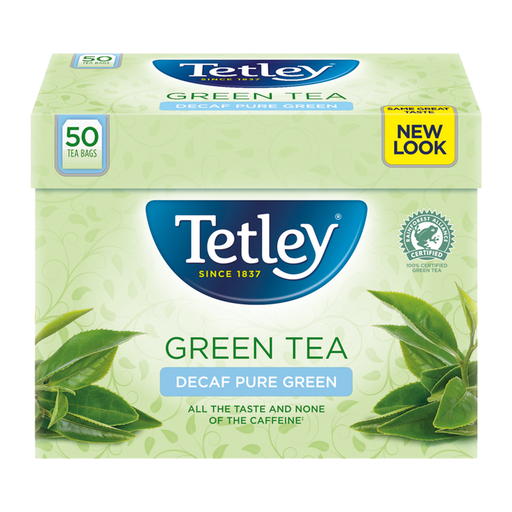 Image unavailable
The tea-bag format suits making a cup at work if hot water is available. Tesco lists this Tetley product as 100% decaffeinated green tea in a 50-bag, 100 g pack and uses the wording “decaffeinated to 0.2%”. Check the pack if you need a caffeine amount per prepared cup.
No. Decaffeinated green tea is made from green-tea leaves, while Pukka describes its caffeine-free range as herbal teas. Read the pack wording and ingredients rather than using “decaf” and “caffeine-free” interchangeably.
It can take the place of a coffee as a hot drink if you have a way to make it, but the swap alone does not establish your total caffeine intake. Food Standards Scotland and the Food Standards Agency advise counting caffeine from coffee and tea alongside other sources, including energy drinks and supplements.
Choose according to how many cups you expect to make and whether you already know you like the tea. The documented decaf green-tea packs contain 20 Twinings bags, 40 Clipper bags or 50 Tetley bags; a smaller pack means fewer cups to commit to when trying a new flavour.
Follow the instructions on the pack you buy. For its decaf green tea, Clipper advises letting boiled water cool for a minute before infusing the bag for 1–3 minutes; other products may give different directions.