Cream-tea hosts reducing caffeine
Decaf green tea offers a green-tea option alongside scones, cream and jam when you want to reduce, rather than necessarily eliminate, caffeine.


Choose decaf green tea for a cream tea if you want green-tea flavour while reducing caffeine; decaffeinated tea can still contain traces, as Twinings notes. If caffeine must be avoided, check the ingredients of a naturally caffeine-free infusion instead. For guests who prefer a fuller-bodied tea, consider decaf black tea as a separate option.
Decaf green tea offers a green-tea option alongside scones, cream and jam when you want to reduce, rather than necessarily eliminate, caffeine.
If green-tea flavour matters to you, choose a product explicitly labelled decaffeinated. Twinings notes that decaffeinated tea can retain traces of caffeine, so it is distinct from a caffeine-free infusion.
Some named decaf green teas list a single tea ingredient. Check the exact pack if organically grown tea or a Fairtrade claim matters to you; Clipper makes those statements for its Organic & Fairtrade Decaf Green Tea.
Start with whether reducing caffeine meets your needs, then choose the tea style and check the ingredients and preparation directions on the specific pack.
| Priority | What to check | Your needs |
|---|---|---|
| Caffeine | Look for an explicit decaffeinated label. Twinings says traces can remain in decaf tea; Tesco Groceries lists Tetley Green Tea Decaffeinated as decaffeinated to 0.2%. | I want green tea with less caffeine. If I need to avoid caffeine instead, I’ll check the ingredients of a naturally caffeine-free infusion, including for mate or guarana. |
| Tea style | Check whether the product is green tea or a herbal or fruit infusion. Twinings describes its Pure Green Decaffeinated as mild and its decaf English Breakfast as having strength and body. | A mild green-tea cup would suit my cream tea; for guests expecting a fuller-bodied tea, I’d consider decaf black tea separately. |
| Ingredients | Read the exact product’s ingredient list and any sourcing claim. Clipper lists decaffeinated organically grown green tea and a Fairtrade statement for its named 40-bag product. | I’d like to know what is in the tea and whether a sourcing claim applies to the pack I’m buying. |
| Brewing | Follow the selected pack’s directions. Clipper advises cooling boiled water for one minute before a 1–3 minute infusion; Tesco Groceries gives different directions for the named Tetley product. | When serving several guests, I want preparation instructions I can follow consistently for each cup. |
| Pack size | Check the bag count against the number of cups you plan to serve. The named Twinings, Clipper and Tetley packs contain 20, 40 and 50 bags respectively. | A smaller pack suits a trial cup; for several guests or repeat use, I’ll check how many bags I need. |
Decaffeination reduces caffeine but does not necessarily remove every trace. Twinings says traces can remain, while Tesco Groceries lists the named Tetley green tea as decaffeinated to 0.2%.
If lower caffeine is your aim, check for a decaf label. If caffeine must be avoided, choose an infusion labelled caffeine-free and check its ingredients.
A green-tea range can include products that are not labelled decaffeinated. The Pukka and teapigs UK range pages describe green teas without identifying the displayed products as decaf.
Confirm the full product name and decaffeinated wording on the specific pack before buying.
Directions differ between products: Clipper specifies cooled water and a 1–3 minute infusion for its named decaf green tea, while the Tetley listing advises freshly boiled water and brewing to preferred strength.
Follow the chosen pack’s instructions and make a test cup before serving guests.
Its Organic & Fairtrade Decaf Green Tea is a 40-bag option for buyers checking ingredients and sourcing.
Pure Green Decaffeinated comes in a 20-bag pack and is described by Twinings as mild.
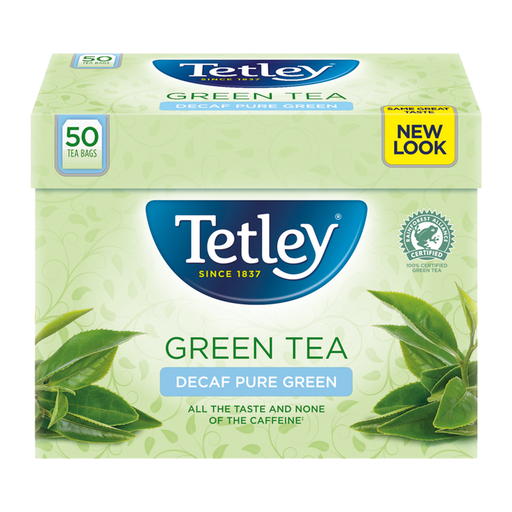
The named Green Tea Decaffeinated pack contains 50 tea bags and is listed by Tesco Groceries as 100% decaffeinated green tea.
Pukka’s UK green-tea range includes matcha blends, but a green-tea range name does not establish that a particular pack is decaf.
teapigs presents green teas and a separate caffeine-free tea category; the product type matters when choosing between them.
This plain decaf green tea is an option when you want green tea for several cream-tea cups while reducing caffeine.
 No image available
The 50-bag pack is an option for serving several cream-tea guests or making repeat cups of decaf green tea.
Tesco Groceries lists the ingredients as 100% decaffeinated green tea and describes the product as decaffeinated to 0.2%. Decaf does not necessarily mean caffeine-free; check the current pack label.
Not necessarily. Twinings says minor traces can remain in decaffeinated tea, and Tesco Groceries lists the named Tetley green tea as decaffeinated to 0.2%. If you need to avoid caffeine, check the ingredients of a naturally caffeine-free infusion instead.
Follow the directions for the product you serve. Clipper advises leaving boiled water to cool for one minute and infusing its named decaf green tea for 1–3 minutes. The named Tetley product instead advises one bag per mug with freshly boiled water, brewed to preferred strength.
Consider decaf black tea as a separate choice if they want a fuller-bodied cup. Twinings describes its Pure Green Decaffeinated as mild and its decaf English Breakfast as having strength and body. Decaf black tea is not necessarily caffeine-free either.
Confirm the exact tea type, ingredients, decaffeination wording, bag count and brewing directions. ASDA advises reading the current label because product information and ingredients can change.