Choose tea explicitly labelled decaffeinated green tea if you want to keep drinking green tea while reducing caffeine. For a weekly shop, compare pack size and where you can buy it: Tesco lists a 50-bag Tetley pack, while Twinings offers 20 bags with a stated caffeine level and Clipper offers a 40-bag organic and Fairtrade option. Decaf can still contain caffeine, so check the label if avoiding it matters to you.
Who is this choice for?
Regular green-tea drinkers
If green tea is a cupboard staple, an explicitly decaffeinated pack lets you keep the same type of tea while reducing caffeine. Bag count and whether the product fits your usual grocery order may matter for repeat purchases.
Shoppers keeping track of caffeine
Decaf and caffeine-free are different labels. Twinings says decaffeinated tea can retain traces of caffeine, so check the product information if you need to account for caffeine across your drinks and food.
Organic and Fairtrade shoppers
If ingredient sourcing influences your choice, look for the specific product’s organic and Fairtrade information rather than assuming those attributes apply to every decaf green tea.
What should you check before buying?
Start with the distinction between decaf green tea and a caffeine-free infusion, then compare the pack and sourcing details that matter for your weekly shop.
| Priority |
What to check |
Your needs |
| Caffeine |
Look for an explicit decaffeinated green-tea label. Check any stated residual caffeine level; Twinings lists 0.02% caffeine for Pure Green Decaffeinated. Decaf does not mean caffeine-free. |
I want to keep drinking green tea but reduce caffeine. If I need to avoid caffeine, I’ll look for a clearly labelled caffeine-free alternative and check its ingredients. |
| Pack size |
Compare bag counts with how often your household drinks tea. Tesco lists Tetley decaf green tea in 50 bags; the Twinings product has 20 bags and the Clipper product has 40. Confirm the item is available for your grocery order. |
A larger pack may suit our regular tea drinking; a smaller one may suit me if I use fewer bags. I want a format I can add to my usual shop. |
| Ingredients and sourcing |
Read the ingredients and product-specific sourcing statements. Clipper lists decaffeinated organically grown green tea and says the tea is traded in compliance with Fairtrade standards. Clipper also says it uses carbon dioxide to decaffeinate its teas. |
Organic ingredients or Fairtrade sourcing matter to me, so I want those details confirmed for the pack I’m choosing. A stated decaffeination method alone does not tell me which flavour I’ll prefer. |
What is easy to overlook?
-
Treating decaf as caffeine-free
Decaffeination reduces caffeine but can leave traces. Twinings describes this distinction for its decaf teas, so the label matters if you are tracking your intake.
Check the exact product’s caffeine information. If you want to avoid caffeine, choose an infusion clearly labelled caffeine-free and check its ingredients too.
-
Assuming every green-tea brand sells a decaf version
A regular green-tea blend is not interchangeable with decaf green tea. Pukka says it does not use decaffeinated green tea, while the teapigs green-tea range describes its teas as containing caffeine.
Check the full product name and ingredients rather than relying on the brand or the words ‘green tea’ alone.
-
Reading sourcing or process details as a flavour promise
Clipper’s organic and Fairtrade information describes its ingredients and sourcing; its carbon-dioxide decaffeination description is the brand’s own process statement. None of those details establishes which tea you will prefer to drink.
Use those attributes if they matter to your purchase, but consider pack size and your own flavour preference separately.
Which brands are relevant?
Tetley
A decaf green-tea option to consider when adding a larger pack to a UK grocery order.
- Tesco lists Tetley Green Tea Decaffeinated as a 50-bag, 100g pack with 100% decaffeinated green tea in the ingredients.
- The Joybuy product information states decaffeination to 0.2%; do not treat the tea as caffeine-free. Check availability for your own order.
Twinings
A smaller pure decaf green-tea pack with a stated product-level caffeine figure.
- Twinings lists 20 bags, 100% decaffeinated green tea and 0.02% caffeine for Pure Green Decaffeinated.
- Its stated caffeine level is not zero. The Twinings product listing does not establish availability in your usual supermarket.
Clipper
A 40-bag decaf green-tea option for shoppers prioritising organic ingredients and Fairtrade sourcing.
- Clipper lists decaffeinated organically grown green tea and says its tea is traded in compliance with Fairtrade standards.
- Clipper says it uses carbon dioxide for its decaf teas; that process statement does not establish a flavour advantage. Check whether the pack fits your grocery order.
Pukka
Relevant when considering an herbal infusion instead of decaf green tea.
- Pukka offers herbal blends for shoppers considering a different type of hot drink.
- Pukka says it does not use decaffeinated green tea. Its Supreme Matcha Green contains green tea and matcha, so check ingredients rather than treating it as a decaf substitute.
teapigs
A green-tea range to consider if regular caffeinated green tea also meets your needs.
- The teapigs green-tea range includes several green-tea blends.
- teapigs describes caffeine in its green-tea range; do not substitute one of those blends for a product explicitly labelled decaf.
Decaf green tea on Joybuy
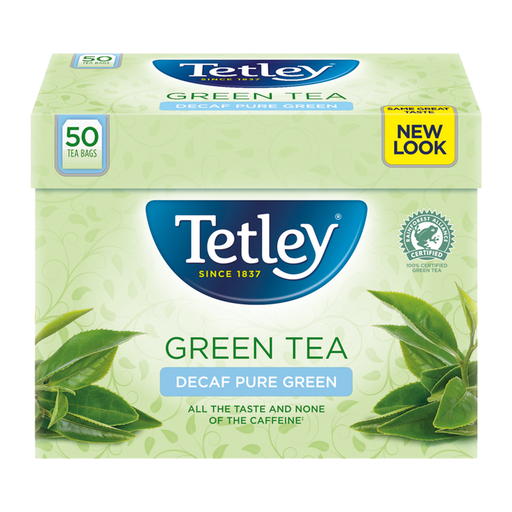
This 50-bag Tetley pack is an option if you want decaf green tea for regular household use. Check its stated caffeine information if trace caffeine matters to you.
 No image available
Tetley Green Tea Decaffeinated, 50 tea bags, 100g
The 50-bag format is worth considering if your household drinks green tea regularly. The ingredients are stated as 100% decaffeinated green tea, and the product information says it is decaffeinated to 0.2%; it is not a caffeine-free choice.
View on Joybuy
Frequently asked questions
Does decaf green tea contain no caffeine?
No. Twinings says decaffeinated tea can retain traces of caffeine and lists its Pure Green Decaffeinated product at 0.02% caffeine. If avoiding caffeine is your aim, look for an infusion clearly labelled caffeine-free and check its ingredients.
Which decaf green tea can I add to a weekly grocery shop?
Tesco lists Tetley Green Tea Decaffeinated in a 50-bag, 100g pack in its UK decaf-green-tea range. Check your own store or delivery basket before relying on it for a repeat order.
How should I brew decaf green tea?
Follow the brewing directions on the pack you buy. Preparation can differ between products, so use the instructions for that particular tea rather than assuming every decaf green tea needs the same infusion time.
Are Pukka or teapigs green teas substitutes for decaf green tea?
Do not assume so. Pukka says it does not use decaffeinated green tea, and teapigs describes caffeine in its green-tea range. Check the exact blend’s ingredients and caffeine labelling before making a substitution.


