Office tea organisers reducing caffeine
Choose a clearly labelled decaffeinated green tea when stocking repeat snack breaks. Check the ingredients and bag count before choosing a pack for the team.


Choose a product explicitly labelled decaffeinated green tea if the office wants green tea while reducing caffeine; decaf tea can still contain traces. If avoiding caffeine takes priority over retaining a green-tea base, check a labelled caffeine-free herbal infusion instead. For shared supplies, compare the ingredients, bag count and brewing directions.
Choose a clearly labelled decaffeinated green tea when stocking repeat snack breaks. Check the ingredients and bag count before choosing a pack for the team.
If you want green tea rather than a herbal infusion, check that the individual pack says decaffeinated. Decaf does not necessarily mean caffeine-free.
If those product declarations matter to your office, check them on the particular decaf green tea you plan to stock rather than assuming they apply across a brand’s range.
Start with the type of tea and its caffeine labelling, then check whether the pack and preparation directions work for shared office use.
| Priority | What to check | Your needs |
|---|---|---|
| Decaf status | Look for “decaffeinated green tea” on the individual product and check its ingredients. If a residual-caffeine figure is stated, read it as a product statement, not a per-cup amount. | I want green tea for office breaks without accidentally choosing an ordinary caffeinated green tea. |
| Tea type | Distinguish decaffeinated green tea from a labelled caffeine-free herbal infusion. Pukka describes its caffeine-free range as herbal teas. | Green-tea character matters to me; I would consider a herbal infusion only if avoiding caffeine mattered more. |
| Pack count | Check the number of bags against how often the office restocks. The identified decaf green tea packs contain 20 Twinings bags, 40 Clipper bags or 50 Tetley bags, according to their respective product listings. | A smaller pack would suit a trial, while a larger pack would suit repeat shared servings. |
| Brewing | Use the directions for the pack you buy. Twinings specifies one bag in 200ml freshly boiled water for 3 minutes; Clipper advises letting boiled water cool for a minute before a 1–3 minute infusion. | Our office kitchen needs directions that people can follow consistently, rather than one method assumed to suit every tea. |
Decaffeinated green tea can retain traces of caffeine. A caffeine-free herbal infusion is a different type of drink, not another name for decaf green tea.
Check the product name and ingredients. If avoiding caffeine is essential, assess a specifically labelled caffeine-free alternative against that requirement.
An ordinary green tea or matcha product does not meet a decaf requirement simply because it appears beside decaf teas in a range.
Read the individual pack’s description and ingredients for an explicit decaffeinated green-tea claim.
Twinings Pure Green Decaffeinated comes in a 20-bag pack, which may suit an office trying a smaller supply.
Clipper offers a 40-bag Organic & Fairtrade Decaf Green Tea for buyers looking for those stated product attributes.
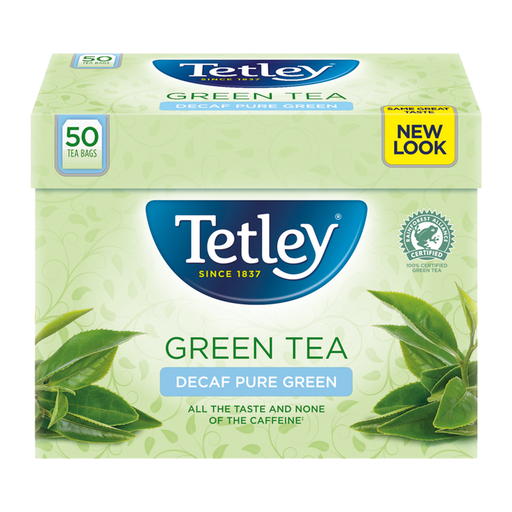
Tesco lists Tetley Green Tea Decaffeinated as a 50-bag, 100g pack for repeat tea breaks.
Decaffeinated green tea bags for stocking shared office tea breaks.
 No image available
The 50-bag pack is an option for repeat shared office servings. Tesco describes this Tetley product as decaffeinated to 0.2%; that does not mean zero caffeine. Follow the pack’s directions when brewing it.
No. Decaffeinated tea can retain traces: Twinings states that its Pure Green Decaffeinated tea is decaffeinated to 0.02% caffeine. Check the individual product if caffeine avoidance is essential, and consider whether a labelled caffeine-free herbal infusion meets your needs instead.
Use the directions for the chosen pack rather than one method for every brand. Twinings specifies one bag in 200ml of freshly boiled water for 3 minutes; Clipper advises letting boiled water cool for a minute, then infusing for 1–3 minutes.
Not without checking the specific product. Pukka describes its caffeine-free range as herbal, while its displayed green-tea range includes matcha blends; teapigs describes its green-tea range in terms of caffeine. Look for an explicit decaffeinated claim on the tea you intend to serve.
Check the product name and ingredients to distinguish decaf green tea from ordinary green tea or a herbal infusion. GOV.UK guidance says prepacked food requires a label displaying mandatory information; keep the pack available so people using the office supply can read its details and preparation directions.