Evening coffee drinkers choosing decaf
If you want coffee after dinner but prefer decaf to regular coffee, look for an explicit caffeine statement when the remaining amount matters to your choice.


For a bedtime coffee when a stated caffeine limit matters, illy’s decaf lists no higher than 0.1% caffeine, while Sainsbury’s Taste the Difference Colombian Decaff lists less than 0.1% by weight; choose between them by your brewer. If brewing method or flavour matters more, Taylors suits a cafetière or filter, while Lavazza and Rombouts name other preparation options. Decaf does not mean caffeine-free.
If you want coffee after dinner but prefer decaf to regular coffee, look for an explicit caffeine statement when the remaining amount matters to your choice.
Choose ground decaf that names your cafetière, filter machine or cone among its preparation methods, rather than assuming every grind suits the same equipment.
Once the coffee suits your brewer, compare the maker’s roast and flavour descriptions. Some products also state how the caffeine was removed.
Start with the caffeine statement if it is decisive for you, then check the named brewing methods and the flavour description. For storage, follow the instructions on the pack you buy.
| Priority | What to check | Your needs |
|---|---|---|
| Stated caffeine content | Check whether the pack gives a residual-caffeine figure and how it is expressed. illy states no higher than 0.1% caffeine; Sainsbury’s Taste the Difference Colombian Decaff states less than 0.1% by weight. | I want a stated limit for the caffeine remaining in my evening coffee, rather than assuming that decaf means none. |
| Brewing method | Match the product’s named methods to your equipment. Lavazza lists moka, filter and French press; Rombouts lists cafetière, filter machine and filter cone; Tesco Finest lists cafetière, filter machine, moka pot and percolator. | My usual brewer should be named on the coffee I choose, whether I use a cafetière, filter machine or moka pot. |
| Flavour and process | Compare roast and flavour descriptions as the makers describe them, not as a taste guarantee. Taylors describes caramel and malt and a water-based decaffeination process; Lavazza describes carbon-dioxide decaffeination. | I would like an evening cup with a flavour profile that appeals to me, and I may want to know how it was decaffeinated. |
| Pack instructions | Read the current label for preparation, storage after opening and the best-before date. Check any caffeine statement on that pack if it is central to your choice. | I want to make the coffee with my usual equipment and store the opened pack as instructed. |
Decaffeinated coffee can still contain residual caffeine, so the word ‘decaf’ does not establish a zero-caffeine drink.
If the remaining amount matters to you, choose a product with a stated limit and check that statement on the current pack.
A flavour description does not tell you whether the ground coffee is intended for your preparation method.
Check the named methods: for example, Lavazza lists moka, filter and French press, while Rombouts lists cafetière, filter machine and filter cone.
Ingredients and storage instructions can change, making the pack important when those details affect your choice.
Read the label on the product you receive, particularly its caffeine statement, ingredients, best-before date and after-opening instructions.
These descriptions refer to specific ground-decaf products, not to every coffee made by each brand. Flavour notes are the makers’ or retailers’ descriptions.
Lavazza’s ground decaf is an option for moka, filter or French press preparation.
illy’s 125g decaffeinated ground coffee is a 100% Arabica option described for Italian espresso preparation.
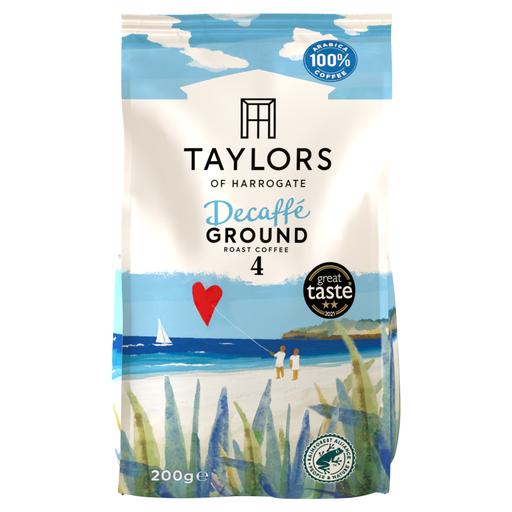
Taylors Decaffé Ground Coffee 200g is listed for cafetière or filter preparation.
Rombouts Decaf Ground Coffee 250g is medium-ground for cafetières, filter machines and filter cones.
Tesco Finest Decaffeinated Colombian Ground Coffee 227g names several preparation methods.
Its Colombian Decaff 227g is a single-origin, Fairtrade, 100% Arabica ground coffee with cafetière and filter-machine instructions.
This ground-decaf option is suited to a cafetière or filter routine. If a stated residual-caffeine limit is your deciding condition, check the current pack before choosing it.
 No image available
For an evening coffee made in a cafetière or filter, the matching 200g product listing names both preparation methods. This 100% Arabica ground decaf is described by Taylors as using a water-based decaffeination process, with caramel-and-malt flavours. Check the current pack if you need a stated residual-caffeine limit.
No. Decaf can retain caffeine: illy states no higher than 0.1% caffeine for its decaffeinated ground coffee, and Sainsbury’s states less than 0.1% by weight for its Taste the Difference Colombian Decaff. Check the current pack if the remaining amount matters to you.
Rombouts names cafetières for its medium-ground decaf; Tesco Finest also lists cafetière use, and Sainsbury’s describes Taylors Decaffé as suited to a cafetière or filter. Choose among them by the other details that matter to you, such as a stated caffeine limit or flavour description.
Yes, if the product names moka preparation. Lavazza lists moka, as does Tesco Finest for its Decaffeinated Colombian Ground Coffee. Follow the instructions for your coffee maker and the product you choose.
Follow the storage and after-opening instructions on the individual pack. Check them when you buy the coffee rather than assuming that all ground decaf has the same storage directions.