Households making a shared breakfast pot
If you use a cafetière, filter machine or filter cone, look for a grind expressly suited to that equipment. Rombouts describes its Decaf as medium ground for filter and cafetière use.


Choose decaf ground coffee by the brewer you use at breakfast: Rombouts states that its medium-ground Decaf suits cafetières and filter brewers, while Lavazza lists moka, filter and French press preparation for its Decaf. For an Italian espresso-style cup, illy describes its decaf as suited to that preparation. Compare the makers’ flavour descriptions too, and check product-specific caffeine information rather than assuming decaf means caffeine-free.
If you use a cafetière, filter machine or filter cone, look for a grind expressly suited to that equipment. Rombouts describes its Decaf as medium ground for filter and cafetière use.
For smaller breakfast cups, check the maker’s preparation guidance rather than assuming any ground decaf will suit your brewer. Lavazza lists moka preparation for its Decaf; illy describes its ground decaf as suited to Italian espresso.
Decaf does not necessarily mean zero caffeine. Check the information for the particular coffee: illy states that its ground decaf has a caffeine content no higher than 0.1%.
Start with the brewer, then compare the stated cup profile and the pack you will use at home.
| Priority | What to check | Your needs |
|---|---|---|
| Brewer and grind | Look for an explicit preparation method and, where stated, grind size. Lavazza lists moka, filter and French press; Rombouts specifies medium ground for filter and cafetière; illy identifies Italian espresso preparation. | I make a shared pot, so cafetière or filter suitability matters more to me than an espresso description. |
| Caffeine information | Read the product’s own caffeine statement if you need one. illy states that its ground decaf contains no more than 0.1% caffeine; that is not a zero-caffeine claim. | I want decaf for breakfast, but I do not want to mistake the word for a promise that the cup contains no caffeine. |
| Flavour description | Compare the makers’ stated notes rather than treating them as a taste test: Lavazza describes dried fruit and an intensity of 3/10; illy lists caramel, orange blossom and jasmine; Taylors describes caramel and malt. | With bread or pastries, I would choose between those stated profiles according to the flavours I prefer. |
| Pack size | Check the weight on the exact variant. The described Taylors pack is 200 g, the Tesco Finest listing is 227 g, and the Lavazza, illy and Rombouts products described here are 250 g. | For a regular breakfast routine, I want a pack size that fits how often I make coffee. |
Rombouts specifies filter and cafetière use, while Lavazza also lists moka preparation. One product’s stated suitability does not establish another preparation method.
Match the preparation guidance on the exact pack to your cafetière, filter brewer, moka pot or espresso equipment.
A decaf description alone does not tell you that a coffee contains zero caffeine. illy, for example, states a caffeine content no higher than 0.1% for its ground decaf.
Check product-specific caffeine information when the amount matters to your choice.
A shared brand and pack weight do not establish that two differently named coffees have the same formulation or preparation guidance.
Check the full product name and variant on the listing and pack before relying on details from another product page.
Lavazza describes a 250 g Decaf ground coffee for households using more than one manual brewing method.
illy describes its 250 g ground decaf as suited to Italian espresso preparation.
Rombouts describes its 250 g Decaf as medium ground for filter and cafetière coffee.
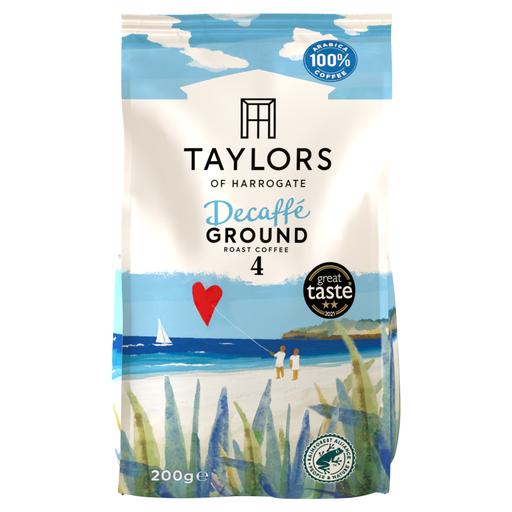
Taylors describes its 200 g Decaffé ground coffee with caramel-and-malt notes and a water-based decaffeination process.
Tesco Groceries lists a 227 g Tesco Finest Decaffeinated Colombian Ground Coffee.
This Taylors ground decaf is an option for a continental-breakfast cup when its described caramel-and-malt profile appeals to you; check its grind for your brewer.
 No image available
For a home-brewed breakfast cup, this 200 g ground decaf is described with caramel-and-malt notes and a water-based decaffeination method. Check the pack’s grind guidance if you use a particular brewer, and its caffeine information if that matters to your choice.
Not necessarily: decaf is not a zero-caffeine promise. For its own ground decaf, illy states a caffeine content no higher than 0.1%; check the information for the product you intend to buy.
Choose a coffee that expressly states suitability for your brewer. Rombouts describes its Decaf as medium ground for filter and cafetière use and lists cafetières, filter machines and filter cones; it suggests 60 g per litre as a starting recipe.
Yes, if the particular coffee lists moka preparation: Lavazza does so for its Decaf ground coffee. Do not take a filter- or cafetière-only description as confirmation of moka-pot suitability.