Cafetière and filter-coffee drinkers
Look for decaf ground coffee that names your brewing method. Rombouts, for example, describes its decaf product as medium ground for cafetières, filter machines and filter cones.


Choose decaf ground coffee by the brewer you use: look for an explicit cafetière or filter preparation statement for those methods, or espresso preparation wording if you brew espresso-style coffee. For an online grocery order, check the exact pack details and your substitution settings if a different grind, coffee or caffeine statement would not suit you.
Look for decaf ground coffee that names your brewing method. Rombouts, for example, describes its decaf product as medium ground for cafetières, filter machines and filter cones.
Check preparation wording on the exact pack rather than choosing by brand alone. illy labels its 250 g decaf ground coffee for espresso; compatibility with a particular machine still needs checking.
If you add coffee to a Tesco or Sainsbury’s order, check the selected product and any proposed substitution. Another decaf coffee may have a different grind, format or label details.
Start with your brewing equipment, then check the pack details that matter to you and how the retailer handles substitutions.
| Priority | What to check | Your needs |
|---|---|---|
| Brewing method | Read the stated grind and preparation methods. Rombouts specifies a medium grind for cafetières and filter brewing; illy labels its 250 g decaf ground coffee for espresso. Check your equipment’s instructions too. | I use a cafetière or filter machine and want the pack to name that method. For an espresso-style setup, I want preparation wording that matches my brewer. |
| Caffeine statement | Read the declaration for the exact product rather than interpreting decaf as caffeine-free. illy states that its 250 g decaf ground coffee has a caffeine content not higher than 0.1%. | If the amount of caffeine matters to me, I need the product’s own statement before deciding whether it meets my requirements. |
| Substitutions | Review the retailer’s substitution setting and inspect any proposed replacement. Sainsbury’s says it may offer substitutes for unavailable goods unless you ask it not to; Tesco describes returning an unwanted substitute to the driver. | A different decaf pack is not suitable for my order if its grind, format or label details do not meet what I need. |
| Storage | Follow the exact pack instructions after opening. Lavazza advises cool, dry storage and careful resealing for its ground-coffee range. | I want storage instructions I can follow between uses, especially if one pack will last across several grocery deliveries. |
A product described as medium ground for cafetière and filter use is a different starting point from one labelled for espresso preparation.
Match the pack’s stated grind and brewing methods to your equipment before ordering.
Decaf does not necessarily mean caffeine-free: illy states a caffeine content not higher than 0.1% for its 250 g decaf ground product.
Check the exact pack if a caffeine limit matters to you. For a medical or other strict restriction, seek advice appropriate to your circumstances.
A replacement can be decaf ground coffee yet differ from your chosen product in grind, roast, origin or format.
Ask the retailer not to substitute if only the chosen product will do, or review a proposed substitute before accepting it.
These named products and listings offer pack details to compare; check the exact item available for your delivery.
Sainsbury’s lists Lavazza Café Decaffeinated Ground Coffee in a 250 g pack.
illy’s UK site lists a 250 g decaffeinated ground coffee labelled for espresso.
Tesco and Sainsbury’s have listed a Taylors decaf roast ground coffee in a 200 g pack.
Rombouts describes its decaf ground coffee on its UK site as medium ground for cafetières, filter machines and filter cones.
Tesco’s decaf category has listed Tesco Finest Decaffeinated Colombian Ground Coffee in a 227 g pack.
Sainsbury’s search results have listed own-label Italian Decaf R&G 227 g and Fairtrade Colombian Decaff coffee.
These ground decaf options include a 200 g Taylors pack and a 250 g Lavazza pack. Check the preparation guidance on the exact pack before choosing either for a particular brewer.
 Image unavailable
A ground decaf option to consider for a grocery order. Check the pack’s grind and preparation instructions against your brewer, and read its caffeine statement if the amount matters to you.
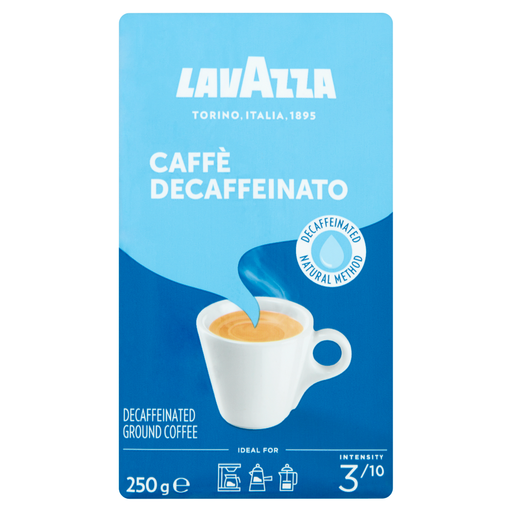 Image unavailable
A ground decaf option for shoppers considering espresso-style preparation. Check the exact pack for its stated grind and suitability for your espresso machine or moka pot; read its caffeine statement if needed.
No: decaf does not necessarily mean caffeine-free. For example, illy states that its 250 g decaf ground coffee has a caffeine content not higher than 0.1%. Check the exact product statement if the amount matters to you.
Allow one only if a different product could still meet your needs. Sainsbury’s says it may offer substitutes for unavailable goods unless you ask it not to; Tesco describes returning an unwanted substitute to the driver. Check its grind, format and label before keeping it.
Look for a stated grind and a preparation method that matches your brewer. Rombouts describes its decaf ground coffee as medium ground and suitable for cafetières, filter machines and filter cones; do not assume every pack labelled ground coffee has the same intended use.
Follow the instructions on your exact pack, particularly after opening. Lavazza advises keeping its ground-coffee range in a cool, dry place and resealing the pack carefully after use.