What should you check first?
Start with the brewer you will use, particularly if your work and home setups differ. Then consider caffeine information and the kind of coffee you would want with a snack.
| Priority |
What to check |
Your needs |
| Brewer fit |
Read the stated preparation methods and grind guidance. Lavazza lists moka, filter and French press; Rombouts lists cafetière, filter machine and filter cone. |
I make coffee using the equipment available on my shift or when I get home, and want the pack guidance to match it. |
| Caffeine information |
Check whether the exact product states a residual-caffeine level. illy UK states that its ground espresso decaf contains no more than 0.1% caffeine; that is not a zero-caffeine claim. |
If I am drinking coffee near my planned sleep time, I want to know what the pack says about caffeine rather than assuming decaf means none. |
| Roast and flavour |
Compare the stated roast, beans and flavour notes. Taylors describes caramel and malt notes for Decaffé; Lavazza describes a medium-roast Arabica-and-Robusta blend. |
I want a coffee whose stated profile sounds appealing alongside the snacks I usually bring, without assuming that every decaf tastes alike. |
| Pack and storage |
Check the pack size and storage instructions for the exact product. Taylors lists a 200 g pack; illy advises keeping its coffee away from light and heat and preferably refrigerating it after opening. |
A smaller pack may suit me if I make ground coffee only on occasional shifts; I also need storage instructions I can follow at home. |
Brand references
These examples show how particular ground-decaf products differ; a brand name alone does not establish brewer compatibility or caffeine content across its range.
Lavazza
Decaf Classico is a 250 g medium-roast Arabica-and-Robusta ground coffee for several stated preparation methods.
- Lavazza lists moka, filter and French-press preparation.
- Lavazza describes its carbon-dioxide decaffeination method, but its product information does not give a residual-caffeine percentage.
illy
Its 250 g ground espresso decaf is listed as 100% Arabica.
- illy UK states that caffeine content is no higher than 0.1%.
- Caramel, orange-blossom and jasmine notes are illy’s flavour descriptions, not independent tasting results.
Taylors of Harrogate
Decaffé is a 200 g ground coffee for shoppers interested in a disclosed water-based decaffeination method.
- Taylors describes its Pure Water Process and caramel-and-malt flavour notes.
- Check the exact pack’s brewer guidance and caffeine information if either is important to your choice.
Rombouts
Its 250 g medium-ground decaf is specified for cafetières, filter machines and filter cones.
- Rombouts suggests starting with 60 g of coffee per litre of water.
- Its stated preparation list does not include moka-pot use; check the pack if that is your brewer.
Tesco Finest
Its 227 g decaffeinated Colombian ground coffee is a dark-roast option.
- Tesco lists cafetières, filter machines, moka pots and percolators among its preparation methods.
- Tesco advises checking the current label because food product details can change.
Sainsbury's
Its decaffeinated-coffee category lists own-label ground coffees alongside branded options.
- The category includes Italian Decaf R&G and Taste the Difference Colombian decaf ground coffee.
- A shared category listing does not mean those coffees have the same grind, brewing guidance or decaffeination method.
Ground decaf on Joybuy
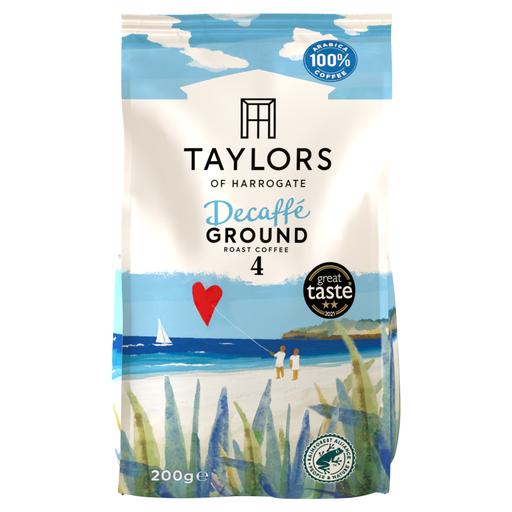
This Taylors of Harrogate option is relevant if a disclosed water-based process and caramel-and-malt flavour notes matter for your snack-break coffee. Check the exact pack’s preparation guidance against your brewer.
 No image available
Taylors of Harrogate Decaf Ground Coffee 200 g
A ground decaf to consider for a night-shift snack break if Taylors’ stated caramel-and-malt flavour notes appeal to you. The listing identifies a 200 g pack, 100% Arabica coffee and Taylors’ Pure Water Process. Check the pack’s brewing guidance for your equipment, and do not treat decaf as caffeine-free.
View on Joybuy
Frequently asked questions
Is decaf ground coffee caffeine-free?
No. Decaf can contain residual caffeine: illy UK states a caffeine content no higher than 0.1% for its ground espresso decaf. If you need to avoid caffeine completely for a medical reason, ask the clinician responsible for your care rather than relying on a decaf label.
Which ground decaf can I use in a cafetière?
Rombouts lists cafetières among the suitable methods for its medium-ground decaf and suggests starting with 60 g per litre of water. Tesco Finest also lists cafetière use. Follow the instructions for your brewer and the exact coffee you buy.
Can one decaf work in both a moka pot and a French press?
Lavazza lists both moka and French-press preparation for Decaf Classico. Check the individual product’s guidance rather than assuming every ground decaf covers both methods; the Rombouts preparation list, for example, names cafetière and filter methods but not moka.
How should I store ground decaf after opening?
Follow the exact pack’s instructions. illy advises keeping its ground decaf away from light and heat and preferably refrigerating it after opening, while Tesco says to keep its Finest decaf in a cool, dry place. One product’s instruction should not be applied to every coffee.
What should I check when serving coffee with snacks?
Read the current labels for the coffee, any milk or flavourings, and the snacks themselves if ingredients or allergens matter to you. A product description for the coffee cannot tell you what is in the other items served with it.


