Older adults concerned about bladder symptoms
Someone who enjoys coffee but finds that caffeine affects urinary urgency or incontinence may consider decaf. NHS guidance suggests switching to decaf as one option; individual responses can differ.


Choose decaf ground coffee that suits the household’s brewer, then check the exact product’s caffeine statement and storage instructions. NHS guidance suggests switching to decaf when caffeine worsens incontinence, but decaf is not necessarily caffeine-free. For someone following iron-deficiency advice, coffee timing still matters: University Hospitals Coventry and Warwickshire NHS Trust advises keeping coffee away from meals.
Someone who enjoys coffee but finds that caffeine affects urinary urgency or incontinence may consider decaf. NHS guidance suggests switching to decaf as one option; individual responses can differ.
Decaf can reduce caffeine exposure, but it does not make coffee an automatic match for mealtimes. University Hospitals Coventry and Warwickshire NHS Trust advises people with iron deficiency anaemia to avoid coffee within an hour before or after meals.
A ground decaf that matches the existing cafetière, filter brewer or moka pot can preserve a familiar preparation routine. Check the product’s brewing directions and any caffeine or storage information that matters to the person drinking it.
Start with the brewer and the reason for choosing decaf. Then check product-specific information and decide when coffee fits into the person’s eating and drinking routine.
| Priority | What to check | Your needs |
|---|---|---|
| Brewer fit | Check the stated grind and preparation methods against the equipment at home. Rombouts specifies medium-ground decaf for cafetières and filters; Lavazza lists moka preparation for its ground decaf. | I want ground coffee that works with the brewer already in the kitchen, without changing the routine just to switch to decaf. |
| Caffeine information | Check whether the exact product gives a caffeine maximum. Illy states that its specified ground decaf contains no more than 0.1% caffeine; a decaf label alone does not mean caffeine-free. | If caffeine affects my bladder symptoms, I want to know what the product says about its remaining caffeine. NHS guidance suggests decaf as an option for incontinence. |
| Coffee timing | For iron deficiency anaemia, University Hospitals Coventry and Warwickshire NHS Trust advises avoiding coffee within one hour before or after meals. Follow individual advice about prescribed iron. | I would rather have coffee between meals when following iron-deficiency advice, not assume that choosing decaf removes the timing concern. |
| Pack and storage | Check the pack size and its instructions for storing coffee after opening. Follow those instructions for the product chosen. | A manageable pack and clear storage directions make it easier to keep ground decaf in the household’s usual routine. |
Decaffeinated coffee can retain some caffeine, which matters if a clinician has advised a strict limit.
Check the exact product’s caffeine statement and discuss its suitability with the clinician if needed. Illy, for example, states a maximum of 0.1% for its specified ground decaf.
University Hospitals Coventry and Warwickshire NHS Trust says coffee or tea with a meal can greatly reduce iron absorption in its guidance for iron deficiency anaemia.
When following that guidance, keep coffee at least one hour before or after meals. Follow individual advice on the timing of prescribed iron.
Preparation directions differ between ground coffees. Rombouts specifies its medium-ground decaf for cafetières and filters, while Lavazza lists moka preparation for its ground decaf.
Identify the brewer before buying and check the directions for the exact pack.
Switching to decaf changes the caffeine choice; it does not replace food, other drinks or prescribed nutritional support.
Keep coffee as an optional drink within the person’s eating and drinking routine. Seek appropriate clinical advice about poor appetite, unintentional weight loss or swallowing difficulties.
These examples describe specific products or formats, not everything each brand makes. Check the current pack for the details that affect your choice.
Lavazza’s ground decaf is a 250 g Arabica-and-Robusta blend.
Illy lists 100% Arabica ground decaf in 125 g and 250 g cans.
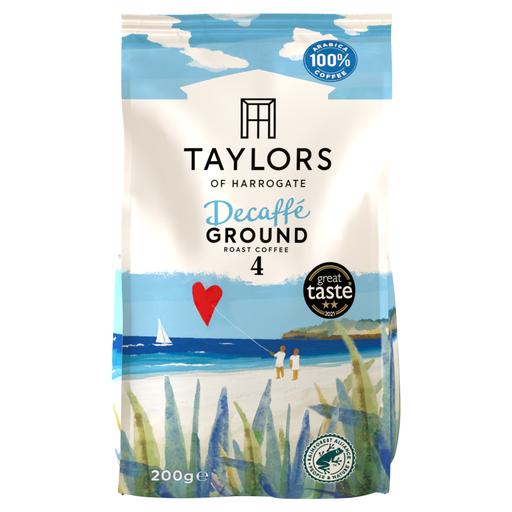
Taylors Decaffe Roast is listed as ground coffee in a 200 g pack.
Rombouts lists a 250 g decaf ground coffee for cafetières, filter machines and filter cones.
Tesco lists a 227 g Finest Decaffeinated Colombian Ground Coffee.
The Sainsbury's decaf Americano described here is an instant-coffee product, not a pack of ground coffee for brewing.
This Taylors of Harrogate option is ground decaf for a household considering a lower-caffeine coffee routine. Check its pack against the brewer used at home.
 No image available
A ground decaf option for a household switching from regular coffee while keeping a home-brewing routine. The Joybuy listing describes it as 100% Arabica, roast level 4, and made using a water decaffeination method. Check the pack for brewer suitability and a product-level caffeine statement if a strict limit applies.
No. Decaf can retain some caffeine; illy, for example, states that its specified ground decaf contains no more than 0.1%. If a clinician has advised a strict caffeine limit, check the exact product and ask whether it is suitable.
It may be an option when caffeine worsens symptoms. NHS guidance says caffeine can irritate the bladder and suggests stopping coffee or switching to decaf, but an individual may still find that coffee does not suit them. Seek clinical advice if symptoms persist or worsen.
Do not assume decaf removes the coffee-timing concern. University Hospitals Coventry and Warwickshire NHS Trust advises people with iron deficiency anaemia to avoid coffee within one hour before or after meals; follow individual advice about prescribed iron as well.
Choose one whose preparation directions specify cafetière use. Rombouts lists its medium-ground decaf for cafetières, and Lavazza describes its ground decaf as suitable for French press preparation. Check the directions on the exact pack you buy.
Follow the instructions on the individual pack. Illy advises keeping its ground decaf away from light and heat and prefers refrigeration after opening; directions for another product may differ.