Evening coffee drinkers
If you enjoy coffee after dinner but want to reduce caffeine near bedtime, the decaffeinated label matters more than a mild-sounding roast name. NHS guidance notes that caffeine in coffee can make you feel more awake.


For a coffee-flavoured drink near bedtime, start with an instant coffee labelled decaffeinated rather than choosing a regular blend because it sounds mild: NHS sleep guidance says caffeine in coffee can make you feel more awake. Then choose between the stated roast and blend styles that appeal to you. Decaf still contains some caffeine, so it is not a caffeine-free choice.
If you enjoy coffee after dinner but want to reduce caffeine near bedtime, the decaffeinated label matters more than a mild-sounding roast name. NHS guidance notes that caffeine in coffee can make you feel more awake.
If you already buy decaf, compare the stated flavour styles: a medium-roast blend, an Arabica-and-Robusta blend, or instant coffee combined with finely milled beans. Those descriptions help narrow the choice, but they cannot guarantee how a cup will taste to you.
If evening coffee is an occasional drink, consider the jar size alongside the preparation and storage instructions. A smaller jar may be more practical while you work out whether a blend suits your routine.
Check decaf status first, then compare blend descriptions and the practical details of the jar you would use.
| Priority | What to check | Your needs |
|---|---|---|
| Decaf status | Check that the exact jar says decaffeinated. Do not use a smooth or medium-roast description as a substitute; decaf still contains some caffeine, as Nescafé explains. | I want coffee flavour near bedtime without choosing a regular caffeinated blend. If I need a caffeine-free drink, decaf is not the same thing. |
| Blend character | Compare the stated roast, bean blend and format. Nescafé describes Gold Blend Decaf as medium-roasted Arabica and Robusta; Kenco says Millicano Decaff combines instant coffee with finely milled whole beans. | A familiar medium-roast description may be enough for me, or I may want to try the different format of a finely milled-bean blend. Brand flavour notes are descriptions, not a taste guarantee. |
| Preparation | Read the directions on the particular jar for the amount of coffee and water temperature. Sainsbury's listing for Carte Noire Decaffeinated says one or two teaspoons per cup with hot water just off the boil. | I want a straightforward evening mug and a way to adjust its strength using that product's instructions. |
| Jar size | Compare the labelled weights and check the storage and best-before instructions on the jar. Consider how often you expect to make an evening cup. | If I drink decaf only occasionally, I would rather choose a size I expect to use than buy a larger jar solely for its size. |
Nescafé explains that decaffeinated coffee retains a small amount of caffeine. That distinction matters when the reason for choosing the drink is to avoid caffeine altogether.
Choose an explicitly caffeine-free alternative if you need to avoid caffeine, rather than relying on the word decaf.
Medium, smooth and rich describe how a coffee is positioned for flavour; none of those words establishes that the jar is decaffeinated.
Check the decaffeinated label on the exact product first. Use the roast and flavour description to choose among decaf options afterwards.
A conventional medium-roast instant coffee and one containing finely milled beans have different stated blend formats. A flavour description alone cannot tell you which you will prefer.
When trying a new style, consider a smaller jar or one you can share before choosing a larger size.
These references describe particular decaf lines and listings, not every coffee made by each brand or the products currently available from Joybuy.
Gold Blend Decaf is a medium-roasted instant coffee that Nescafé describes as an Arabica-and-Robusta blend.
Kenco describes its Decaf as a medium-roast instant blend, while Millicano Decaff combines decaffeinated instant coffee with finely milled whole beans.
Tesco's listing describes Pure Decaffeinated as freeze-dried, medium-roasted instant coffee with a stated strength of 3.
Sainsbury's lists a 100g Carte Noire decaffeinated freeze-dried instant coffee.
Sainsbury's Gold Roast Decaffeinated is listed as a 200g instant coffee with a medium profile.
Tesco's decaf coffee category lists its own-label Decaffeinated Classic Coffee and Decaff Gold Instant Coffee.
These Joybuy options are decaffeinated instant coffees for someone considering a coffee-flavoured evening drink. Their jar sizes and named formats differ; none should be treated as caffeine-free merely because it says decaf.
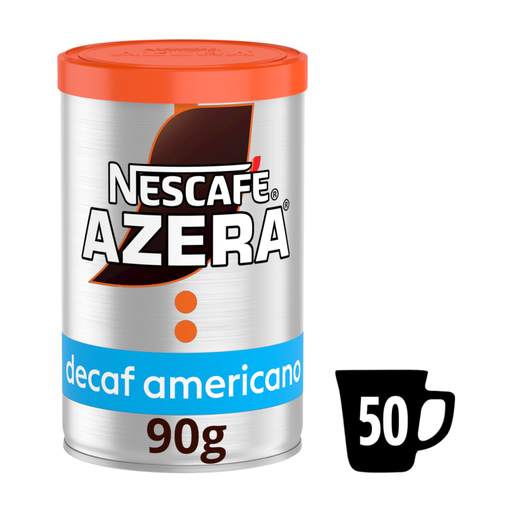 No image available
A decaf instant Americano option in a 90g tin if that named style appeals for an evening drink. Decaf does not mean caffeine-free; check the pack if the remaining caffeine matters to you.
 No image available
A 100g decaf instant coffee for a straightforward evening cup. Check the jar's roast and preparation directions if you are choosing it for a particular flavour profile.
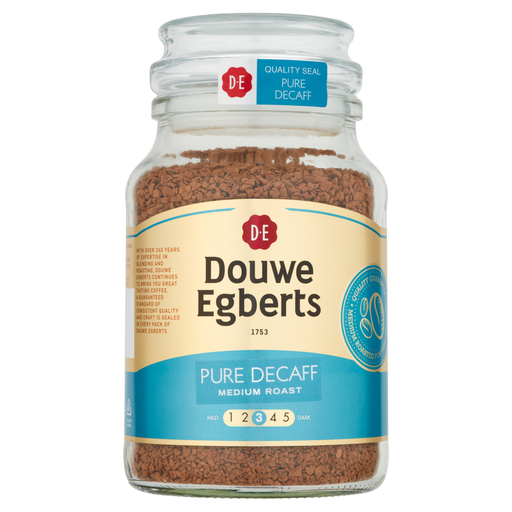 No image available
This 190g decaf instant coffee corresponds to the Pure Decaffeinated product that Tesco lists as freeze-dried and medium-roasted, with a stated strength of 3. Check the pack's directions when preparing it as a hot drink.
 No image available
A 190g decaf Gold Blend jar to consider if you want a named medium-roast blend: Nescafé describes Gold Blend Decaf as made with Arabica and Robusta beans. Its flavour descriptions are the brand's own, and decaf still contains some caffeine.
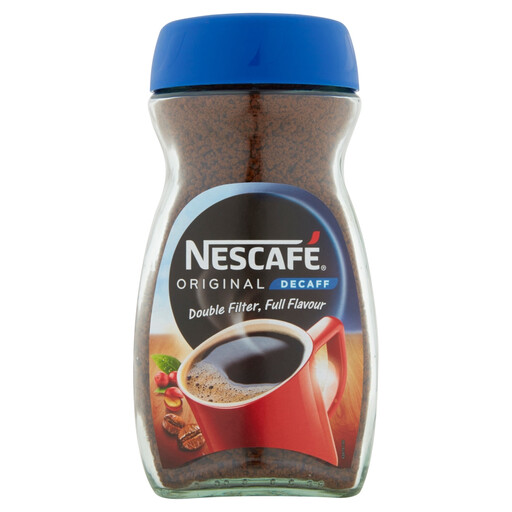 No image available
A 200g decaf coffee jar for an evening instant drink. If roast or bean blend determines your choice, check this particular jar's label rather than applying the description of another Nescafé decaf product.
Choose a product labelled decaffeinated if reducing caffeine near bedtime is your priority. NHS sleep guidance says caffeine in coffee can make you feel more awake; a smooth or medium-roast label on regular coffee does not mean it is decaf.
No. Nescafé explains that decaffeinated coffee still contains a small amount of caffeine. If you need to avoid caffeine altogether, choose a drink explicitly identified as caffeine-free instead.
Start by comparing decaf jars described as medium-roasted, balanced or smooth, such as the named Nescafé, Kenco and Sainsbury's lines. Those are brand or retailer flavour descriptions rather than a guarantee of taste, so consider a smaller jar when trying one for the first time.
Follow the directions on the jar you buy. For example, Sainsbury's Carte Noire Decaffeinated listing says to use one or two teaspoons per cup and hot water just off the boil; do not assume the same directions apply to every blend.
Read the current ingredients and allergen information on the exact product pack, particularly when choosing a flavoured coffee drink or sachet. Check any milk or other ingredient you add separately.