Commuters making coffee at home or work
If you have a mug and access to hot water, instant coffee avoids a machine, pods and a brewing routine. Check the directions on the particular jar before relying on it for a workplace kettle.


For coffee before leaving home or at a workplace kettle, a decaf instant jar is a straightforward choice when its preparation directions fit the hot-water access you have. Choose between jars by their stated flavour profile and a pack size you will use; decaf does not mean caffeine-free, according to Nescafé UK & IE.
If you have a mug and access to hot water, instant coffee avoids a machine, pods and a brewing routine. Check the directions on the particular jar before relying on it for a workplace kettle.
Decaf offers a way to keep an instant-coffee routine while reducing caffeine. Nescafé UK & IE notes that decaf coffee is not completely caffeine-free, so it is not a zero-caffeine choice.
A larger jar may suit repeated cups at home or work if you can keep it dry and use it by the date on the pack. A smaller pack may be easier to accommodate if you drink it less often.
Start with caffeine expectations and how you will make the coffee, then narrow the choice by flavour description and pack format.
| Priority | What to check | Your needs |
|---|---|---|
| Residual caffeine | Check that the product is labelled decaffeinated. Do not read “decaf” as “caffeine-free”: Nescafé UK & IE says some caffeine remains. | I want to reduce caffeine without assuming my cup contains none. |
| Preparation | Read the jar’s directions for the amount of coffee and water temperature. Check that you can follow them with the kettle and mug available where you make your cup. | A quick cup before I leave, or during a work break, matters more to me than a brewing routine. |
| Flavour description | Compare each maker’s roast and flavour wording. Kenco calls its Decaf intensity 7; Tesco lists Douwe Egberts Pure Decaff as medium roast and strength 3. Those are product-specific descriptions, not a shared scale. | I would rather choose a profile that appeals to me than assume every decaf jar tastes alike. |
| Pack and storage | Check the pack weight, storage instructions and best-before information. A refill also needs a suitable container: Tesco describes Kenco’s paper refill as intended for a Kenco glass jar. | For regular cups, I want a pack I can store properly and finish while it is at its intended quality. |
A decaf coffee can still contribute caffeine to a day’s drinks. Nescafé UK & IE explicitly says decaf is not completely caffeine-free.
Choose it for caffeine reduction rather than zero caffeine, and check the particular product if you need to account for your intake.
Kenco’s intensity 7 and the strength 3 shown for Douwe Egberts Pure Decaff are labels for different product ranges. The numbers alone do not establish which cup you will prefer.
Read each product’s roast and flavour description alongside its rating.
A particular flavour is less useful as a regular choice if you cannot obtain it when the jar runs out.
Check availability when you need to replace a jar, especially if your routine depends on one product.
These descriptions help distinguish the cited decaf lines; flavour and strength wording comes from the brands or product listings, not a comparative taste test.
Original Decaf is described as bold and intense, while Gold Blend Decaf is positioned as smooth and rounded.
Kenco describes its standard Decaf as balanced and gives it an intensity rating of 7. Millicano Decaff combines decaffeinated instant coffee with finely milled whole beans.
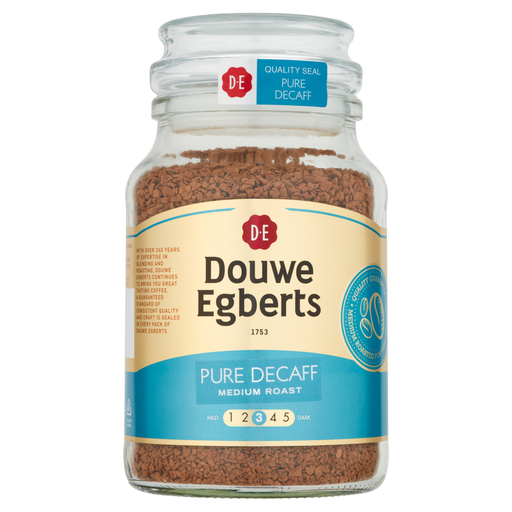
Tesco lists the 190g Pure Decaff instant coffee as freeze-dried, medium roast and strength 3.
Tesco Decaffeinated Classic Coffee is a 200g instant jar described by the retailer as mellow and smooth, using Robusta and Arabica beans.
Gold Roast Decaffeinated Instant Coffee Granules is a 200g freeze-dried product described by Sainsbury’s as smooth, well-rounded and medium.
Carte Noire Decaffeinated Instant Coffee is a 100g freeze-dried option positioned around an Arabica-led flavour profile.
These instant decaf products offer different pack sizes and stated profiles for coffee at home or at work. Check each jar’s directions if your routine depends on a kettle.
 No image available
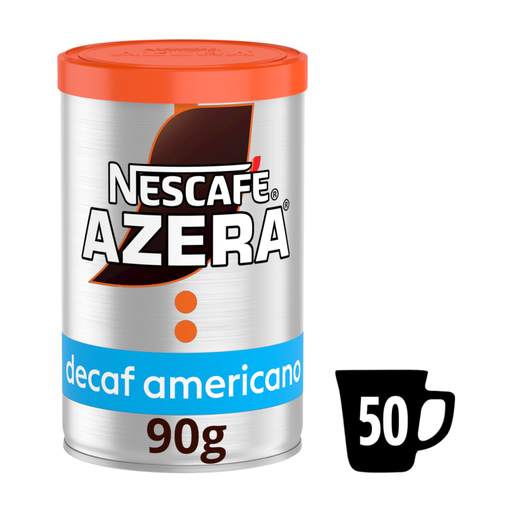
This 90g decaf instant coffee is an option if you want a smaller pack for cups made before or after a commute. Check its directions for the cup you plan to make; an Americano-style name does not establish the flavour of a prepared serving.
 No image available
This 100g decaf instant coffee suits a simple mug-and-kettle routine when you can follow the pack’s directions. Kenco describes its Decaf range as balanced and rounded; treat that as the maker’s flavour description rather than a comparison with other brands.
 No image available
This 190g decaf coffee is worth considering if Nescafé’s stated smooth, rounded Gold Blend profile appeals to you. Nescafé describes Gold Blend Decaf as freeze-dried and says its beans are decaffeinated using only water; that does not mean the coffee is caffeine-free.
 No image available
Consider this 190g freeze-dried jar if its stated medium roast and strength 3 appeal to you; those descriptions appear on Tesco’s listing for the same product. Check the jar’s directions before counting on a hot-water cup at work, as the product description also discusses chilled serving.
 No image available
This 300g decaf soluble coffee may suit a household that makes repeated cups. Nescafé describes its Original Decaf profile as bold and intense; read this jar’s directions before relying on it for your usual workplace-kettle routine.
No. Nescafé UK & IE says decaf coffee is not completely caffeine-free. Choose it as a way to reduce caffeine, not as proof that a prepared cup contains none.
A jarred instant decaf works when you have a mug and can follow that product’s hot-water directions. Check the amount of coffee and water temperature on the pack, since instructions differ between products.
Follow the directions on your jar rather than using one rule for every brand. The Tesco and Sainsbury’s own-label guidance in the product information calls for hot, not boiling, water.
Follow its storage instructions, replace the lid after use and check the best-before information on the pack. Keeping the jar in the conditions specified on its label matters particularly if you expect a larger pack to last through many commuter-day cups.