Care-home catering teams serving decaf routinely
A jar of instant coffee suits a repeatable hot-drink service. Staff still need to check whether the flavour is acceptable to residents and whether decaf fits each person’s plan.


For routine care-home dining, a decaf instant coffee jar around 190–200g is a practical starting point if demand supports that size, but trial the flavour with residents before settling on one. Decaf still contains caffeine, so check the supplied jar’s label and each resident’s care plan. Keep caffeinated coffee available for residents who want it where this fits their individual plan.
The same jar may serve several dining routines, but the choice still needs to work for the people drinking it.
A jar of instant coffee suits a repeatable hot-drink service. Staff still need to check whether the flavour is acceptable to residents and whether decaf fits each person’s plan.
A decaf routine need not remove the option of caffeinated coffee. For regulated care services in England, the Care Quality Commission’s Regulation 14 guidance requires assessment of nutrition and hydration needs and consideration of people’s preferences, religious and cultural backgrounds.
For steady communal demand, compare 190–200g instant jars with smaller and larger sizes. Match the jar to likely use rather than choosing by size alone.
Start with the drink residents need and will accept, then choose a jar size that fits the service routine.
| Priority | What to check | Your needs |
|---|---|---|
| Decaf and preparation | Look for a product labelled decaf and confirm its preparation instructions. Decaf is not caffeine-free, as NESCAFÉ explains. | I want a coffee staff can prepare during routine hot-drink service, while checking individual plans where caffeine must be avoided. |
| Resident taste | Use the stated roast or coffee style to shortlist jars, then let residents try them; a description cannot establish their preference. | I want residents to enjoy the coffee they are offered. The British Geriatrics Society reports that 50% of 699 surveys in a Leicester hospital campaign noted no taste difference between decaf and caffeinated drinks; that does not predict care-home residents’ views of a particular jar. |
| Individual choice | Agree how decaf and caffeinated coffee will be offered. In England, the Care Quality Commission’s Regulation 14 guidance requires providers to assess nutrition and hydration needs and take account of individual preferences. | If decaf becomes the routine option, I still want residents to be able to express a different preference within their individual plan. |
| Jar size | Compare the stated weights with actual decaf use. The manufacturer and retailer listings include 190g and 200g jars; the selected Joybuy products also include 100g and 300g options. | Our decaf use needs to justify the size we open, whether that means fewer jar changes or choosing a smaller jar. |
| Label and storage | Check the physical jar’s ingredients, allergen information, best-before date and storage directions against relevant resident requirements. Marks & Spencer advises reading the label because product information can change. | I need staff to identify the exact coffee being served and check that it fits each resident’s assessed food-and-drink needs. |
NESCAFÉ explains that decaf retains some caffeine, which matters if a resident’s plan calls for strict caffeine avoidance.
Check the exact product and the resident’s plan rather than relying on the word 'decaf' alone.
A routine decaf offer can overlook individual preferences and assessed food-and-drink needs. In England, the Care Quality Commission’s Regulation 14 guidance requires providers to consider those preferences and needs.
Explain the drinks routine, ask residents what they want and retain a caffeinated option where it fits their individual plans.
Roast descriptions and jar weight do not establish whether residents will like a particular coffee.
Offer a taste trial before standardising a jar, and compare pack size with actual decaf use.
A partly used larger jar may go to waste if residents do not want that flavour.
Food information may change. Marks & Spencer directs shoppers to read the supplied product label.
When a jar arrives and before it is served, check its label, best-before date and storage instructions against relevant resident requirements.
These brand references help distinguish instant jars from other decaf formats; they do not establish that a particular coffee will suit every resident.
Original Decaf is listed in 100g, 190g and 300g jars, offering different sizes for an instant-coffee routine.
Kenco lists its instant Decaf in 95g and 190g jars.
Gold Decaf is a 200g instant coffee that M&S describes as medium-roasted arabica, ground and freeze-dried.
Tesco lists Decaffeinated Classic Coffee and Decaff Gold Instant Coffee in 200g formats.
Taylors appears in the decaf category through coffee bags, ground coffee and beans listed by Tesco.
These decaf jars cover smaller, 190–200g and larger sizes for care-home hot-drink service. Compare each size with actual use and trial the flavour before adopting a routine jar.
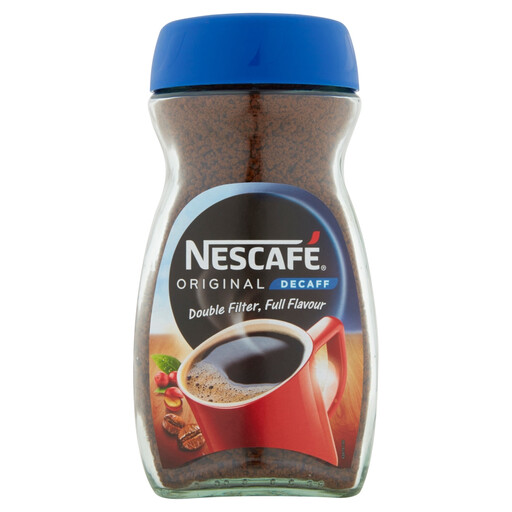 No image available
The 200g size is worth considering where a home uses decaf regularly. Trial the flavour, and check the supplied label and individual dietary requirements before service; decaf does not mean caffeine-free.
 No image available
The 190g jar is another size to compare with routine decaf use. Let residents try the flavour before settling on it, and check the supplied label against their individual requirements.
 No image available
At 300g, this jar calls for a check of likely demand before opening. Trial the coffee with residents and follow the supplied label’s dietary, best-before and storage information.
 No image available
The 100g instant jar gives a smaller-size option where decaf use does not justify a larger open jar. Check how often it would need replacing, offer a taste trial and read the supplied label before service.
Yes, provided the routine still allows for individual needs and preferences. Care England describes a care-home trial that kept caffeinated drinks available on request; in England, the Care Quality Commission’s Regulation 14 guidance requires assessment of nutrition and hydration needs and consideration of people’s preferences.
No. NESCAFÉ explains that decaf retains some caffeine. Where a resident’s plan calls for strict caffeine avoidance, check the exact jar and follow the individual advice in that plan.
Check its ingredients, allergen information, best-before date and storage directions against residents’ relevant requirements. Marks & Spencer advises reading the supplied label because product information can change.
Choose according to actual decaf use and residents’ response to the coffee, rather than treating a 10g difference as decisive. NESCAFÉ Original Decaf and Kenco Decaf are listed in 190g formats, while M&S Gold Decaf and Tesco own-label instant decaf options are listed in 200g formats; check the supplied jar’s best-before and storage directions.