Regular decaf drinkers
If you make decaf at home most days, jar quantity and your usual amount per cup matter when choosing a format you will use up.


For a budget shop, choose a decaf instant jar you are likely to use regularly, rather than judging by jar size or brand alone. A soluble coffee suits straightforward hot-water preparation; a freeze-dried jar may be worth considering if you prefer its stated style. Check the serving directions before estimating how long either jar will last.
If you make decaf at home most days, jar quantity and your usual amount per cup matter when choosing a format you will use up.
If a stated flavour profile matters to you, compare the descriptions of soluble and freeze-dried jars rather than assuming they will taste alike.
An instant decaf jar offers convenient preparation, but decaf should not be treated as a guarantee of zero caffeine.
Start with the coffee format, then consider your usual serving and whether the jar size fits how often you drink it.
| Priority | What to check | Your needs |
|---|---|---|
| Jar quantity | Check the stated weight; compare the amount you use per cup and any serving guidance on the label. | I drink decaf regularly and want a jar size that fits how quickly I get through it. |
| Instant format | Look for instant, soluble or freeze-dried on the pack; do not confuse ground coffee with an instant jar. | For a quick cup, I want coffee that can be prepared without brewing equipment. |
| Stated style | Compare the retailer’s flavour description and preparation directions; treat the description as a guide, not a taste test. | I would rather choose a style I expect to enjoy than leave a jar unfinished. |
| Residual caffeine | Read the decaf label; remember that decaffeination does not necessarily remove every trace of caffeine. | Reducing caffeine matters to me, so I do not want to mistake decaf for caffeine-free coffee. |
Ground decaf needs a suitable brewing method, whereas instant coffee is prepared directly with water.
Check for instant, soluble, granules or freeze-dried on the pack if you want a jar for straightforward preparation.
Nescafé notes that decaf coffee can retain a small amount of caffeine.
If caffeine intake matters to you, do not rely on the word “decaf” as a zero-caffeine claim.
Descriptions such as “smooth” or “well-rounded” describe a product’s stated profile, not how it will taste to everyone.
Compare the format and label description with coffees you already enjoy, and check the preparation directions.
These examples help distinguish instant jars from other decaf formats; a brand’s inclusion does not mean every product in its range is an instant coffee.
Tesco lists Decaffeinated Classic Coffee and Decaff Gold Instant Coffee in 200g sizes.
Sainsbury’s lists 200g Rich Roast decaffeinated soluble coffee and Gold Roast decaffeinated freeze-dried instant coffee.
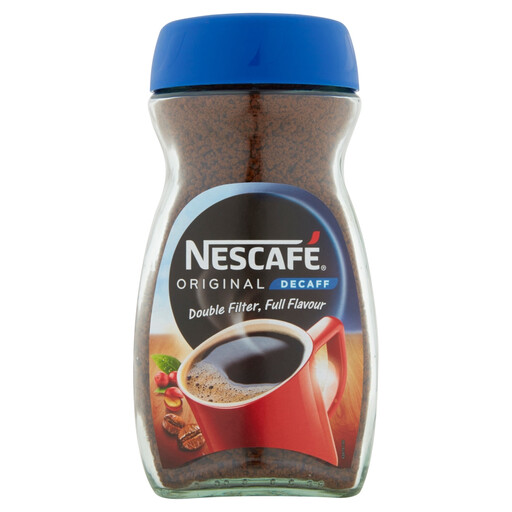
Nescafé describes Original Decaf as coffee decaffeinated using water and made from pure coffee.
Kenco describes its Decaf instant coffee as balanced, with an intensity rating of 7.
The Taylors Decaffe Roast 200g product listed by Tesco is ground coffee.
M&S describes Gold Decaf Instant Coffee as a 200g, freeze-dried Arabica product and states that its coffee is Fairtrade sourced.
These are decaf instant-coffee options in different jar sizes and stated styles. Check each product’s directions against how you usually make coffee.
 No image available
A 100g decaf instant jar for someone who prefers a smaller quantity. Its directions specify 1–2 teaspoons and hot water; use your usual dose when judging how long the jar will last.
 No image available
This 300g decaffeinated soluble-coffee jar may fit regular home use if you already prefer NESCAFÉ Original’s stated style. Check the pack directions and your usual dose to estimate how long it will last.
 No image available
A 200g decaffeinated soluble-coffee jar for hot-water preparation. The product directions call for cool, dry storage; check the pack for the dose that suits your cup.
 No image available
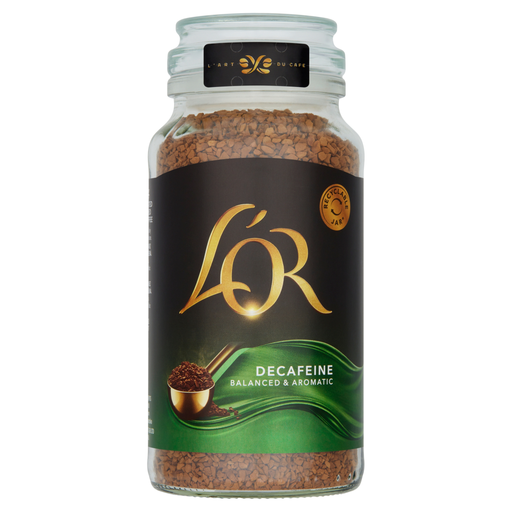
A 150g decaf freeze-dried instant coffee for shoppers considering that format. Its product description emphasises chilled serving, so check the pack directions if you mainly want a hot cup.
Sainsbury’s labels Rich Roast as agglomerated decaffeinated soluble coffee and Gold Roast as decaffeinated freeze-dried instant coffee. Their stated flavour descriptions also differ, so choose by the format and style you prefer rather than assuming the names indicate the same coffee.
Not necessarily. Nescafé explains that a small amount of caffeine can remain after decaffeination; do not treat a decaf label as a zero-caffeine claim.
Follow the directions on the jar you buy. The checked Sainsbury’s instant jars specify hot rather than boiling water and cool, dry storage; preparation directions can differ between products.