Busy weekday coffee drinkers
An instant jar lets you make a mug with hot water, without grinding beans or using a coffee machine.


Choose NESCAFÉ Original Decaf if you prefer the bold profile described by NESCAFÉ, or Kenco Decaf if its stated balanced, medium-roast profile sounds closer to your usual cup. For a quick weekday breakfast, also check the jar size and current pack label: decaf still contains a small amount of caffeine.
An instant jar lets you make a mug with hot water, without grinding beans or using a coffee machine.
Look at the maker’s flavour description if you have a preference for a bolder, smoother or richer-tasting cup. Those descriptions are not independent taste-test results.
If you make coffee most weekdays, check the pack size and preparation directions to find a jar that fits your routine.
Start with the coffee format and flavour direction, then check whether the specific jar meets your caffeine and ingredient requirements.
| Priority | What to check | Your needs |
|---|---|---|
| Quick preparation | Check that the product is instant or soluble coffee. Read its directions for the amount to use and how to add hot water. | I want to make a weekday mug without a separate brewing step. |
| Flavour direction | NESCAFÉ describes Original Decaf as bold and intense; Kenco describes Decaf as balanced. Sainsbury’s describes Gold Roast as smooth and well rounded and Rich Roast as rich and full flavoured. These are brand or retailer descriptions. | A smoother cup may suit me better than one described as bold or rich, or I may prefer the opposite. |
| Residual caffeine | Check the specific product information if your caffeine limit is strict. NESCAFÉ explains that decaf coffee retains a small amount of caffeine. | I want to reduce caffeine, but I cannot treat a decaf label as a promise of zero caffeine. |
| Jar size and label | Compare the stated pack weights and read the current ingredients, allergy statement and storage directions on the jar. Do not assume different products from one brand have identical labels. | I make coffee regularly and want a suitable jar size. If an ingredient or allergen matters to me, I need the label for the exact product. |
NESCAFÉ explains that decaf coffee retains a small amount of caffeine. A standard decaf jar therefore may not meet a strict zero-caffeine requirement.
Check the specific product information if the remaining caffeine matters to your decision.
NESCAFÉ, Kenco and Sainsbury’s use different flavour descriptions for their decaf coffees; those descriptions indicate a direction, not how every drinker will experience the cup.
Start with the flavour terms closest to the coffee you already enjoy, then check the exact variant rather than choosing by brand alone.
Ingredients and allergy information are product-specific. For example, Marks & Spencer’s Decaf Americano Micro-Ground listing says that product is not suitable for people with a milk allergy.
Read the current label on the exact jar, especially when buying a different variant or if you have an allergy or dietary restriction.
Some of these brands list instant decaf jars; others provide related decaf formats, so check the product type before choosing one for a quick mug.
Original Decaf and Gold Blend Decaf are distinct instant-coffee lines with different descriptions.
Kenco lists Decaf in its instant jar range, including 95g and 190g sizes.
Sainsbury’s lists 200g Gold Roast and Rich Roast decaffeinated instant coffees.
Tesco’s decaf category lists 200g Decaffeinated Classic Coffee and Decaff Gold Instant Coffee.
M&S lists Gold Decaf instant coffee and a separate Decaf Americano Micro-Ground product.
Taylors appears in decaf supermarket listings for formats other than an instant jar.
These Joybuy listings are decaf instant-coffee options for a weekday mug. Compare the named variant and jar weight; the product descriptions do not establish that every jar has the same flavour or caffeine content.
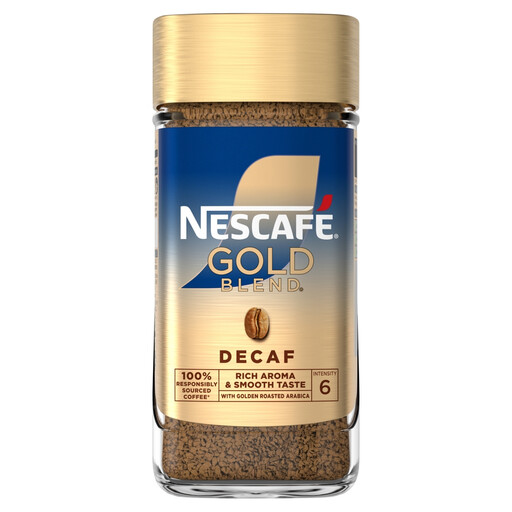 No image available
A 190g decaf option for an instant weekday cup. NESCAFÉ describes Gold Blend Decaf as a freeze-dried blend of Arabica and Robusta coffee; decaf does not mean caffeine-free.
 No image available
This 300g jar is an option if you make instant decaf regularly and prefer the bold flavour direction NESCAFÉ describes for Original Decaf. The brand says Original Decaf contains only coffee; decaf still retains some caffeine.
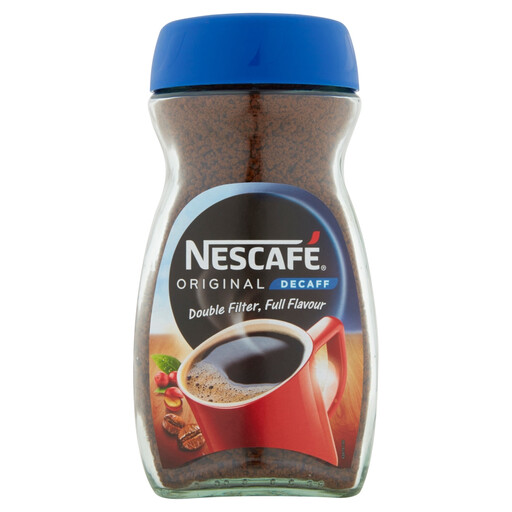 No image available
A 200g NESCAFÉ decaf option for a simple weekday coffee. Check the current pack for the exact variant, preparation directions and ingredient information; do not interpret decaf as caffeine-free.
 No image available
This 100g instant jar suits a mug-based weekday routine. Check this variant’s own label for preparation directions rather than applying the intensity rating stated for Kenco’s other Decaf jar sizes.
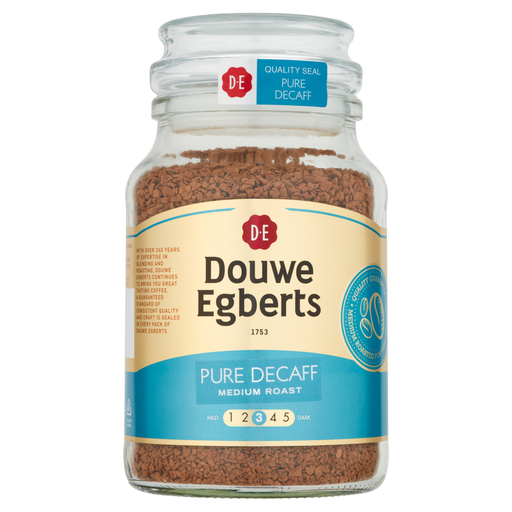 No image available
A 190g decaffeinated instant-coffee jar to consider for a weekday routine. Check the pack’s preparation directions for the cup you intend to make, and do not assume decaffeinated means caffeine-free.
Yes. NESCAFÉ explains that decaf coffee retains a small amount of caffeine, so a decaf jar should not be treated as caffeine-free. Check information for the specific product if the remaining amount matters to you.
For a bolder direction, NESCAFÉ describes Original Decaf as bold and intense; for a balanced direction, Kenco describes Decaf as a medium roast. Sainsbury’s describes Gold Roast as smooth and well rounded and Rich Roast as rich and full flavoured. These are the brands’ or retailer’s descriptions, not a taste-test ranking.
Check the exact product’s ingredients, allergy statement, preparation directions, storage guidance and best-before date. Do not transfer an allergy statement between variants: Marks & Spencer’s separate Decaf Americano Micro-Ground listing, for example, says it is not suitable for people with a milk allergy.