Afternoon black-tea drinkers
If you like a conventional cup with or without milk, start with plain decaf black tea. Check the brewing instructions on the pack before deciding whether its strength suits you.


Choose plain decaf black tea if you want a familiar afternoon cup, particularly one you might serve with milk; choose decaf Earl Grey if you prefer bergamot flavour alongside your snack. If avoiding even small traces of caffeine matters more than keeping a black-tea flavour, check the ingredients and caffeine wording on a herbal or fruit infusion instead: decaf tea is not necessarily caffeine-free.
The useful distinction for an afternoon snack is whether you want a familiar black-tea cup, a different flavour, or a drink selected with residual caffeine in mind.
If you like a conventional cup with or without milk, start with plain decaf black tea. Check the brewing instructions on the pack before deciding whether its strength suits you.
Decaffeinated tea can still contain very low levels of caffeine, as University Hospitals of Leicester NHS Trust explains in its patient information. Check the exact product rather than treating the word “decaf” as a caffeine-free guarantee.
For regular use, compare the tea-bag count and net weight so you know what each box contains. If organic or Fairtrade claims matter to you, check that they apply to the particular tea you are choosing.
Choose the type of cup first, then check the exact product’s caffeine wording, preparation and pack details.
Choose it when: You want a familiar black-tea cup with your afternoon snack, with the option of adding milk.
Bear in mind: Decaffeination does not guarantee that no caffeine remains.
Choose it when: You would rather have bergamot flavour than a plain black-tea cup.
Bear in mind: Earl Grey is still a decaffeinated tea-leaf drink, not automatically a caffeine-free infusion.
Choose it when: Avoiding residual caffeine matters more to you than retaining a black-tea flavour.
Bear in mind: Check the ingredients and caffeine wording of the exact blend; its flavour will differ from black tea.
| Priority | What to check | Your needs |
|---|---|---|
| Caffeine wording | Read the exact product’s caffeine statement and ingredients. Twinings states that its Everyday Decaffeinated tea contains 0.02% caffeine; that figure does not describe every decaf tea. | I want to cut back on caffeine without assuming that a decaf cup contains none. If I am choosing an infusion instead, I will check that particular blend. |
| Tea and flavour | Check whether the product is plain decaf black tea, bergamot-flavoured Earl Grey or a herbal or fruit infusion. These are different drinks, even when each fits an afternoon tea break. | A familiar cup with optional milk appeals to me, or I might prefer Earl Grey’s bergamot flavour with a sweet snack. |
| Brewing | Follow the timing on the selected pack. Tesco advises 4–5 minutes for its Decaff Original; its Tetley 40-bag product page recommends 2–3 minutes before adding milk. | Before changing tea because a cup tastes too mild, I can prepare it as that product directs. |
| Pack format | Compare the stated tea-bag count and net weight, and confirm whether a pack contains bags or loose tea when the format matters. | For a household supply, I want to know how many cups the stated bag count provides. For occasional use, a smaller box may suit the space I have. |
| Ingredients and credentials | Read claims on the exact product. Clipper lists organically grown decaffeinated black tea for Everyday Decaf and identifies Fairtrade-compliant tea in its decaf Earl Grey. | If sourcing or flavouring matters to me, I want a claim that applies to the tea I am buying—not an assumption based on the brand alone. |
Decaffeinated tea can retain very low levels of caffeine. University Hospitals of Leicester NHS Trust makes this distinction in its patient information, so the word “decaf” alone cannot settle a caffeine-free choice.
Read the caffeine wording and ingredients on the exact tea or infusion you plan to drink.
Bergamot flavour is part of the drink, not simply a different name for a plain decaf blend. Tesco describes its Finest Decaffeinated Earl Grey as black tea with bergamot flavour.
Choose Earl Grey deliberately for that flavour; choose plain decaf black tea for a more conventional cup with milk.
An organic or Fairtrade statement concerns a stated characteristic of the product. On its own, it does not tell you the residual caffeine level or whether you will prefer the flavour.
Check each point separately: the ingredients and credentials, caffeine wording, brewing instructions and pack format.
These brand references describe particular decaf teas and ranges; flavour and pack details should be checked on the product you choose.
Yorkshire Tea Decaf is a plain black-tea route for a familiar afternoon cup.
Tetley offers decaffeinated black tea in conventional tea-bag formats.
PG Tips Decaf is another plain black-tea option for an everyday afternoon cup.
Twinings offers decaf styles including everyday black tea and Earl Grey, allowing a choice between plain and flavoured cups.
Clipper has plain decaf black tea and decaf Earl Grey for shoppers considering ingredients and sourcing claims as well as flavour.
Tesco’s own-label choices include a plain decaf black tea and a bergamot-flavoured decaf Earl Grey.
These are decaf black-tea choices for a conventional afternoon cup. Compare their stated pack formats and check the individual tea’s caffeine wording before choosing one for your snack.
 No image available
A tea-bag option for a familiar afternoon black-tea cup. The pack states 80 bags and 250g, and the product description gives a 2–3-minute brew. Check the exact pack for its decaf and residual-caffeine wording: its ingredient line says “Black tea”.
 No image available
Consider this plain decaf black-tea option if its stated organic and Fairtrade claims matter to your choice. The listing states 80 tea bags and 277g. Check the exact tea and pack details before buying, as the description also contains conflicting soft-drink serving text; decaf does not establish zero caffeine.
 No image available
This is a plain decaf black-tea choice for an afternoon cup with or without milk. The listed pack weight is 250g. Confirm whether the selected pack contains tea bags or loose tea, and check its caffeine wording if that affects your choice.
 No image available
The stated 160-bag format may suit a household that makes decaf black tea regularly. The pack weight is 500g, and the product description identifies decaffeinated black tea and makes a Rainforest Alliance sourcing claim. Check the pack for its caffeine statement and brewing directions.
 No image available
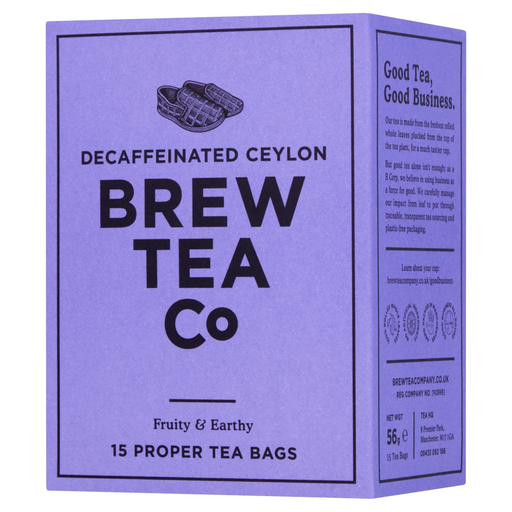
This smaller stated pack offers 15 bags and 56g for an occasional afternoon black-tea cup. The description identifies decaffeinated Ceylon tea and describes a CO₂ decaffeination process, but its ingredient line says “Organic Black Tea”. Check the exact pack’s decaf wording; do not read the listing’s unqualified “not detected” caffeine statement as a guarantee of zero caffeine.
No. Decaffeination removes caffeine from tea leaves, but very low levels can remain, as University Hospitals of Leicester NHS Trust explains. Twinings states that its Everyday Decaffeinated tea contains 0.02% caffeine; check the exact product’s wording rather than applying that figure to other teas.
Choose plain decaf black tea for a familiar cup, particularly if you might add milk. Choose decaf Earl Grey if you prefer bergamot flavour; neither option is automatically caffeine-free.
Follow the instructions for your particular tea. Tesco advises 4–5 minutes for Decaff Original, while its Tetley 40-bag product page recommends 2–3 minutes before adding milk. A different pack may give different directions.
It can be an alternative if the specific infusion’s ingredients and caffeine wording suit that aim. Check the exact blend rather than assuming every drink labelled herbal or fruit is caffeine-free, and expect a different flavour from black tea.