Hosts with mixed caffeine preferences
Offer decaf black tea to guests who want less caffeine without giving up a familiar brew. Keep a distinct choice for anyone who wants to avoid caffeine entirely.


Serve a decaffeinated everyday or English Breakfast-style black tea if guests want a conventional cup with milk but less caffeine. Decaf tea can retain traces of caffeine, so offer a separately labelled herbal or fruit infusion for anyone avoiding caffeine altogether, and check its ingredients rather than assuming every infusion is caffeine-free.
Offer decaf black tea to guests who want less caffeine without giving up a familiar brew. Keep a distinct choice for anyone who wants to avoid caffeine entirely.
An everyday or English Breakfast-style decaf black tea is a closer match to the expected drink than a herbal infusion. Flavoured teas can be offered alongside it rather than in its place.
The NHS advises pregnant people not to have more than 200 mg of caffeine a day. Offer clearly identified drinks so a guest can make their own choice while accounting for caffeine consumed throughout the day.
Start with the kind of drink guests expect, then check caffeine information, ingredients and how many servings the pack provides.
Choose it when: Guests want a conventional black-tea cup with less caffeine, including one they can serve with milk.
Bear in mind: Decaffeination does not necessarily remove every trace of caffeine, and flavour varies by blend.
Choose it when: A guest wants a separately identified drink without caffeine rather than a reduced-caffeine black tea.
Bear in mind: It tastes different from black tea. Twinings notes that blends containing ingredients such as maté or guarana can contain caffeine, so check the individual blend.
| Priority | What to check | Your needs |
|---|---|---|
| Familiar tea flavour | Look for an everyday or English Breakfast-style decaf black tea if you want a plain brew. Check the blend and brewing instructions on the pack rather than assuming all decaf teas taste alike. | I want to offer a recognisable black tea with milk, not ask every guest to switch to a herbal drink. |
| Caffeine distinction | Keep decaf tea and naturally caffeine-free infusions separately labelled. Twinings says minor traces of caffeine can remain in decaf tea; check an infusion’s ingredients for maté or guarana. | Someone avoiding caffeine needs to be able to tell which drink is which before it is served. |
| Pack quantity | Estimate cups per guest, including second servings, and compare that figure with the stated tea-bag count. Confirm the format if a pack gives a weight but no bag count. | For a larger gathering, I need enough of the main tea for more than one round. |
| Ingredients and flavour | Read the exact pack’s ingredients and allergen information. Keep a plain black tea distinct from flavoured choices such as bergamot Earl Grey; check any organic or Fairtrade claims on the product concerned. | I would like guests to recognise the plain and flavoured options and check a label if they have a dietary concern. |
| Pregnancy-related caffeine | The NHS advises a limit of 200 mg of caffeine a day during pregnancy. A guest considering tea needs to account for caffeine from other foods and drinks that day; decaf is not automatically caffeine-free. | I can offer clearly identified alternatives without assuming one cup determines anyone’s daily intake. |
Twinings says minor traces of caffeine can remain after decaffeination. That distinction matters to a guest who wants to avoid caffeine, not just reduce it.
Label decaf black tea separately, and check the ingredients of any herbal or fruit infusion before presenting it as caffeine-free.
Decaf Earl Grey and green tea offer different flavours from a plain everyday black tea, so they may not meet an expectation of traditional tea with milk.
Make a plain everyday or English Breakfast-style decaf black tea available, then add a flavoured choice if guests would appreciate one.
Tea-bag counts differ between formats, and guests may have another cup during the party.
Estimate the likely number of cups and compare it with the count on each pack. Check the format where only the pack weight is clear.
A PG Tips Decaf product page viewed on Joybuy was marked no longer available. A product description is therefore not a substitute for checking the purchase details.
Confirm availability, delivery and the exact pack label before ordering for a specific party date.
These brand examples illustrate different decaf black-tea styles and formats; they are not a ranking or a list of current stock.
Its Decaf is positioned by Yorkshire Tea as a familiar black-tea brew for people reducing caffeine.
Tetley has a decaffeinated black-tea option in a stated 160-bag, 500 g format for hosts planning repeated servings.
A PG Tips Decaf product page describes a decaffeinated black tea in a 70-bag format.
Twinings offers decaf styles including English Breakfast and Earl Grey for hosts who want a choice of black-tea flavours.
Clipper’s Everyday Decaf and Earl Grey Decaf offer a choice between plain and bergamot-flavoured black tea.
These options are decaf black teas for guests who want a conventional tea choice with reduced caffeine. Offer a separately checked, caffeine-free infusion if that is needed at your party.
 No image available
The stated 160-bag count is useful when planning several rounds of black tea. The product description identifies decaffeinated black tea; check the exact pack’s ingredients and allergen information before serving, and do not present decaf as caffeine-free.
 No image available
This plain black-tea option has a stated count of 80 bags. The product description claims organic and Fairtrade attributes, but its ingredient line does not itself specify decaffeination; check the exact pack label before serving it as decaf.
 No image available
The stated 80-bag format offers a different quantity from the 160-bag Tetley pack. The listing gives a 2–3 minute brewing instruction, but its caffeine-free wording should not be treated as proof of zero caffeine; check the exact pack label.
 No image available
This decaffeinated black tea is an option for a conventional tea service. The pack is stated as 250 g; check its format and serving count if you are calculating how much tea to order. Do not assume it is caffeine-free.
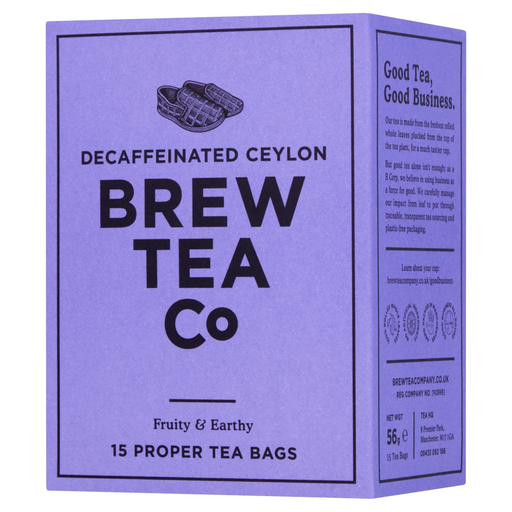 No image available
The stated 15-bag count makes this a smaller-quantity decaf black-tea choice. Plan additional packs if more servings are needed; the listing’s caffeine-not-detected wording is not a general guarantee that decaf tea is caffeine-free.
No. Twinings says minor traces of caffeine can remain in decaffeinated tea. A herbal or fruit infusion may be naturally caffeine-free, but check its ingredients: blends containing maté or guarana can contain caffeine.
Choose a plain everyday or English Breakfast-style decaf black tea if guests expect a conventional tea-with-milk cup. A bergamot-flavoured decaf Earl Grey can be an additional choice, while a separately labelled caffeine-free infusion serves a different preference.
Offer clearly identified decaf and, if appropriate, caffeine-free choices so the guest can decide. The NHS advises pregnant people not to have more than 200 mg of caffeine a day; intake from other foods and drinks also counts, and decaf tea is not necessarily caffeine-free.
Yes. Check the exact pack’s ingredients and allergen information, particularly for flavoured blends or when a guest has an allergy. Do not assume that information for one plain decaf tea applies to another product.