Hosts serving tea with milk
A plain decaf blend keeps the main pot familiar alongside sandwiches, scones and cakes. Twinings specifically suggests milk with its English Breakfast Decaffeinated tea.


For a traditional afternoon tea where guests may take milk, start with a plain decaf tea blend; Yorkshire Tea Decaf, Twinings English Breakfast Decaffeinated and Clipper Organic Everyday Decaf offer different versions of that route. Offer decaf Earl Grey as a separate choice when guests would welcome its bergamot flavour. Check the exact pack’s bag count and caffeine information before serving, particularly if a guest needs to avoid caffeine completely.
A plain decaf blend keeps the main pot familiar alongside sandwiches, scones and cakes. Twinings specifically suggests milk with its English Breakfast Decaffeinated tea.
A separate decaf Earl Grey pot gives guests who enjoy bergamot an alternative to plain tea.
Check the exact tea’s caffeine information before serving. A decaf label alone does not establish that a drink is completely caffeine-free.
Choose the flavour for the main pot first, then check whether the pack and its directions suit the number of guests and the way you plan to serve it.
| Priority | What to check | Your needs |
|---|---|---|
| Plain tea with milk | Look for a plain decaf blend. Twinings describes its English Breakfast Decaffeinated tea as a blend of Assam, Kenyan and Ceylon teas and suggests serving it with milk. | I want a main pot for guests who take milk, rather than making a flavoured tea the only choice. |
| Bergamot flavour | Check whether the tea is Earl Grey or a plain blend. Clipper identifies its decaf Earl Grey as black tea with bergamot flavour. | A second, citrus-led pot would give guests another flavour to choose from. |
| Caffeine information | Read the exact pack’s caffeine statement; seek manufacturer clarification if a precise amount matters. Twinings gives conflicting figures on its English Breakfast Decaffeinated product page. | Someone attending needs to avoid caffeine completely, so I cannot treat “decaf” as a zero-caffeine guarantee. |
| Pack size | Compare the stated bag count and net weight with the cups you expect to make. Check the pack’s storage and brewing directions. | I need enough bags for the gathering without assuming that packs of similar weight contain the same number. |
Clipper’s decaf Earl Grey contains bergamot flavour, which makes it a distinct choice from a plain everyday blend.
For a traditional spread, consider plain decaf tea for the main pot and Earl Grey as an additional option.
Decaffeinated tea should not be treated as proof of zero caffeine. Twinings’ English Breakfast Decaffeinated product page also gives conflicting caffeine figures.
If a guest must avoid caffeine completely, check the current pack and ask the manufacturer to clarify its caffeine information before serving.
Decaf tea listings include different combinations of bag count and net weight, so pack weight alone does not tell you how many bags you can serve.
Estimate the cups needed, then compare the stated bag counts and storage guidance on the packs you are considering.
These references describe particular decaf teas, not every product made by each brand.
Yorkshire Tea presents its Decaf as a blend intended to retain its character after decaffeination.
Twinings English Breakfast Decaffeinated contains Assam, Kenyan and Ceylon teas; Twinings suggests brewing it for two to three minutes and serving it with milk if preferred.
Clipper’s Organic Everyday Decaf is an Assam-blended black tea, while its decaf Earl Grey contains bergamot flavour.
Tesco Groceries has listed Tetley Decaffeinated Tea Bags among its decaf teas.
Tesco Groceries listed PG Tips Decaf Black Tea in a 160-bag, 464 g format in its September–October 2026 catalogue.
Tesco Groceries has listed its own-label Tesco Decaff Original Tea in an 80-pack, 250 g format.
These decaf tea packs are options to consider for the main pot at an afternoon tea. Choose by the stated bag count and blend information; this selection does not include a decaf Earl Grey option.
 No image available
A decaf tea option for the main pot. The pack states 250 g; check its bag count before planning how many cups it will cover, and confirm the caffeine information if a guest needs a precise amount.
 No image available
The stated 80-bag count helps when planning tea for several guests. This pack weighs 250 g; check its directions and caffeine information before serving.
 No image available
Clipper describes its Everyday Decaf as an Assam-blended black tea, making this a plain-tea option rather than an Earl Grey. The named pack contains 80 tea bags and weighs 277 g; check the pack if milk-serving directions or precise caffeine information matter.
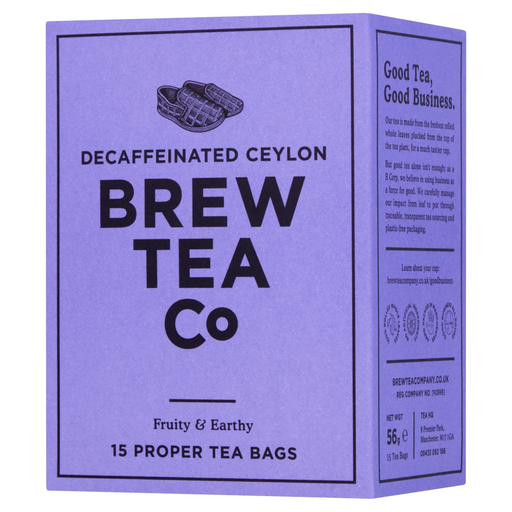 No image available
The stated 15-bag pack may be worth considering for a smaller tea service or an additional pot. Check how many cups you intend to make, along with the current pack’s brewing and caffeine information.
 No image available
The stated 160-bag count gives you a larger pack to compare against the cups planned for the gathering. It weighs 500 g; follow the exact pack’s brewing directions and check its caffeine information where necessary.
For a traditional afternoon tea, a plain decaf blend can be the main pot. Add decaf Earl Grey when guests would welcome bergamot flavour; it is a distinct choice rather than a neutral substitute.
Do not assume so from the word “decaf”. Twinings’ English Breakfast Decaffeinated product page gives conflicting caffeine figures, so check the exact current pack and seek manufacturer clarification if a guest must avoid caffeine completely.
Twinings advises brewing its English Breakfast Decaffeinated tea for two to three minutes, or four minutes for a stronger cup, and adding milk if wanted. Follow the directions for the exact tea you serve.
Check the exact product name, ingredients, bag count or net quantity, and storage and brewing directions. Read its caffeine information closely if a guest has a strict requirement.