Households that drink decaf regularly
If tea bags go into the trolley every week, bag count and pack weight help you judge how much cupboard space to set aside and how soon you may need another pack.


For a household that drinks decaf regularly, start with a larger everyday black-tea pack; for occasional cups, compare smaller packs and choose a blend description that appeals to you. Check the bag count as well as the weight, and do not assume decaf means no caffeine: University Hospitals of Leicester NHS Trust notes that decaffeinated tea can still contain very low levels.
If tea bags go into the trolley every week, bag count and pack weight help you judge how much cupboard space to set aside and how soon you may need another pack.
An everyday decaf black tea can keep the familiar brewing routine, but the caffeine statement belongs to the individual product. University Hospitals of Leicester NHS Trust notes that decaf tea can retain very low levels of caffeine.
If organic or Fairtrade tea matters to you, look for those claims on the specific pack rather than assuming they apply across a brand’s whole range.
Choose the quantity your household will use, then narrow the options by stated blend style and any product-specific claims that matter to you.
| Priority | What to check | Your needs |
|---|---|---|
| Pack quantity | Compare tea-bag count and pack weight. Check the quantity on the exact variant, particularly when a listing gives a weight but no bag count. | We get through decaf regularly, so a 160-bag box could mean fewer additions to the weekly shop. For occasional cups, I would rather check a smaller format. |
| Blend style | Read the product’s stated flavour profile and any brewing directions. Twinings describes its English Breakfast Decaffeinated tea as using Kenyan teas; Tetley Smooth Decaf has its own separately described profile. | I want a named breakfast-style tea rather than choosing every decaf blend as though it will taste the same. Alternatively, a familiar everyday black tea may suit our routine. |
| Residual caffeine | Read the caffeine statement on the exact pack; do not carry a figure from one blend to another. University Hospitals of Leicester NHS Trust says decaf tea can still contain very low caffeine levels. | Even a small amount matters to me, so I need the individual product’s information rather than the word “decaf” alone. |
| Sourcing claims | Check which tea carries an organic or Fairtrade claim and what the current pack says. Keep claims about the tea separate from any claims about its bags or box. | Organic or Fairtrade sourcing is part of my choice, and I want to know exactly which product makes the claim. |
University Hospitals of Leicester NHS Trust notes that decaffeinated tea can still contain very low caffeine levels. A statement about one blend does not establish the level in another.
Read the exact pack’s caffeine information. If you need to limit caffeine for a medical reason, seek individual clinical advice rather than relying on the category name.
An organic or Fairtrade claim about tea does not, by itself, describe the tea bag, box or disposal method.
Check which component each claim covers and follow the pack instructions and local waste guidance when disposing of packaging.
These are references for comparing styles and stated product attributes, not a claim that every blend or pack format is interchangeable.
An everyday decaf black-tea option for shoppers who want the brand’s familiar blend style.
An everyday decaf range that includes standard packs and a separately named Smooth Decaf blend.
A decaf black-tea range for shoppers considering a familiar everyday tea.
A named English Breakfast Decaffeinated option for shoppers looking for a more specifically described blend.
An Organic Everyday Decaf range for shoppers interested in the stated sourcing of the tea.
An own-label everyday decaf option for shoppers comfortable choosing a supermarket blend.
These packs offer different quantities and stated blend or sourcing choices for a weekly tea shop. Check each product’s current label when a particular caffeine statement or sourcing claim affects your choice.
 No image available
A 160-bag pack to consider when decaf tea is a regular household item. The stated weight is 500g; check the pack’s caffeine information if you need a specific level.
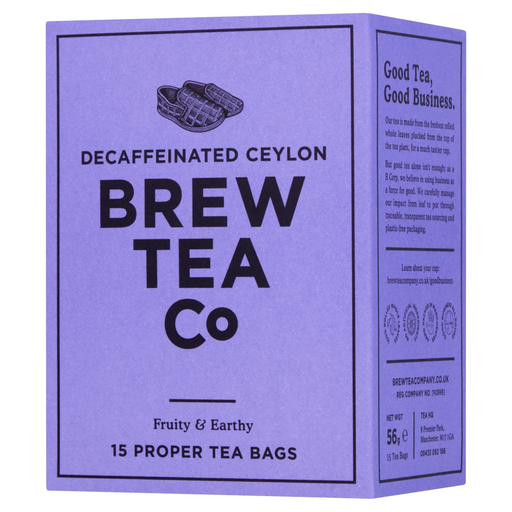 No image available
The 15-bag, 56g format is smaller than the other stated bag counts here, so consider how often your household drinks decaf. The product name identifies CO2 decaffeination; check the current pack for any caffeine statement important to you.
 No image available
An 80-bag, 250g option if a smaller Tetley pack better matches your household’s use than the 160-bag format. Read this pack’s own caffeine information if that detail affects your choice.
 No image available
Choose this 80-bag, 277g format if the stated organic and Fairtrade tea claims are part of your selection criteria. Confirm the claims and any caffeine information on the current pack.
 No image available
A 250g Yorkshire Tea Decaf pack for an everyday black-tea routine. Check its bag count before deciding whether the quantity fits your weekly shop, and read the exact pack for caffeine information.
Not necessarily. University Hospitals of Leicester NHS Trust says decaffeinated tea can still contain very low caffeine levels. Read the individual pack’s statement if you need to limit caffeine strictly.
Match the bag count to how quickly your household uses tea. An 80-bag pack may suit more occasional use, while a 160-bag pack means more bags in the cupboard for regular drinkers; check the quantity on the exact variant rather than judging by weight alone.
Start with the style described on the particular product. Twinings describes its English Breakfast Decaffeinated blend as using Kenyan teas, while everyday decaf ranges offer other stated profiles. Follow the chosen pack’s brewing directions before judging the cup.
Clipper describes its Organic Everyday Decaf as a blend of organic and Fairtrade teas. Check the current pack to see precisely which claims apply to the tea you are buying.