Shoppers cutting back on late-day caffeine
These customers still want black tea in the afternoon or evening but may be looking to reduce caffeine. Decaf remains a tea choice to check carefully when a specific caffeine limit matters.


Stock decaf black tea bags for customers who want a familiar cup with less caffeine, while giving shoppers a choice between everyday blends and options with stated sourcing or decaffeination methods. Decaf does not necessarily mean caffeine-free: Tetley states approximately 2.5 mg of caffeine per 190 ml cup for its decaffeinated tea, and that figure should not be applied to every product or brewing method. Customers who need to keep to a particular caffeine limit should check the current pack rather than rely on the word “decaf” alone.
A retirement shop can make the choice easier by separating caffeine information, familiar black-tea styles and sourcing preferences rather than treating every decaf bag as interchangeable.
These customers still want black tea in the afternoon or evening but may be looking to reduce caffeine. Decaf remains a tea choice to check carefully when a specific caffeine limit matters.
For customers who usually make tea with milk, a decaf black-tea bag keeps the choice within a familiar format rather than switching to a herbal infusion. Pack guidance and the blend’s description can help them choose a cup style.
Organic tea, Fairtrade sourcing or a stated decaffeination method may be deciding factors for some customers. These attributes answer different questions from how much caffeine remains in a brewed cup.
Start with the reason a customer wants decaf, then compare the current packs on cup style, preparation and any sourcing attributes they care about.
| Priority | What to check | Your needs |
|---|---|---|
| Residual caffeine | Read the current pack’s caffeine wording. Keep a percentage claim separate from a milligram figure per brewed cup; compare cup figures only when their preparation bases are comparable. | I want less caffeine later in the day, or I need to check a particular limit. Tetley gives approximately 2.5 mg per 190 ml cup for its decaffeinated tea, but that is not a figure for every decaf product. |
| Cup style | Look for a decaf black-tea blend if the customer wants a conventional cup with milk. Read flavour descriptions as product descriptions, not results of a comparative taste test. | My usual tea is black tea with milk, and I would rather choose a decaf version than a herbal infusion. |
| Brewing | Follow the time on the pack and adjust to the preferred cup. Product guidance differs: the research materials list 1–2 minutes for PG Tips, 2–3 minutes for Twinings and a 1–5 minute range for Typhoo. | I want clear preparation guidance, especially if I am comparing teas with different suggested brewing times. |
| Sourcing and process | Check the exact pack for organic and Fairtrade statements and any disclosed decaffeination method. Do not use those attributes as a measure of caffeine per cup. | Organic or Fairtrade sourcing matters to me, or I want to know how the tea was decaffeinated. |
| Pack information | Check the bag count, ingredients, dietary information and best-before date on the pack being purchased. | I am choosing a pack size for regular use, or I need to check its current ingredients before buying. |
Residual caffeine can matter to someone deliberately limiting it. Tetley states approximately 2.5 mg per 190 ml cup for its decaffeinated tea; preparation can affect the amount extracted.
Describe decaf as a lower-caffeine choice, not a promise of zero caffeine. A customer following an individual caffeine limit should check the current product information and seek advice from their healthcare professional where appropriate.
A percentage statement and milligrams per brewed cup use different measurement bases. They do not establish which finished cup contains less caffeine.
For a caffeine-specific comparison, look for figures for the exact products measured on a comparable brewed-cup and preparation basis.
Organic, Fairtrade and carbon-dioxide decaffeination statements describe sourcing or process. They do not, on their own, establish flavour or residual caffeine per cup.
Keep a sourcing-focused option alongside everyday black-tea choices, and let the customer compare the attributes that matter to them.
Ingredients and other pack details need to match the item the customer actually buys, particularly when dietary information matters.
Use the current physical pack to check ingredients, caffeine wording, bag count, best-before date and relevant dietary information.
These brand references describe particular decaf ranges or products; they are not a ranking or a statement that every pack is available in the shop.
A decaf black-tea option for customers who want a brand-published indication of caffeine per cup.
A conventional decaf black-tea choice described by the brand as smooth and refreshing.
Yorkshire Tea positions its Decaf range for people seeking a traditional tea later in the day.
An English Breakfast-style decaf for customers interested in the brand’s description of a fuller-bodied cup with a light finish.
A decaf black-tea option for customers who prioritise organic tea, Fairtrade sourcing and a stated process.
An everyday decaf black-tea option described by Typhoo as a Kenyan-tea brew.
These decaf tea bags include everyday black-tea packs and options labelled with organic, Fairtrade or CO2-decaffeination details. Compare the exact pack before choosing for a particular caffeine limit.
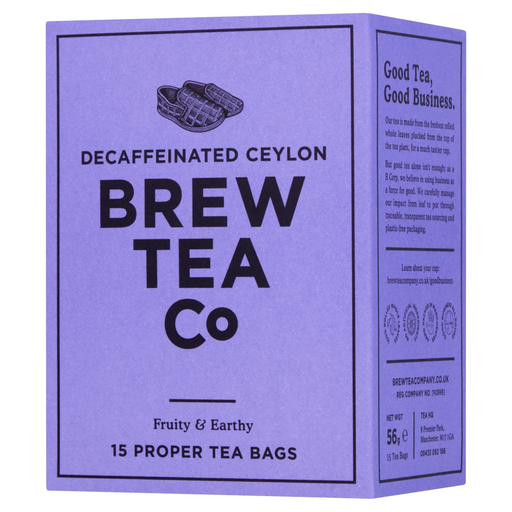 No image available
For shoppers interested in a stated decaffeination method and a 15-bag pack. The product name identifies CO2-decaffeinated tea; check the current pack if a particular caffeine limit matters.
 No image available
For shoppers looking for a decaf pack labelled organic and Fairtrade. This is an 80-bag, 277g pack; those sourcing labels do not specify its caffeine amount per brewed cup.
 No image available
For customers who want a larger pack of decaf tea bags for regular use. The stated pack size is 160 bags and 500g; check its current caffeine wording rather than assuming decaf means caffeine-free.
 No image available
For customers who prefer an 80-bag decaf pack. It is labelled 250g; anyone choosing around a specific caffeine limit should check the information on this pack.
 No image available
For shoppers seeking Yorkshire Tea’s decaf range as a traditional tea option later in the day. This product is labelled 250g; check the current pack for its bag count and caffeine information.
Not necessarily. Tetley states approximately 2.5 mg of caffeine per 190 ml cup for its decaffeinated tea. Treat “decaf” as a reason to check the product’s caffeine information, particularly if someone needs to keep to a specific limit.
Present it as a lower-caffeine black-tea choice, not as caffeine-free or as a solution to sleep problems. NHS Borders advises avoiding caffeine-containing hot drinks close to bedtime; customers concerned about residual caffeine should check the current pack.
Follow the guidance for the particular pack and adjust for the preferred cup. The product guidance in the research materials differs: PG Tips lists 1–2 minutes, Twinings 2–3 minutes and Typhoo a 1–5 minute range. Brewing conditions can also affect caffeine extraction.
Check the physical pack at purchase, especially when ingredients or dietary information affect the choice. Online listings can help narrow the options, but the pack in hand is the reference for its current ingredients, labelling and best-before date.