Households changing their everyday brew
If you usually make black tea, look at decaffeinated black-tea bags before switching tea styles. Bag count and the pack’s brewing directions help you choose a format for your usual routine.


For an everyday pantry brew, start with a decaffeinated black tea in a pack size your household is likely to use, then compare the tea style and any product-specific sourcing credentials you care about. Decaf does not necessarily mean caffeine-free: Twinings says minor traces can remain, so check the exact pack if caffeine content matters to your choice.
If you usually make black tea, look at decaffeinated black-tea bags before switching tea styles. Bag count and the pack’s brewing directions help you choose a format for your usual routine.
Decaffeinated tea keeps the option of a conventional tea brew, but Twinings notes that minor caffeine traces tend to remain. Check ingredients and caffeine information if you are considering a fruit or herbal infusion instead.
If organic tea, Fairtrade status or certified sourcing affects your choice, check the claim on the particular variety and pack size. Clipper’s Organic Everyday Decaf and the Tetley Decaf pack listed by Waitrose illustrate different product-specific credentials.
Choose the tea type and caffeine labelling first, then compare pack size, brewing directions and any credentials on the exact product.
| Priority | What to check | Your needs |
|---|---|---|
| Caffeine information | Check that the exact variety says decaffeinated and read any product-specific caffeine statement. Twinings says decaffeinated tea can retain minor traces; its English Breakfast Decaffeinated product is described as decaffeinated to 0.2%. | I want to reduce caffeine while keeping a conventional tea brew. If caffeine content is decisive, I need the information for the particular pack rather than an assumption about all decaf tea. |
| Tea style and brewing | Distinguish decaf black tea from decaf green tea and fruit or herbal infusions. Follow the chosen pack’s brewing directions before judging its flavour. | For the household’s usual milk tea, I would start by comparing black-tea varieties. Someone who prefers green tea may want a different pantry option. |
| Pack size and storage | Compare the stated bag count and pack weight, rather than treating weight as a bag count. Read the storage directions on the pack. | A frequently used tea can justify a larger box; if the household is trying a new blend, I would choose a quantity it is likely to finish. |
| Ingredients and credentials | Read the exact ingredients and any organic, Fairtrade or certified-sourcing wording. Check tea-bag disposal instructions against local collection rules if disposal matters to you. | I want the credential on the tea I actually buy, not on another variety from the same brand. Ingredients and allergen information on the received pack matter for household dietary decisions. |
Twinings explains that decaffeinated tea has had nearly all its caffeine removed, but minor traces tend to remain.
Read the caffeine statement for the exact product. If you need to avoid caffeine entirely, do not rely on the word “decaf” alone; check the ingredients of any alternative infusion too.
Brands describe different blends, and brewing directions can differ. A large supply is less useful if the household does not like the resulting cup.
Try one pack using its stated brewing directions before choosing a larger quantity.
An unused multipack also takes up pantry space.
Organic and Fairtrade statements identify particular products; they do not establish the credentials of every tea or tea bag in a range.
Check the exact variety and pack for the claim you need. For tea-bag disposal, check both the pack wording and your local authority’s collection rules.
Ingredients and packaging can change. Waitrose advises checking the physical Tetley pack where ingredient information matters.
Screen products online, then read the received pack’s ingredients and allergen information before use, particularly for a household allergy or intolerance.
These are product-line references for comparing styles and label details, not a list of brands necessarily available in the product selection below.
Tetley Decaf is a decaffeinated black tea available in an 80-bag format, according to Waitrose.
Tesco lists PG Tips Decaf as a 70-bag black-tea pack.
Yorkshire Tea positions its decaf blend for people seeking a lower-caffeine version of a familiar brew.
Twinings offers decaffeinated tea styles including English Breakfast.
Clipper’s Organic Everyday Decaf is a decaffeinated black tea in an 80-bag format.
Typhoo lists an 80-bag decaf tea for an everyday black-tea routine.
These options include black- and green-tea bags in different stated pack sizes. Compare the style and quantity with your household’s usual brew; check the individual pack for caffeine and ingredient details that matter to you.
 No image available
A green-tea option if you want a different style from everyday decaf black tea. The pack is labelled 50 tea bags, 100g. Check its caffeine information on the exact pack if you monitor caffeine closely.
 No image available
An 80-bag format for a household seeking an everyday decaf black tea; the Waitrose listing identifies the corresponding Tetley Decaf format as decaffeinated black tea. Read the received pack for current ingredients and caffeine information.
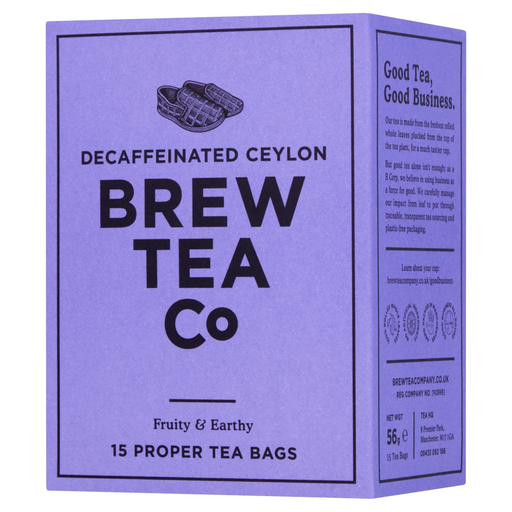 No image available
The stated 15-bag format offers a smaller quantity to try before stocking more. The title identifies CO2 decaffeination; check the received pack’s decaf and ingredient wording, and do not treat an unqualified “not detected” caffeine statement as proof of zero caffeine.
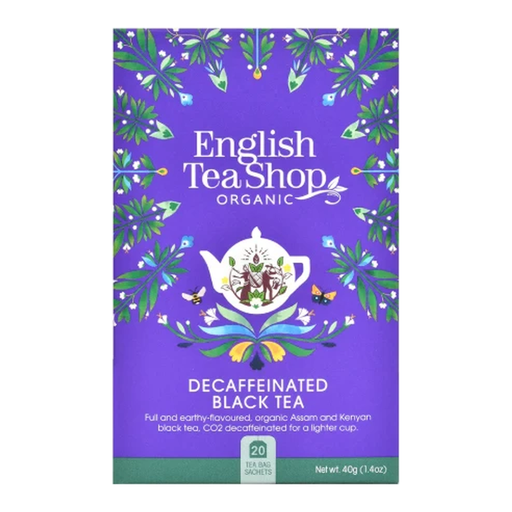 No image available
Consider this 20g organic decaf black-tea pack if that tea style and product wording match your needs. Check its bag count before comparing pantry quantities, and check what any caffeine figure refers to before using it to compare products.
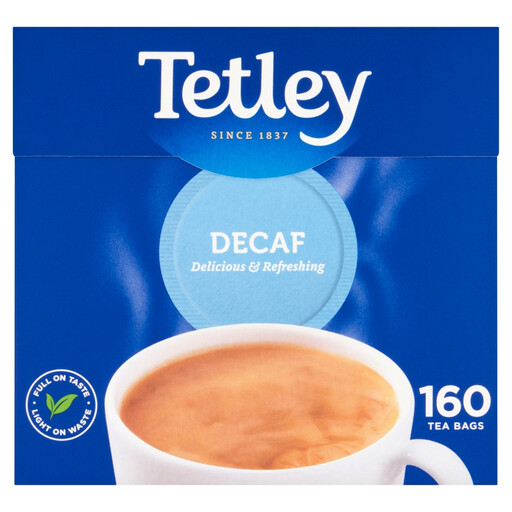 No image available
The stated 160-bag pack is worth considering where decaf tea is used regularly and the household can use that quantity. Its title gives a 500g pack weight; check the exact pack for caffeine, ingredients and brewing directions.
No. Twinings says decaffeination removes nearly all the caffeine from tea, but minor traces tend to remain. Its English Breakfast Decaffeinated product is described as decaffeinated to 0.2%; check the particular product if its caffeine content affects your choice.
Choose a count your household is likely to use, rather than assuming a larger box is preferable. The listed formats include a 70-bag PG Tips pack at Tesco and 80-bag Tetley, Typhoo and Clipper products. If the flavour is new to you, trying one pack before buying several boxes keeps the decision tied to your household’s preference.
Follow the directions for the particular tea bag you buy; decaf varieties and tea styles need not have identical instructions. Brew one pack as directed before deciding whether its flavour suits your usual cup.
Use it to screen a product before buying, then read the received pack before use. Waitrose cautions that product recipes can change, making the physical label particularly important where an ingredient, allergy or intolerance affects your household.