Occasional second-home visitors
If weeks pass between visits, a modest pack limits the number of bags left in storage. Twinings offers a 20-envelope decaf black tea format for this sort of lower-turnover cupboard.


Choose the pack size around how often the second home is used: a small, individually wrapped pack makes sense for occasional visits, while a 70–80-bag pack suits more regular tea drinking. Reserve larger quantities for reliably frequent use, and check the exact pack’s caffeine statement, storage instructions and best-before date before stocking it.
If weeks pass between visits, a modest pack limits the number of bags left in storage. Twinings offers a 20-envelope decaf black tea format for this sort of lower-turnover cupboard.
When household members or guests drink tea on most visits, a 70–80-bag pack offers a larger reserve. Check its best-before date and follow the storage instructions on the pack.
Several tea drinkers may justify keeping more bags on hand. A catering-size pack, such as Clipper’s 250-bag format, is a more considered choice when expected use is consistently high.
Start with likely use between visits, then check the tea type and the information on the exact pack.
| Priority | What to check | Your needs |
|---|---|---|
| Pack size | Compare the bag count with expected visits and guest numbers. Twinings lists 20 envelopes, PG Tips 70 bags and Clipper a 250-bag catering format. | If I visit only occasionally, I would rather keep a modest supply. For regular stays or frequent guests, I may use a larger pack steadily. |
| Caffeine and tea type | Read the current pack’s caffeine declaration and ingredients; do not equate “decaf” with zero caffeine. Check whether it is black or green tea if that distinction matters to guests. | I want an evening tea or a lower-caffeine choice, but I need to know what the particular pack says rather than rely on the word “decaf” alone. |
| Storage and dates | Follow the pack’s storage directions and check its date marking. GOV.UK distinguishes best-before dates, which concern quality, from use-by dates, which concern safety. | Tea may sit between visits, so I want to store it as directed and know what its date marking means before serving it. |
| Disposal | Check the current packaging instructions and the local council’s food-waste rules. ASDA’s PG Tips listing qualifies its industrial-composting claim by whether the council accepts the bags. | Waste collection at the second home may differ from what I use elsewhere, so I need the bags to fit the local arrangements. |
The PG Tips listing states less than 0.2% caffeine, while the Twinings English Breakfast Decaffeinated page gives differing residual-caffeine figures in separate sections.
Check the current pack’s declaration and ingredients if a particular caffeine limit matters to you.
A 250-bag catering pack leaves considerably more tea to store than a 20-envelope or 70–80-bag household pack.
Choose the quantity around expected visits and guest use, rather than assuming a large pack suits every second home.
GOV.UK explains that best-before dates relate to quality, whereas use-by dates relate to safety. Passing a best-before date does not promise unchanged flavour.
Read the date type and storage directions on the pack; do not apply a best-before assessment to food carrying a use-by date.
ASDA’s PG Tips listing specifies industrial composting conditions and makes food-waste disposal conditional on local council acceptance.
Check both the current pack and the collection guidance for the second-home address.
These brand examples illustrate different pack formats and label details; the right quantity still depends on how the property is used.
An everyday decaf black-tea option with household-size packs, including an 80-bag product.
A 70-bag decaf black-tea format for a regularly used cupboard.
The manufacturer presents its Decaf blend as a black tea for lower-caffeine and bedtime drinking.
English Breakfast Decaffeinated comes in a 20-envelope format that may suit less frequent visits.
Clipper offers a 250-bag Organic Everyday Decaf catering format for properties with substantial, regular use.
Typhoo lists an 80-bag decaf product for a standard household reserve.
These packs offer black-tea supplies of 80 or 160 bags for different rates of use, plus a 50-bag decaf green tea for those who prefer green tea. Choose by likely turnover and tea type, then check the delivered pack’s label.
 No image available
An 80-bag decaf tea pack to consider when regular visits will use a household-size supply. Store it in a cool, dry place and check the current pack’s caffeine and date markings.
 No image available
This 80-bag black-tea pack fits a second home where tea is used regularly. Its product information specifies cool, dry storage; check the delivered pack’s caffeine declaration and best-before date.
 No image available
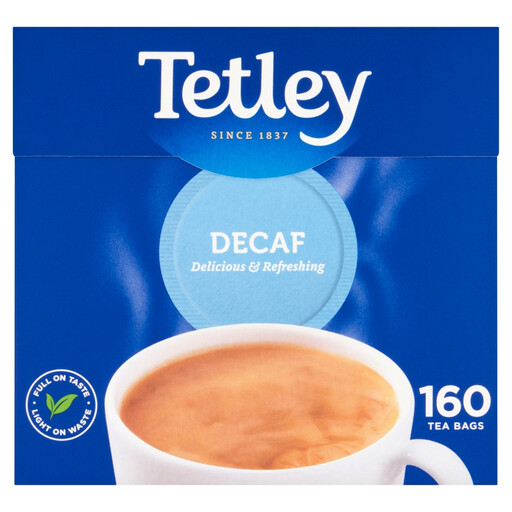
The 160-bag quantity calls for reliably frequent use or several tea drinkers; it may be more than an occasional visitor needs. Check the pack’s storage directions, caffeine information and date marking.
 No image available
This 50-bag green tea is a smaller reserve than the 70–80-bag black-tea examples, but it is a different tea style. Check the current pack’s caffeine declaration, storage directions and date marking.
Choose a large pack when visits and guest use are frequent enough to justify the quantity. Twinings offers 20 envelopes for a smaller reserve, while Clipper’s 250-bag product is a catering format; 70–80-bag packs sit between those sizes.
Do not assume that it is caffeine-free. Sainsbury’s PG Tips listing states less than 0.2% caffeine, and the Twinings product page gives differing figures; check the declaration on the exact current pack if a strict limit matters.
Follow the directions on the pack. Product information for Clipper, Tetley, PG Tips and Typhoo specifies a cool, dry place; keep the date marking available so you can check it on a later visit.
A best-before date concerns quality, not the same safety limit as a use-by date, according to GOV.UK. Follow the storage instructions and do not assume tea kept past its best-before date will have unchanged flavour.
Check the pack and the council rules for that address. ASDA’s PG Tips listing says its plant-based bags are biodegradable in industrial composting conditions when the local council accepts them in food waste.