For a train journey, choose decaf tea bags only if you can bring a cup and hot water or confirm where you can make the drink. Compare pack size and brewing instructions before packing a few bags with your food, and check the label if the amount of caffeine matters: decaf does not mean caffeine-free.
Who might pack decaf tea?
Travellers choosing less caffeine
Decaf black tea offers a familiar type of tea with less caffeine than regular tea, but it is not necessarily caffeine-free, as the British Heart Foundation explains. Check the exact pack if the caffeine amount is important to you.
Travellers making their own hot drinks
If you carry a cup or flask, allow for the tea’s stated brewing time as well as a source of hot water. The product guidance cited for PG Tips is 1–2 minutes; Clipper’s is 2–5 minutes with boiling water.
Shoppers checking sourcing and packaging
Clipper describes its Organic Everyday Decaf as organic and Fairtrade. Tetley makes plant-based tea-bag claims for its cited decaf pack. Check the claims and disposal instructions on the particular pack you buy.
What should you check before choosing?
Start with how you will make the tea, then compare the pack and product details that matter for your journey.
| Priority | What to check | Your needs |
|---|
| Caffeine |
Read the exact pack’s decaf and caffeine wording. Do not treat “decaf” as “caffeine-free”; the British Heart Foundation says decaf tea retains some caffeine. |
I want to reduce caffeine, but need to know what the label actually says before choosing a pack. |
| Brewing |
Check the instructions, the required water temperature and whether you can bring a cup and hot water. The cited guidance is 1–2 minutes for PG Tips, 2–3 minutes for Twinings and 2–5 minutes for Clipper. |
If I have only a short stop, I need enough time and a practical place to make the drink. |
| Pack size |
Compare the bag count with what you intend to carry. Check whether the bags are individually wrapped if that matters for packing them with food. |
I may want just a few bags for one journey, rather than carrying a household box. |
| Tea type |
Check whether the product is decaf black tea or another type of infusion. Use the exact product description rather than assuming every decaf option has the same tea base. |
With my journey food, I’m looking for a conventional black-tea option rather than a fruit or herbal infusion. |
| Sourcing and disposal |
Check organic, Fairtrade and tea-bag material claims on the exact pack. Follow its disposal instructions and the rules for the bin you use. |
Those product claims matter to my choice, but I also need a suitable way to dispose of the used bag while travelling. |
What can make tea bags impractical?
-
Assuming decaf means no caffeine
Decaf tea can still contain caffeine. The British Heart Foundation describes decaf tea as having most, rather than all, of its caffeine removed.
Read the precise product label if a particular caffeine amount is important to your decision.
-
Packing bags without a way to brew them
A dry tea bag is not a ready-to-drink option: you need a suitable cup, hot water and time to let it infuse.
Bring a prepared flask if appropriate, or check your hot-water arrangements before relying on tea bags for the journey.
-
Carrying a whole box for one trip
The cited packs range from 40 to 160 bags. A household-sized box can take more room than the amount you expect to use.
Consider taking the bags you need in a clean, dry, food-safe container. Keep the outer pack for its ingredient, storage and best-before information.
-
Assuming every used bag goes in the same bin
Plant-based, biodegradable and industrially compostable claims do not establish what collection facilities a train or station provides.
Follow the exact pack’s disposal instructions and the bin signage where you are; do not put tea bags into recycling without an appropriate collection route.
Decaf tea brand references
These details refer to the named product lines and packs, not every tea sold by each brand.
Twinings
Twinings lists an English Breakfast Decaffeinated black tea in a 40-bag, 109 g pack.
- Its stated brewing guide is 2–3 minutes.
- The online product information gives conflicting decaffeination figures. Check the physical pack or ask Twinings if a precise figure matters.
Yorkshire Tea
Yorkshire Tea presents its Decaf as a black-tea blend developed to retain its character after decaffeination.
- A Joybuy product page lists a Yorkshire Tea Decaf 40-bag, 125 g pack.
- The description of the blend’s character is Yorkshire Tea’s own position, not an independent flavour comparison.
Clipper
Clipper describes its 80-bag Organic Everyday Decaf as organic and Fairtrade black tea.
- Clipper states that its tea bags are plant-based and biodegradable and gives a 2–5 minute infusion guide.
- An 80-bag box may be more than you want to carry for a single journey; check how you will pack the bags you need.
PG Tips
Tesco lists a 70-bag PG Tips Decaf black-tea pack.
- The cited preparation guidance is 1–2 minutes, and Tesco states that the product contains less than 0.2% caffeine.
- Less than 0.2% caffeine does not mean caffeine-free; check that the 70-bag format suits how much you plan to carry.
Tetley
Tesco lists Tetley Decaffeinated black tea in a 160-bag, 500 g pack.
- The cited product information describes the tea bags as plant-based.
- For one journey, consider taking a few bags separately rather than carrying the full 160-bag box.
Typhoo
Typhoo lists an 80-bag Decaf Premium Tea product described as a Kenyan tea blend.
- Typhoo’s brewing guide allows 1–5 minutes.
- Check the pack details if you need a smaller quantity or a particular way of carrying the bags.
Decaf tea options on Joybuy
These Joybuy options include smaller supplies for carrying with journey food and larger decaf packs from which you could take a few bags. Check the product’s form and packaging before planning what to take.
 No image available
Clipper Organic Fairtrade Decaf Everyday 80 Tea Bags 277g
An 80-bag decaf option if organic and Fairtrade claims matter to your choice. Pack the quantity you need for the journey, and check whether the bags are individually wrapped if that affects how you carry them.
View on Joybuy
 No image available
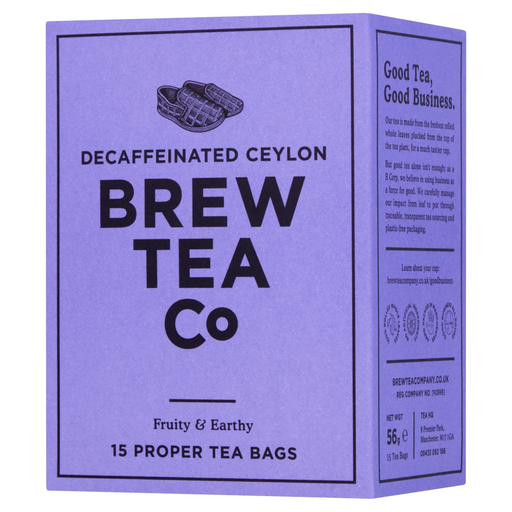
Brew Tea Co CO2 Decaffeinated Tea, 15 Proper Tea Bags, 56g
The 15-bag pack is a smaller supply to consider alongside journey food. Check its brewing instructions and whether the bags are individually wrapped before deciding how to pack them.
View on Joybuy
 No image available
Tetley 80 Decaffeinated Tea Bags 250g
This 80-bag pack could supply several cups or journeys. If you plan to make tea en route, arrange a cup and hot water, and check the pack for the instructions and wrapping details you need.
View on Joybuy
 No image available
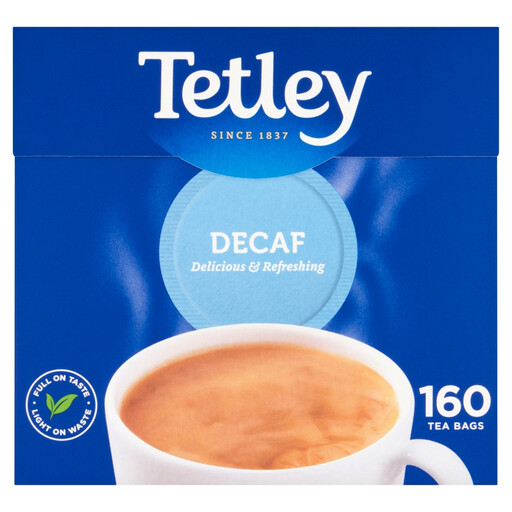
Tetley 160 Decaf Tea Bags 500g
The 160-bag, 500 g pack is a larger supply from which to take bags for repeated journeys. For one trip, consider carrying only the amount you expect to use in a clean, dry container.
View on Joybuy
 No image available
Taylors of Harrogate Yorkshire Tea Decaf 250g
A Yorkshire Tea decaf option to consider if you prefer that blend. Before planning to carry it with journey food, check the product packaging for its form, tea-bag count if applicable, and brewing instructions.
View on Joybuy
Frequently asked questions
Are decaf tea bags caffeine-free?
No. The British Heart Foundation says decaf tea has had most of its caffeine removed but is not completely caffeine-free. Check the exact product label if the caffeine amount affects your choice.
Can I make tea from a bag on any train?
Do not assume a cup or hot water will be available on every service. Arrange to bring what you need or check the facilities for your journey; then allow for the product’s stated brewing time.
Which pack size makes sense for one journey?
Choose by how many bags you expect to use and how you will carry them, rather than assuming a box is travel-sized. You can take a few bags from a larger pack in a clean, dry container; check the exact packaging if individual wrapping matters.
Can used tea bags go in a food-waste bin while travelling?
Only where the product’s disposal instructions and the available collection facility allow it. Check the pack and the bin signage at the station or on your route instead of assuming the same disposal option is available everywhere.


