Evening black-tea drinkers
If you want a conventional cup with milk while reducing caffeine, start with decaf black tea. Compare the product’s caffeine statement and brewing directions rather than assuming every decaf blend will make the same cup.


Choose an everyday decaf black tea if you want a familiar cup with milk, or a decaf green tea or Earl Grey if you prefer a different style. Decaf does not necessarily mean caffeine-free: check the exact product’s caffeine wording, then set your grocery retailer’s substitution preference if the tea type, ingredients or pack size matter to you.
If you want a conventional cup with milk while reducing caffeine, start with decaf black tea. Compare the product’s caffeine statement and brewing directions rather than assuming every decaf blend will make the same cup.
A substitute could change the tea style, flavour, ingredients or number of bags. Check your substitution choice before checkout and inspect any replacement offered with your delivery.
If organic ingredients, Fairtrade sourcing or tea-bag disposal matter to you, check the claim on the individual product and delivered pack. Do not extend a claim from one tea to every product made by its brand.
Settle on the tea style and caffeine wording you need, then use the listing to distinguish packs and manage possible substitutions.
| Priority | What to check | Your needs |
|---|---|---|
| Caffeine wording | Read the statement for the exact tea. Twinings says minor traces can remain in decaf tea; its Everyday Decaffeinated page states 0.02% caffeine, while Tesco lists PG Tips Decaf at less than 0.2%. | I want to reduce caffeine, or I need to avoid it altogether. If avoidance is essential, I will check the ingredients of an alternative infusion rather than assume a decaf tea contains none. |
| Tea style | Distinguish everyday black tea from decaf green tea or flavoured Earl Grey. Compare the blend description and the brewing directions for the particular product. | For a familiar cup with milk, I would start with black tea. If I prefer green tea or bergamot flavour, I would choose that style deliberately rather than accept it as a substitute. |
| Pack details | Check both bag count and net weight. Reviewed listings identify PG Tips Decaf as 70 bags and 203 g, and Tetley Decaf as 80 bags and 250 g. | I want to know which pack will arrive and how many bags it contains, especially when similar-looking boxes have different counts. |
| Substitutions | Review the grocery retailer’s substitution controls before checkout. Tesco and Sainsbury’s describe options for declining an unwanted substitute at collection or delivery. | If a particular ingredient, caffeine statement or tea style matters, I want a chance to check any replacement before keeping it. |
| Sourcing and disposal | Read product-specific ingredient and packaging claims, then check the supplied pack for disposal instructions. Collection arrangements also depend on the local service. | I want the stated sourcing or tea-bag material to match the product I receive, not merely another tea in the same brand’s range. |
Twinings explains that minor traces of caffeine can remain after tea is decaffeinated. A decaf label therefore does not answer a requirement to avoid caffeine altogether.
For caffeine reduction, compare the statement on the exact tea. If you need to avoid caffeine, check the ingredients of a herbal or fruit infusion too; ingredients such as mate or guarana can contain caffeine.
A replacement may differ in tea type, flavour, ingredients, caffeine wording or pack size, even when it is also labelled decaf.
Set your substitution preference before checkout. Tesco says an unwanted substitute can be returned to its driver or Click+Collect colleague for a refund; Sainsbury’s says customers can choose whether to keep a substitute or receive a refund.
Bag counts and net weights differ: the reviewed PG Tips Decaf listing gives 70 bags and 203 g, while the Tetley Decaf listings give 80 bags and 250 g.
Check both figures on the product you order, alongside the tea style and caffeine information that matter to you.
Ingredient, sourcing and packaging statements belong to particular products. Typhoo also notes that packaging supplied may differ.
Check the exact listing and delivered pack for any claim essential to your choice, including its disposal instructions.
These are product and range references for comparing decaf styles and pack claims, not a statement that every product is available in a particular grocery order.
Waitrose and Sainsbury’s list Tetley Decaf as an 80-bag, 250 g decaffeinated black tea.
Tesco lists PG Tips Decaf as decaffeinated black tea in a 70-bag, 203 g pack.
Yorkshire Tea describes its Decaf as a black-tea blend intended to retain its character after decaffeination.
Twinings lists decaf black, green and Earl Grey teas. Its Everyday Decaffeinated product is an 80-bag, 250 g pack.
Clipper describes Organic Everyday Decaf as a decaffeinated black tea blended with Assam.
Typhoo identifies its 80-bag Decaf product as an everyday tea made with Kenyan tea.
These options include everyday decaf black teas and a decaf green tea. Compare their stated pack sizes and check the individual product and delivered pack for any caffeine or ingredient detail essential to your order.
 No image available
For a decaf green tea rather than an everyday black-tea blend. The pack contains 50 bags and weighs 100 g. Its product information states decaffeination to 0.2%; check the wording on the supplied pack if the basis of that figure matters to you.
 No image available
An everyday decaf black-tea format for shoppers who want a familiar brew. The pack contains 80 bags and weighs 250 g; the product guidance recommends brewing for 2–3 minutes. Check the delivered pack’s ingredient and caffeine wording if either is essential to your choice.
 No image available
A decaf black-tea option for shoppers comparing organic and Fairtrade product claims. The listed pack contains 80 bags and weighs 277 g. Check the supplied pack for the sourcing claims and caffeine wording that matter to you.
 No image available
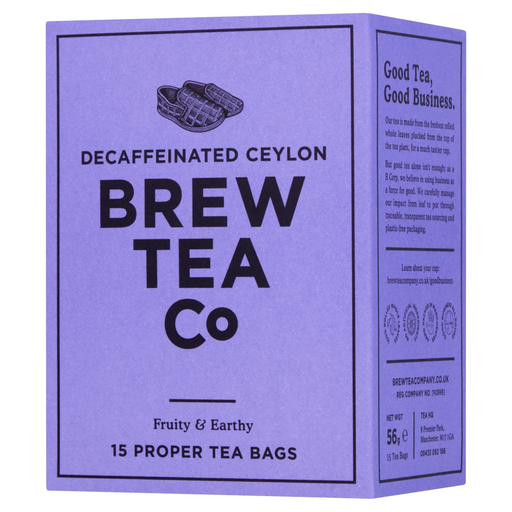
A smaller pack described as decaffeinated Ceylon black tea, with 15 bags and a net weight of 56 g. The seller’s caffeine and decaffeination-method wording does not establish a caffeine amount for a prepared cup; check the supplied pack’s ingredients and caffeine statement if these determine your choice.
 No image available
A decaffeinated black-tea blend for an everyday cup, in a 250 g pack. If bag count, brewing directions or a particular caffeine statement will affect your order, check those details on the product and supplied pack.
No. Twinings says minor traces can remain after decaffeination. Its Everyday Decaffeinated page states 0.02% caffeine, but that figure is for that product, not every decaf tea. If you need to avoid caffeine altogether, check the ingredients of a herbal or fruit infusion; mate and guarana are ingredients to watch for.
Set your retailer’s substitution preference before checkout and inspect any replacement offered. Tesco says you can return an unwanted substitute to its driver or Click+Collect colleague for a refund. Sainsbury’s says you can choose whether to keep a substitute or receive a refund; check the terms of the retailer handling your order.
Compare tea style, bag count, net weight, ingredients, caffeine wording and brewing directions. Check the delivered pack when a particular detail matters, because the item supplied is the one you will use.
Follow the disposal instructions for the exact tea bags delivered and check what your local collection service accepts. A packaging or compostability claim for one product does not establish how every brand’s tea bags should be disposed of.