Hosts serving several guests
Counted tea-bag packs make it straightforward to plan for attendees and second cups. A kettle or teapot also lets guests have decaf tea without a capsule machine.


For a book club using a kettle or teapot, choose decaf black-tea bags rather than assuming tea pods will work. Compare pack count with the number of cups you expect to serve, and check each product’s brewing and caffeine information. Consider capsules only if you know the machine system and can confirm that a decaf tea capsule fits it.
Counted tea-bag packs make it straightforward to plan for attendees and second cups. A kettle or teapot also lets guests have decaf tea without a capsule machine.
A conventional black-tea bag offers a familiar cup, including for guests who add milk. Anyone who needs to know how much caffeine remains should check the exact product’s disclosure rather than assume decaf means caffeine-free.
Tea capsules are worth considering only after identifying the machine system and checking a capsule’s stated compatibility. A general description such as ‘tea pod’ does not establish that it will fit.
Settle the serving format first, then choose a pack and check the information that matters to your guests.
Choose when: The group will make tea with a kettle or teapot.
Bear in mind: Guests need to steep each bag, and decaf does not necessarily mean caffeine-free.
Consider when: You have a named machine system and a decaf tea capsule explicitly marked as compatible.
Bear in mind: MaxiCoffee UK lists tea pods by distinct systems, including Nespresso, Tassimo and Dolce Gusto; a pod for one system should not be assumed to fit another.
| Priority | What to check | Your needs |
|---|---|---|
| Serving format | Check whether you will use a kettle or a capsule machine. For capsules, match the stated machine system to the appliance. | I want everyone to be able to make a cup without working out which pod fits a machine. |
| Remaining caffeine | Read the exact product’s caffeine statement and its measurement basis. Yorkshire Tea states 1.5–2mg per 200ml cup brewed for five minutes; Sainsbury’s lists its PG Tips Decaf product as containing less than 0.2% caffeine. Those figures are not directly interchangeable. | If the amount matters to a guest, I need information for the tea I will actually serve, not a general assumption about decaf. |
| Pack count | Compare the number of bags with expected tea drinkers and possible second cups. Listed examples include Yorkshire Tea packs of 40, 80 and 160 bags and a PG Tips pack of 70. | A counted pack helps me plan for this meeting and any tea left for the next one. |
| Brewing directions | Follow the selected pack’s water and steeping instructions rather than applying one brewing time to every tea. Tesco’s listing for Decaff Original specifies 3–5 minutes. | I want to give guests clear directions without assuming every bag brews the same way. |
| Product attributes | Check the current pack for ingredients and any sourcing attributes you want. Tesco’s Clipper listing identifies a 40-bag organic black-tea product and describes CO2 decaffeination. | Our group may care about what is in the tea or how the chosen product is described, so I would check its label before serving. |
Capsules are sold for named machine systems. A pod that does not match the available appliance may be unusable at the meeting.
Identify the machine system and check compatibility on the capsule listing. If you are serving tea from a kettle or teapot, buy tea bags instead.
Yorkshire Tea states that its Decaf contains an average of 1.5–2mg caffeine per 200ml cup brewed for five minutes. Other products may express remaining caffeine on a different basis.
Check the exact pack and its measurement basis before describing the tea to guests.
Tesco warns that food products can be reformulated and that ingredients, nutrition and allergen information may change.
Read the pack you will serve, particularly when a guest needs to check ingredients or allergens.
These are references for comparing decaf tea-bag products, not a list of brands included in the Joybuy selection below.
Yorkshire Tea Decaf is a black-tea-bag option for a conventional cup; the brand lists 40-, 80- and 160-bag packs.
Sainsbury’s lists PG Tips Decaf as a 70-bag decaffeinated black tea in pyramid bags.
Twinings describes its Everyday Decaffeinated tea as made from Kenyan teas and lists an 80-bag, 250g pack.
Tesco lists a 40-bag Clipper Fairtrade Organic Decaf black-tea product.
Tetley is another decaf tea-bag option to consider for kettle or teapot serving.
Tesco Decaff Original is an own-label, 80-bag decaffeinated tea option.
These four products are tea bags for a book club serving tea with a kettle or teapot, in packs of 15, 80 or 160 bags. They are not machine capsules.
 No image available
An 80-bag decaf option when you are counting out servings for a group. Check the current pack’s brewing and remaining-caffeine information if those details matter to your guests.
 No image available
An 80-bag decaf black-tea option for groups considering the product’s stated Organic and Fairtrade attributes. Check the current pack’s preparation directions before serving.
 No image available
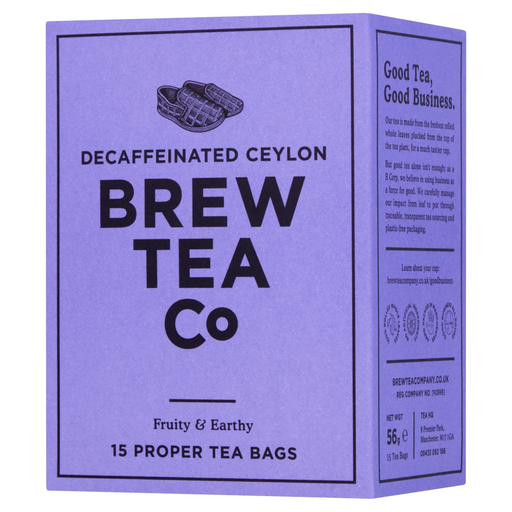
The 15-bag pack may suit a smaller meeting; count expected cups carefully if guests may return for more tea. CO2 decaffeination is stated in the product name. Check the pack for brewing directions.
 No image available
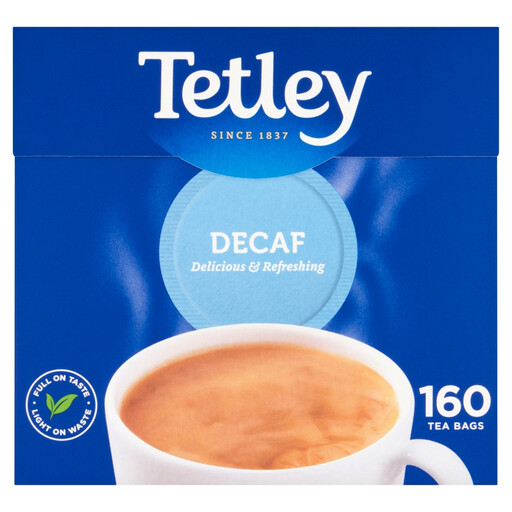
A 160-bag decaf black-tea pack to consider when planning for repeated meetings or second cups. Read the current pack for brewing directions and any remaining-caffeine information your guests need.
Not necessarily. Yorkshire Tea states that its Decaf contains an average of 1.5–2mg caffeine per 200ml cup brewed for five minutes, while Sainsbury’s says its listed PG Tips Decaf product contains less than 0.2% caffeine. Check the exact tea and measurement basis; those figures cannot be directly converted into one another.
Choose tea bags if you will serve tea using a kettle or teapot. If you want capsules, identify the machine system first and buy a decaf tea capsule explicitly marked as compatible with it; MaxiCoffee UK lists tea pods for distinct systems, including Nespresso, Tassimo and Dolce Gusto.
Estimate one bag for each guest who wants tea, then allow for anyone who may have another cup. Compare that estimate with the pack count: Yorkshire Tea lists 40-, 80- and 160-bag Decaf packs, for example.
No; follow the directions on the tea you serve. Tesco’s listing for Decaff Original gives 3–5 minutes, while Yorkshire Tea bases its published remaining-caffeine figure on a cup brewed for five minutes.
Read the ingredients and allergen information on the pack being served. Tesco warns that food products can be reformulated, so an older online listing may not match the current pack.