Everyday tea drinkers
If this is your first box for regular cups, distinguish plain decaf black tea from a breakfast blend or a bergamot-flavoured Earl Grey. Those styles need not taste alike, even though each can be sold as decaf tea.


For a first food shop, start with a plain everyday decaf black tea if you want a familiar tea for regular cups. Choose a breakfast blend for that particular black-tea style or Earl Grey if you want bergamot; if avoiding caffeine is essential, check an individual herbal, fruit or rooibos infusion rather than assuming decaf black tea contains none.
If this is your first box for regular cups, distinguish plain decaf black tea from a breakfast blend or a bergamot-flavoured Earl Grey. Those styles need not taste alike, even though each can be sold as decaf tea.
Decaffeinated black tea keeps you in the black-tea category, but it should not be assumed to contain no caffeine. If caffeine avoidance is the deciding factor, check the ingredients of a herbal, fruit or rooibos infusion instead.
Compare the exact pack for added flavourings and any Organic or Fairtrade credentials that matter to you. Those details answer different questions from whether the tea is plain, breakfast-style or Earl Grey.
Choose the drink type and flavour before comparing pack formats: a plain black tea, a bergamot-flavoured tea and an infusion serve different preferences.
| Priority | What to check | Your needs |
|---|---|---|
| Caffeine | Check the exact pack’s caffeine statement and ingredients. Tesco Groceries lists PG Tips Decaf at less than 0.2% caffeine; that figure does not describe every decaf tea. | I want less caffeine while keeping black tea, or I need to check an individual herbal, fruit or rooibos infusion because avoiding caffeine is essential. |
| Black-tea style | Distinguish plain everyday decaf from a named breakfast blend. Twinings describes its English Breakfast Decaffeinated as having body and a light finish; compare brewing directions for the pack you choose. | For regular cups, I would start with plain decaf; I would pick English Breakfast specifically for a breakfast-style tea. |
| Flavouring | Read the ingredient list rather than relying on the word “decaf”. Clipper lists black tea (95%) and natural flavour (5%) for its bergamot-flavoured Decaf Earl Grey. | If I want a plain tea, I would leave Earl Grey for another shop. If I enjoy bergamot, it belongs on my shortlist. |
| Sourcing | Check credentials on the particular product, alongside its tea style. Clipper describes its Everyday Decaf as Organic and Fairtrade and says it uses carbon dioxide for decaffeination. | Organic or Fairtrade sourcing matters to me, but I still want to know whether the blend is plain or flavoured. |
| Pack format | Compare bag count and weight, then use the retailer’s current unit prices on the same basis. Check whether an offer has conditions or an end date. | For a first shop, I want a pack size I can use before deciding whether to buy more of that blend. |
Decaffeinated black tea may retain caffeine: Tesco Groceries states that PG Tips Decaf contains less than 0.2%. Twinings distinguishes black tea from herbal, fruit and rooibos infusions, which it describes as naturally caffeine-free.
Decide whether you want to reduce caffeine or avoid it, and check the exact pack and ingredients before choosing.
Clipper’s Decaf Earl Grey contains bergamot flavour, so it is a different choice from unflavoured black tea.
Choose it if you want bergamot; otherwise, compare plain everyday decaf blends for your first box.
Different bag counts and weights make ticket prices difficult to compare. Tesco Groceries also displays offers with dates and conditions.
Check the current unit price on a consistent basis and whether any displayed offer applies to your purchase.
Organic and Fairtrade credentials describe sourcing, not whether a blend is plain, breakfast-style, bergamot-flavoured or free from caffeine.
Settle on the drink and flavour you want, then compare credentials on the specific packs.
Yorkshire Tea presents its Decaf as an everyday black-tea blend.
PG Tips Decaf is listed by Tesco Groceries as a 70-bag, 203g black-tea pack.
A listed Tetley Decaffeinated 80-bag pack is described as unflavoured black tea.
Twinings lists several decaffeinated tea styles, including English Breakfast, everyday and green tea.
Clipper lists both an Everyday Decaf and a bergamot-flavoured Decaf Earl Grey.
Tesco Groceries separates decaf black, green, and fruit and herbal tea in its shopping categories.
These Joybuy options are everyday decaf black teas, including one labelled Organic and Fairtrade. Compare their pack details if you are choosing a plain-tea starting point; the list does not cover the breakfast, Earl Grey or infusion choices discussed above.
 No image available
An everyday decaf black-tea option if Organic and Fairtrade credentials are part of your choice. Check the pack’s caffeine information if avoiding caffeine is essential.
 No image available
An 80-bag decaffeinated tea pack for a regular black-tea routine. Check the current ingredient label and caffeine information if either affects your choice.
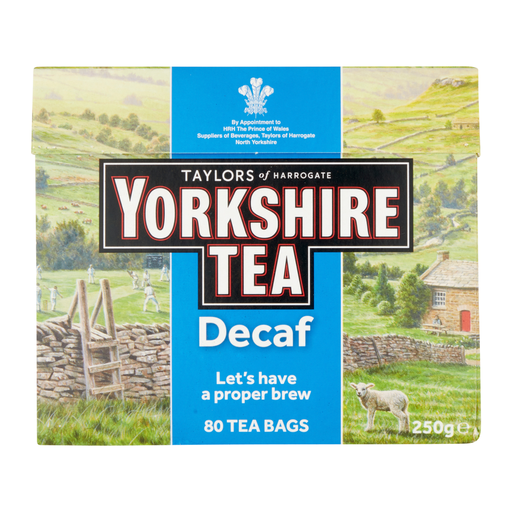 No image available
A 250g decaffeinated black-tea option for an everyday cup. Check the pack’s bag count before comparing it with bag-counted boxes, and check its caffeine information if needed.
Not necessarily. Tesco Groceries states that PG Tips Decaf contains less than 0.2% caffeine. Twinings describes herbal and fruit infusions and rooibos as naturally caffeine-free; check an individual product’s ingredients and label if avoiding caffeine is essential.
A plain everyday decaf black tea is a starting point if you want a familiar style for regular cups. Consider a named English Breakfast blend if that is the style you prefer, and choose Earl Grey only if you want its bergamot flavour.
Check the bag count and weight, then compare current retailer unit prices using the same measure, such as per bag or per 100g. Check whether an offer has conditions or an end date before relying on the displayed figure.
Read the current ingredient list and allergen information on the pack. Clipper, for example, lists natural flavour in its Decaf Earl Grey. GOV.UK guidance says food businesses must tell consumers about 14 specified allergens when they are ingredients in food or drink; do not assume an allergen is present in a particular tea without checking its label.