Everyday tea-and-biscuit drinkers reducing caffeine
If you usually take black tea with milk, an everyday decaf blend lets you keep that style of cup while reducing caffeine. Compare the blends by flavour rather than assuming they will taste alike.


For a familiar tea-and-biscuits break, start with an everyday decaf black tea; choose an English Breakfast blend if you prefer that style, or an organic and Fairtrade option if sourcing matters to you. Flavour is a personal choice, and decaffeinated tea can retain traces of caffeine, so check the exact pack if you need to avoid caffeine.
If you usually take black tea with milk, an everyday decaf blend lets you keep that style of cup while reducing caffeine. Compare the blends by flavour rather than assuming they will taste alike.
If you make tea frequently, check both the number of tea bags and the stated pack weight. Packs with different bag counts are not necessarily the same size by weight.
If sourcing is part of your choice, look for the organic and Fairtrade statements on the specific decaf blend. Do not assume those claims apply to every tea from a brand.
Choose the type of cup you want first, then check caffeine wording and pack details on the particular tea.
| Priority | What to check | Your needs |
|---|---|---|
| Black-tea flavour | Compare everyday and English Breakfast descriptions. Follow the pack’s brewing instructions before judging a blend; Twinings specifies two to three minutes for its English Breakfast Decaffeinated, or four for a stronger cup. | I usually add milk and want a recognisable black-tea cup alongside biscuits, rather than a fruit or herbal infusion. |
| Caffeine | Read the exact product’s caffeine and ingredient information. Twinings says minor traces tend to remain in decaffeinated tea; most fruit and herbal infusions naturally contain no caffeine, but ingredients still need checking. | I want to reduce caffeine, or I need to distinguish a decaf tea from a drink that naturally contains none. |
| Pack format | Check tea-bag count, stated weight and whether the pack contains bags or another format. Compare the same details again when changing pack size. | For regular tea breaks, I want a pack format that fits how often I make a cup. |
| Sourcing | Look for organic ingredients and Fairtrade statements on the exact product. Clipper describes its Organic & Fairtrade Everyday Decaf as organically grown black tea traded in compliance with Fairtrade standards. | Organic ingredients or Fairtrade sourcing matter to me as well as the style of tea. |
| Flavoured tea | Check whether you want bergamot rather than a plain black-tea blend. Clipper describes its decaf Earl Grey as black tea with bergamot flavour. | I might enjoy a citrus note with biscuits, but I do not want to mistake Earl Grey for a plain everyday blend. |
Twinings says its decaffeinated tea can retain minor traces of caffeine. A fruit or herbal infusion is a different type of drink, and its ingredients should still be checked.
If a defined caffeine limit matters to you, read the exact pack rather than relying on the word “decaf”.
Decaf tea listings include different bag counts and pack weights, so one figure does not describe the whole pack.
Check both the stated weight and the number of bags, particularly when moving between smaller and larger formats.
English Breakfast and bergamot-flavoured Earl Grey offer different styles of black tea; organic or Fairtrade statements describe sourcing, not a particular taste.
For a familiar milk-and-biscuits cup, begin with a plain everyday or English Breakfast decaf. Choose Earl Grey when you specifically want bergamot.
These references describe particular decaf lines and pack listings; they do not mean that every tea from a brand has the same ingredients or flavour.
An everyday decaf black-tea blend for shoppers who want a familiar style of brew.
A decaffeinated tea-bag option in smaller and larger everyday formats.
A decaf black-tea option for shoppers comparing tea-bag pack sizes.
A range spanning everyday and English Breakfast decaf teas, Earl Grey and other drink styles.
An organic and Fairtrade everyday decaf black-tea route.
An own-label decaf option to consider alongside branded everyday black teas.
These options are decaf black teas for an everyday tea-and-biscuits break, including an organic and Fairtrade-labelled blend. Compare their stated pack formats and check the exact product details before choosing.
 No image available
A decaf black-tea option for a familiar tea-and-biscuits cup. The stated pack weight is 250 g; check the pack’s caffeine information if a specific limit matters to you.
 No image available
A decaf black tea in an 80-bag, 250 g pack for regular tea breaks. Do not treat caffeine-free wording in a description as a product-specific caffeine figure; check the pack if you need a defined limit.
 No image available
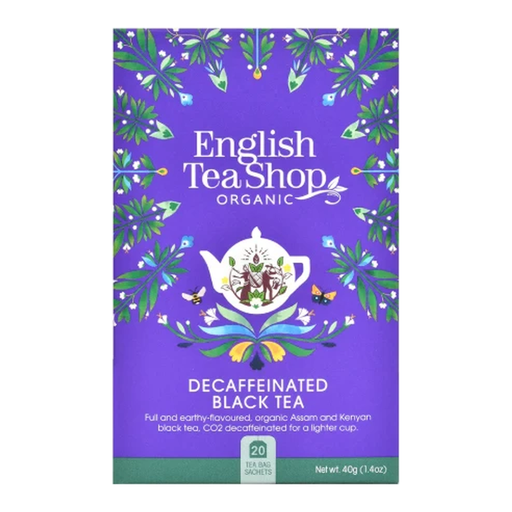
An organic decaf black-tea option for a tea break, in a pack stated as 20 g. Check the pack contents for its format and serving count before ordering.
 No image available
A decaf black-tea choice if organic and Fairtrade-labelled sourcing matters to you. The title states 80 tea bags and 277 g; confirm those pack details before ordering, as accompanying serving directions describe a different kind of drink.
Not necessarily. Twinings says decaffeinated tea has had nearly all its caffeine removed but can retain minor traces. Check the exact product if you need to avoid caffeine; most fruit and herbal infusions naturally contain none, though their ingredients still matter.
Start with an everyday decaf black tea or an English Breakfast decaf if you want a familiar black-tea cup. Twinings suggests a splash of milk with its English Breakfast Decaffeinated, but your preferred strength and biscuit pairing are matters of taste.
Follow the instructions for the tea you choose. Twinings advises two to three minutes for its English Breakfast Decaffeinated, or four minutes for a stronger cup; do not assume that timing applies to every decaf blend.
Follow the instructions on the particular pack. Clipper says to keep its Organic & Fairtrade Everyday Decaf tea in a cool, dry place.