Hosts with occasional decaf requests
If decaf is a backup option for one cottage, a smaller pack is easier to match to expected stays. Keep it clearly marked so arriving guests can distinguish it from standard tea.


For a self-catering holiday cottage, keeping decaf tea in its original pack is the simpler way to make the product and its information identifiable; use a refillable jar only if you can label it clearly and retain accurate information for the tea inside. Start with a smaller pack when requests are occasional, and consider larger packs when guest use and dry storage justify them. Choose the tea style separately from the container: an everyday decaf black tea, a named English Breakfast blend or an organic option may suit different guest offerings.
If decaf is a backup option for one cottage, a smaller pack is easier to match to expected stays. Keep it clearly marked so arriving guests can distinguish it from standard tea.
When guests use decaf regularly, a larger pack may mean fewer replenishment trips. Check how quickly it is used and keep stock in a cool, dry place between bookings.
A labelled jar can keep different teas organised, provided the contents stay identifiable and the current product information remains accessible. If the accommodation operates as a food business, check which food-information requirements apply to the way refreshments are supplied.
Decide how guests will identify the tea and its ingredients, then match the pack quantity and tea style to the cottage’s actual use.
| Priority | What to check | Your needs |
|---|---|---|
| Box or jar | If using a jar, label it as decaf tea and retain the original pack or an accurate record for the product inside. Check that the container stays clean and dry. | I want guests to recognise the decaf option without having to open several containers. Keeping the box beside a labelled jar may be easier than managing a fully decanted supply. |
| Pack quantity | Compare the number of bags with observed use across changeovers. Consider a 40-bag pack for occasional use, 80 or 160 bags for regular use, and a 250-envelope catering pack only if turnover warrants it. | For occasional requests, I would rather replenish a small pack than hold a large supply. With frequent use, fewer restocking trips may matter more. |
| Storage | Check the chosen pack’s storage instructions and the space available between bookings. Tetley’s 80-bag listing and Clipper’s 250-envelope listing specify cool, dry storage. | A dry cupboard and a repeatable changeover routine matter if I keep spare tea or refill a guest jar. |
| Tea style | Check whether the product is everyday decaf black tea, an English Breakfast-style blend or an organic and Fairtrade option. Confirm the exact variant on the pack. | I may want a familiar everyday brew, or a more specifically named style for the drinks station. |
| Product information | Keep the ingredients and exact product identity available when decanting. GOV.UK guidance for food businesses in England, Wales and Northern Ireland, and Food Standards Scotland guidance, address allergen information for both prepacked and non-prepacked food and drink. | If I transfer tea into a jar, I need a way to give guests accurate information for the tea currently in it. Whether food-business requirements apply to my accommodation needs checking for my operation. |
The box may carry the ingredient, storage and product details needed to identify what guests are being offered, particularly if the tea changes between refills.
Keep the original pack until that refill is used, or maintain an accurate record for the tea in the jar. Label the jar with the tea type.
A 160- or 250-bag supply means more stock to store if decaf requests are infrequent.
Start with a quantity suited to expected stays, note what is used over several changeovers and increase the pack size if usage warrants it.
Those terms are not interchangeable. Twinings states that its English Breakfast Decaffeinated tea is decaffeinated to 0.2%.
Use the wording on the exact pack rather than promising that a decaf tea contains no caffeine.
A guest may not be able to tell decaf black tea from standard black tea or another infusion in a shared drinks station.
Label each container with its specific tea type and keep the corresponding product information available.
These brand references help distinguish pack formats and tea styles; check the particular product rather than assuming every pack in a range is identical.
An everyday decaf black-tea option; Tesco Groceries lists a 160-bag, 500g format.
Decaf black tea with an 80-bag pack listed by Waitrose & Partners and a 160-bag format listed by Tesco Groceries.
A mainstream decaf black-tea option; Tesco Groceries lists a 160-bag, 464g format.
A named English Breakfast decaf style, with an 80-bag, 218g product described by Twinings UK.
An organic decaf black-tea option, including an 80-bag product and a 250-envelope catering format described by Clipper Tea Shop.
An own-label decaf option; Tesco Groceries lists Tesco Decaff Original Tea in an 80-pack.
These decaf black-tea options include two 80-bag packs for a regularly stocked guest station and two products whose quantities need checking before planning refills.
 No image available
The 80-bag pack is worth considering for a cottage that uses decaf regularly; compare that quantity with use between changeovers.
Pack details: 80 decaffeinated tea bags, 250g. Keep the original product information if transferring bags to a labelled jar, and use the pack’s exact caffeine wording.
 No image available
This 80-bag option suits a host considering a regularly replenished decaf tea with organic and Fairtrade labelling.
Pack details: 80 tea bags, 277g. Confirm the tea and its preparation instructions on the supplied pack before putting it out for guests; keep its information if decanting.
 No image available
This is an everyday decaf tea option for a cottage drinks station. Check the number of tea bags before deciding how often to replenish it.
Pack detail: 250g. Leave the product identifiable in its original packaging or retain its information beside a clearly labelled container.
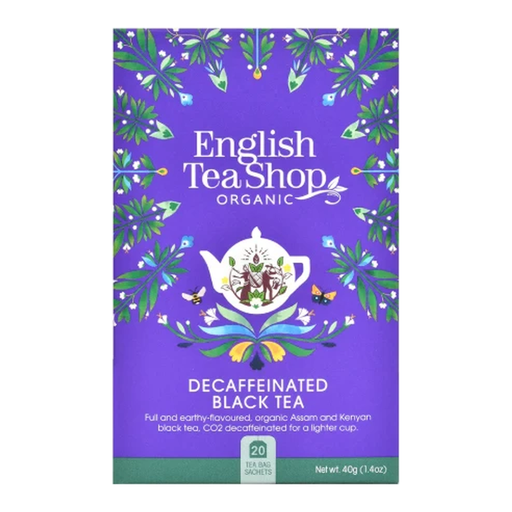 No image available
Consider this organic decaf black tea if that tea type suits your guest offering. Check the contents and number of servings before using the 20g quantity to plan stock.
Pack detail: 20g. If it is transferred to a container, label the tea and retain the corresponding product information.
Not necessarily: the box keeps the product identity and printed information together. A jar is an option if you label it clearly, keep it clean and dry, and retain the original pack or an accurate record for the tea inside.
If decaf requests are occasional, consider a smaller pack such as 40 bags. Move towards 80, 160 or catering-scale quantities when use across changeovers justifies keeping more stock.
Keep it in a cool, dry place, whether it stays in its box or goes into a clean, dry container. That storage instruction appears on Tetley’s 80-bag and Clipper’s 250-envelope product information.
Do not assume it contains none. Twinings states that its English Breakfast Decaffeinated tea is decaffeinated to 0.2%; use the caffeine wording on the exact product you offer rather than calling all decaf tea caffeine-free.
If the accommodation operates as a food business and supplies food or drink, decanting does not remove the need to address applicable allergen-information requirements. GOV.UK guidance for England, Wales and Northern Ireland and Food Standards Scotland guidance cover both prepacked and non-prepacked food and drink; check with the relevant local authority or food-safety authority how the requirements apply to your operation.