Breakfast managers choosing a core decaf
For a self-service station that needs a recognisable black-tea option, a repeatable brewing method and a pack size suited to the number of breakfast guests.


For a hotel breakfast buffet, start with a clearly labelled everyday decaf black tea and trial its brewing instructions with the water, cups and milk used in service. An English Breakfast blend offers an explicitly breakfast-style option; an organic-labelled tea can be a separate choice where its sourcing matters. Check each pack’s caffeine wording, preparation instructions and current ingredient information rather than applying one brand’s claims to every tea.
For a self-service station that needs a recognisable black-tea option, a repeatable brewing method and a pack size suited to the number of breakfast guests.
For teams considering a separate decaf option made with organically grown black tea. Clipper describes its Organic Everyday Decaf this way and says it uses CO2 decaffeination for its decaf teas.
For staff keeping information about the tea served and nearby items such as milk current. GOV.UK allergen guidance for England, Northern Ireland and Wales covers both prepacked and non-prepacked food and drink.
Choose the style of tea first, then check whether its pack information and preparation method work for the breakfast station.
| Priority | What to check | Your needs |
|---|---|---|
| Blend style | Check whether the exact tea is described as English Breakfast or everyday black tea. Twinings identifies Assam, Kenyan and Ceylon teas in its decaffeinated English Breakfast blend; assess the chosen tea with the milk offered at the buffet. | I want guests expecting a traditional breakfast cup to find a clearly identified decaf option. |
| Caffeine wording | Read the current pack’s own statement rather than treating decaf as a promise of zero caffeine. Twinings states decaffeination to 0.2% for its English Breakfast product; Tesco’s Tetley 40-bag listing states decaffeination to 0.2%, while its PG Tips 40-pack listing says less than 0.2% caffeine. | Guests should be able to distinguish the decaf tea from regular black tea without being given a broader caffeine claim than the product makes. |
| Brewing method | Follow the instruction for the exact pack and test it in the hotel’s cups and water. Twinings English Breakfast Decaffeinated and Tesco’s Tetley 40-bag listing specify two to three minutes; Tesco Decaff Original specifies three to five minutes. | Our breakfast team needs a simple instruction it can use consistently, including when milk is added. |
| Pack format | Compare the stated bag count with expected breakfast use, storage space and replenishment routines. Do not assume that a larger retail pack establishes hotel case supply. | I would rather match the pack to how quickly the station uses tea than change packs unnecessarily during service. |
| Organic option | Check the designation on the exact pack. Clipper describes Organic Everyday Decaf as decaffeinated organically grown black tea and says it uses CO2 for its decaf teas; these are the brand’s statements, not a comparison of taste. | A separately labelled organic decaf would give guests a distinct choice alongside an everyday tea. |
| Food information | Keep the current pack or supplier specification accessible when products change. GOV.UK guidance for England, Northern Ireland and Wales requires food businesses to provide allergen information for prepacked and non-prepacked food and drink; the Food Standards Agency also advises controlling allergen cross-contact. | Staff need accurate information for the tea actually served and for other breakfast items offered alongside it, including milk. |
Product statements differ: Twinings and the Tesco-listed Tetley product state decaffeination to 0.2%, while the Tesco-listed PG Tips 40-pack states less than 0.2% caffeine. A blanket buffet sign would lose those distinctions.
Label the station clearly as decaf and use the exact current pack wording when guests ask about caffeine.
Bag counts vary, so a pack that works for a small trial may need changing more often at a busy breakfast station.
Match the bag count to expected use and storage space before settling on a regular order.
Tesco cautions that food products can be reformulated. GOV.UK guidance for England, Northern Ireland and Wales requires allergen information for prepacked and non-prepacked food and drink.
Keep current pack or supplier information available to staff, update it after substitutions and manage cross-contact around the wider buffet.
Stated methods vary: Tesco’s PG Tips 40-pack listing gives one to two minutes, Twinings English Breakfast Decaffeinated gives two to three minutes, and Tesco Decaff Original gives three to five minutes.
Trial the chosen tea in the hotel’s service set-up and give staff an instruction for that product.
These references describe particular decaf products and supplier statements; check the exact pack chosen for service.
Yorkshire Tea presents its Decaf as an everyday blend intended to retain the character of its tea after decaffeination.
Twinings identifies its English Breakfast Decaffeinated as a blend of Assam, Kenyan and Ceylon teas.
Clipper describes Organic Everyday Decaf as decaffeinated organically grown black tea blended with Assam.
The Tetley Decaffeinated 40-bag product listed by Tesco is a decaffeinated black tea.
PG Tips is another everyday decaf black-tea option to assess for buffet service.
Tesco Decaff Original is an own-label everyday tea with a stated three-to-five-minute brewing method.
These tea-bag options include Tetley packs for an everyday buffet station, a Clipper organic-labelled variant and smaller Brew Tea Co packs that a hotel could trial before choosing a service method.
 No image available
An 80-bag decaf pack to consider for an everyday breakfast station. Check this pack’s caffeine wording, brewing instructions and current ingredient information before preparing buffet signs.
 No image available
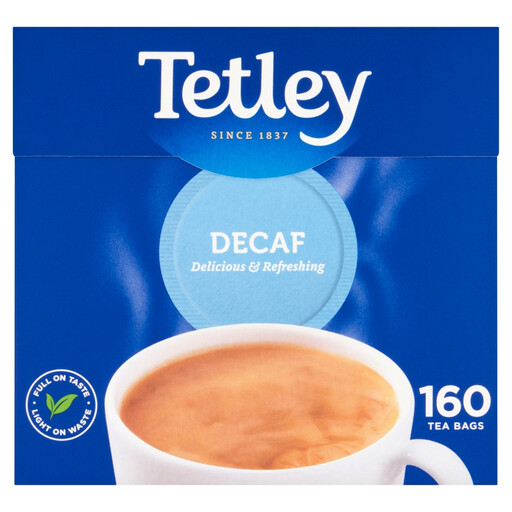
The 160-bag count may suit a station that uses more tea between pack changes. Establish brewing guidance from this pack and check its current caffeine and ingredient wording before service.
 No image available
A 40-bag decaf pack for trialling a separate tea at breakfast. Check the current pack’s preparation and caffeine wording, then test the brew with the hotel’s water and milk service.
 No image available
An 80-bag option to consider for a separately labelled decaf choice. Confirm the current pack’s Organic and Fairtrade designations, ingredients, caffeine wording and hot-tea preparation instructions before using those details at the buffet.
 No image available
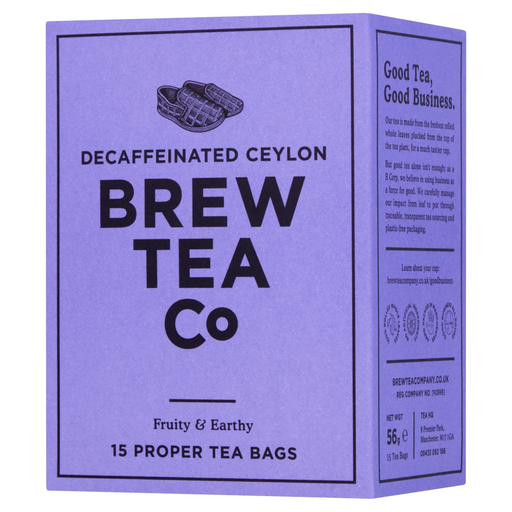
The 15-bag pack offers a smaller quantity for a breakfast-service trial, but would need more frequent replenishment than a larger pack. Confirm the current ingredients and decaf wording on the pack before serving it, and set a product-specific brewing method.
No: use the wording for the exact product rather than treating the terms as interchangeable. Twinings states decaffeination to 0.2% for its English Breakfast Decaffeinated tea, while Tesco’s PG Tips 40-pack listing states less than 0.2% caffeine.
Follow the chosen pack’s instructions and trial them with the hotel’s water, cups and milk service. Twinings English Breakfast Decaffeinated specifies two to three minutes, Tesco’s Tetley 40-bag listing specifies two to three minutes before milk, and Tesco Decaff Original specifies three to five minutes.
GOV.UK guidance for England, Northern Ireland and Wales says food businesses must provide allergen information for prepacked and non-prepacked food and drink. Keep information for the products actually served current, make it accessible to staff and manage allergen cross-contact across the wider buffet, including where milk is offered.
Not necessarily. An everyday or explicitly English Breakfast decaf can serve as the core tea, while an organic-labelled product can be a separate choice if that distinction matters to the hotel. Compare the exact packs’ bag counts, brewing instructions and labels, then trial each tea using the hotel’s service method.